

5 Of The Weirdest-Looking Race Cars Ever Made
When we picture race cars, what are some of the first images that come to mind? Generally, GT cars wearing diverse liveries, open-wheelers with sleek bodies, heavily-modified road cars for use in various disciplines, and so on. For the most part, all of these vehicles share one thing: They are serious cars, designed for serious purposes. The interiors are stripped, the aerodynamics functional, the engines loud, and the bodies specialized. So specialized, at times, that they cross the boundaries of convention and look, frankly, bizarre.
Why do some race cars look this way, though? It depends on several factors, such as the regulations the car is facing, the discipline the car is designed to compete in, and any innovative features or technologies the team's looking to incorporate. Some cars look weird because no one knew how to design them conventionally yet, such as many early racers (one of which we'll take a look at). Others look weird because they're exploiting some sort of loophole in the rules. Whatever the case may be, ugly or beautiful, weird-looking cars certainly stick with us long after the race is over, sometimes even leaving a legacy all on their own from the innovations they brandished.
In this article, we'll take a look at five such designs. Not race cars based on weird-looking or oddball road cars, nor prototype / experimental designs. Every one of these cars qualified and raced at least once, sometimes even for several seasons (to varying levels of success, mind you), and did it with ground-up designs. Moreover, this list only covers circuit racers; drag racing and drifting are worthy of their own categories, honestly. That said, let's check out these monstrosities and what secrets lie under their strange skins.
1976-1977 Tyrrell P34
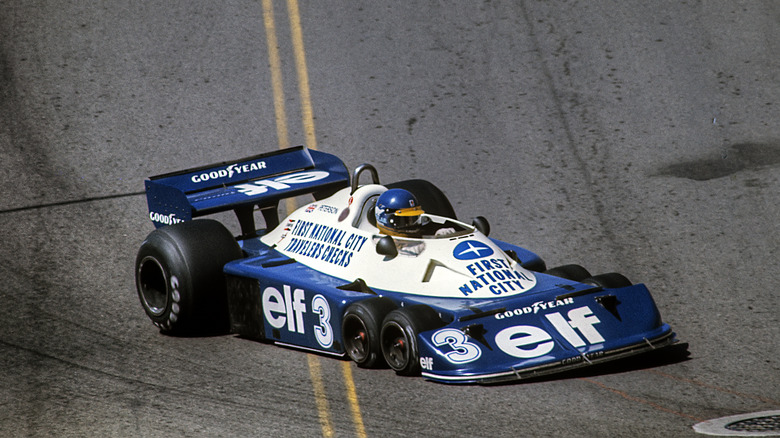
Admittedly, from the front or back, this looks like a fairly ordinary Formula 1 car. But then you see it go past, and suddenly you have to double-check that your glasses prescription is up to date; yes, this F1 car actually does have three axles, and both of the front ones are entirely functional for steering. This wasn't a gimmick, either; there was a perfectly rational reason behind creating a vehicle with four small front tires, despite all the complexity of getting it to function correctly.
To summarize why this car exists, it's because of aerodynamics. The front wing had a maximum rake height, which meant that, in 1976, F1 cars' front wheels were exposed to the open air above and beside the wing, disrupting their aerodynamics. Tyrrell's solution was to make the wheels short and narrow enough to fit behind the wing — just ten inches tall — then double up the front axle. The additional two wheels added a much-needed contact patch so the thing wouldn't just understeer into oblivion, and, as a side effect, it also has six brakes. Because both front wheel pairs steer and brake, in addition to leaving the air relatively undisturbed, this design gained Tyrrell a notable advantage, despite its eccentricity.
This marks the most successful vehicle on this list by race record, achieving a very respectable 15 podiums across two seasons and winning the 1976 Swedish Grand Prix. Sadly, Goodyear no longer supported the P34's unique front tires after 1977, forcing the car to retire and further developments to cease. While it's arguably one of the worst-looking F1 cars ever designed to some, to others it's an incredibly functional and mechanically interesting design (just don't look at the steering linkages unless you want a headache).
1967 STP-Paxton Turbocar
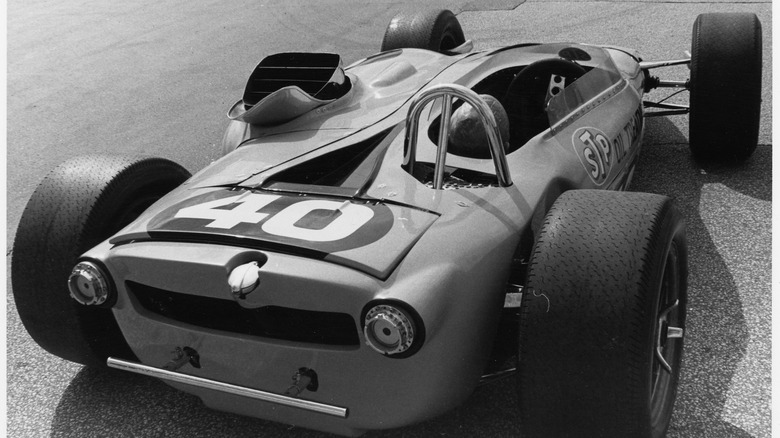
The 1960s were a time of wild innovations in terms of aerodynamics and powertrain design. This era featured a generous helping of bizarre and groundbreaking designs that pushed the boundaries of what racing vehicles could look like and how fast they could go, and the STP-Paxton Turbocar stands out even among this crowd. At first glance, this vehicle seems wrong on many levels, owing to its completely asymmetrical design — though that's less of a concern at the Brickyard when you're only ever turning left.
But what really makes this car special is the engine: specifically, the Pratt & Whitney ST6B-62 turbofan, a popular engine for marine and aircraft applications, not so much in cars, though. Ironically, this engine was actually used twice: once in the Turbocar, and again in the Lotus 56 as the STN 6/76. Basically, it's a car powered by what is ostensibly a jet engine, positioned to the driver's left. It earned various nicknames, the most popular of which were Silent Sam and the Whooshmobile, owing to its unique sound. And it was fast – really fast.
Even with "just" 550 horsepower, this vehicle took the lead in the 1967 race ahead of Mario Andretti, proving extremely competitive all the way to the 197th lap, when the Turbocar was sadly retired due to transmission issues — it housed a one-speed transmission sending power to all four wheels. Fun fact: because the transmission only had one speed, the engine was throttled to 56% at idle, meaning all the driver had to do was lift off the brake pedal, and it took off like a rocket. Tightening restrictions on turbofan cars' intakes left them woefully uncompetitive, and they were phased out by the 1970s, ending the career of one of the strangest IndyCars ever to race.
1970 Chaparral 2J
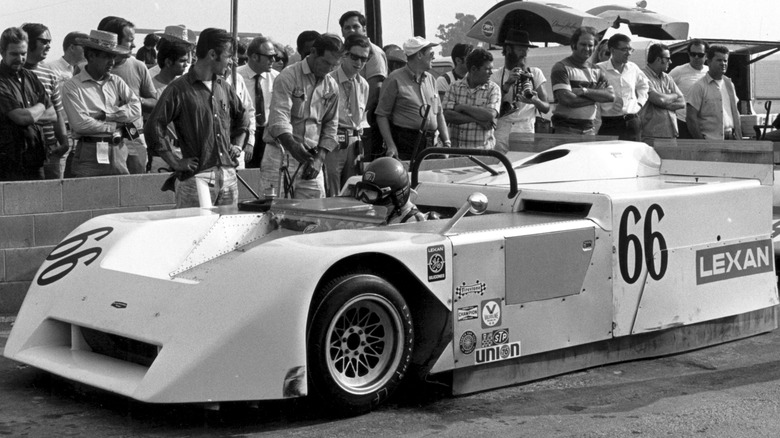
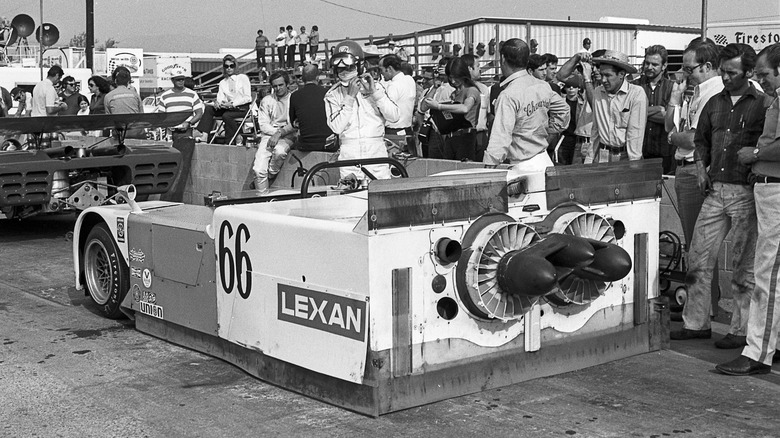
No, this is not a washing machine, nor is it a refrigerator on its side. It's likely that Jim Hall, this vehicle's creator and avid racing driver himself, heard it all when it came to remarks on this monstrosity's looks (he also created the Chaparral 2E, an honorable mention for this list). And who can blame the critics? This car was apparently the exact opposite of "sleek." Moreover, it housed a small Rockwell two-stroke snowmobile engine powering two gigantic fans on the back. It was weird in almost every way, from the body to how it functions. But one thing it was not was slow.
This car produced about 2,000 pounds of downforce, roughly the same weight as the car itself, and it didn't need wings to do it. Rather than using aerodynamic drag to produce downforce, it acted like a giant vacuum cleaner, sucking the car to the ground as the fans removed the air under the car. The car was sealed to the ground by Lexan plastic skirts that moved up and down with the wheels, making it extremely fast at all cornering speeds. Normally, downforce increases its effectiveness with speed, but not this car.
These principles made the Chaparral 2J incredibly fast, but also prone to reliability problems. Due to its inherent complexity, the car never actually finished a race with everything still working. Nevertheless, it would routinely sweep (no pun intended) qualifying runs, finishing pole pretty much wherever it went. Arguably, the thing was so absurdly fast that the SCCA banned it in 1971 by prohibiting the usage of "movable aerodynamic devices," fans included. But for its brief tenure in the 1970 Can-Am season, this car left an indelible impression and remains, to this day, the fastest clothes dryer on four wheels.
2012 Panoz/Nissan DeltaWing
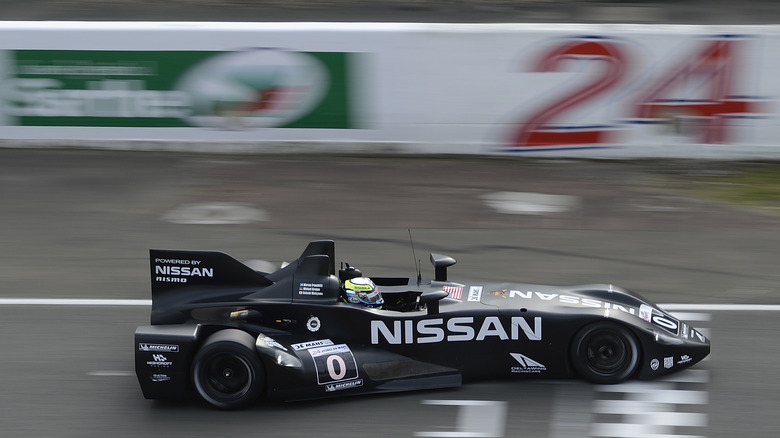
This is arguably the most striking car to attack a circuit in the past decade, and it's easy to see why; just look at it. Who on Earth builds a car shaped like an arrowhead and expects it to be competitive? Actually, several people: Don Panoz, Chip Ganassi, and designer Ben Bowlby, to name a few. A partnership with Nissan saw the plan come to fruition, resulting in the infamous entry into 2012's "Garage 56" division at Le Mans; effectively, the car was in its own class, competing not for points but to make a point.
Every other vehicle in Le Mans must abide by the regulations of its class, which is why they all look quite similar. A Garage 56 car, such as the "Garage 56 Camaro" that competed in 2024, is experimental; it follows its own rules. For the creators behind the DeltaWing, this means flexing their engineering muscles by creating something incredibly light and aerodynamically efficient at all costs. Even the engine took a back seat, the car being powered by a beefed-up variant of a Nissan Juke powerplant.
Believe it or not, it was actually quite competitive as well, hanging with the top LMP1 class before a Toyota crashed it off the road and abruptly ended its Le Mans career. However, it returned to numerous other racing series, competing through 2016 with various teams and liveries. While the car itself was quite successful, it was unceremoniously cut down in its prime due to a wide range of political factors involving the various minds and Nissan's sponsorship, which are beyond the scope of this article. Regardless, it remains one of the greatest "what-ifs" alongside other giants like the Chaparral 2J.
1950 Cadillac Series 61 Le Monstre
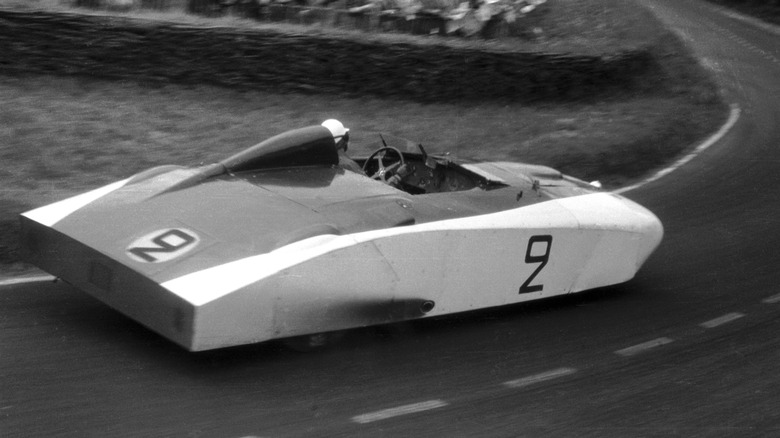
Have you ever wanted to see what a bar of soap would look like going at 130 mph? Well, apparently so did Cadillac, designing what is likely one of the most bizarre-looking contraptions in all of motorsports, not just circuit racing: a car the French dubbed "Le Monstre." The 1950 Cadillac Series 61 actually shared its designation with its sister car, the Series 61 "Petit Pataud," which was otherwise distinguished by its racing numbers — 2 and 3, respectively. Even weirder, the Petit Pataud actually looks like a normal 1950 Cadillac Coupe. Why, then, did Cadillac decide to jump off the deep end with Le Monstre?
Rewind to 1950 for a second; aerodynamic designs were largely restricted to streamliners. Wings wouldn't become a thing for several more years, and aerodynamic efficiency was achieved through more primitive means. In this case, a wind tunnel was used to prepare crop dusters, where the body was fitted around a tubular skeleton mounted on the original Cadillac frame. Apparently, the car was so heavily modified that officials didn't believe it was an original frame and had to dissect the car for hours to verify it as fit for competition.
Unfortunately, Le Monstre met with a terrible fate, plowing into a sand bank during the 24-hour race, forcing driver Briggs Cunningham to dig the thing out with a shovel. It lost its high gear, meaning it never got to stretch its legs fully. Despite this, the car finished a remarkable 11th overall, one position behind its sister car. Likely owing to its radical design and underdog comeback, the car was beloved by the public at the time, and still enjoys glances of joy and utter bewilderment in equal measure at the Revs Institute.