

Investigation Shows How This US Aircraft Carrier Dumped A $60M Jet Into The Sea
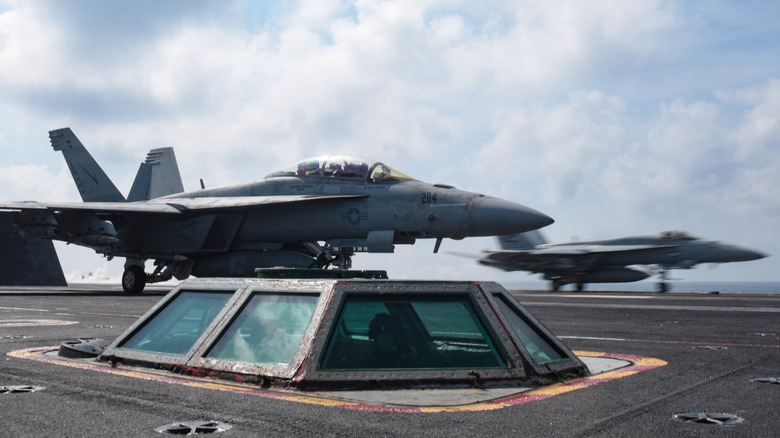
You may have had some bad days at work, but they probably didn't involve a $60 million mistake when you accidentally dumped a fighter jet into the ocean. That's exactly what happened aboard aircraft carrier USS Harry S. Truman in the spring of 2025, in an embarrassing moment for the U.S. Navy. Now that the Navy has fully investigated the accident, we've learned, not surprisingly, that it was a string of errors and mechanical failures that led to the F/A-18 Super Hornet falling off the ship and into the Red Sea. In this case, it was hard maneuvering by the ship, a mechanical failure on the plane, and miscommunication on the deck that resulted in the costly aircraft loss.
Fortunately, this incident didn't result in any deaths or serious injuries. However, it's nonetheless put added scrutiny on the ship and the Navy itself to ensure that pilots and sailors aren't being put at risk, and that more fighter planes aren't lost at sea. And in the case of USS Harry S. Truman in particular, the Hornet going overboard was one of several unfortunate incidents that have happened to the ship and its aircraft over the last year.
Evasive maneuvers and bad brakes
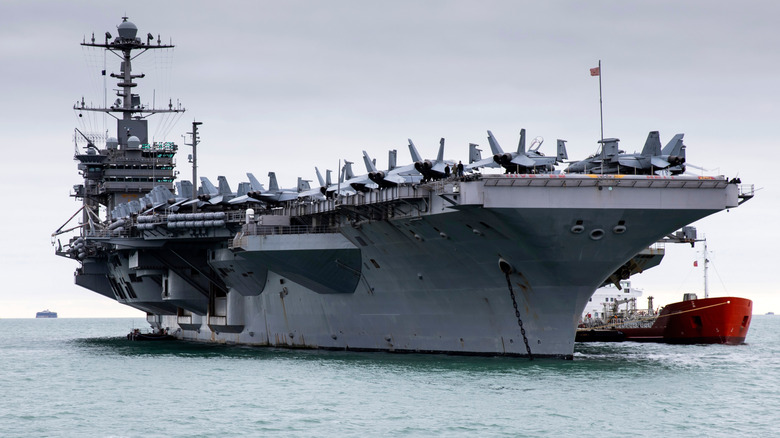
Now, a jet accidentally falling off an aircraft carrier is not unheard of. Carrier operations are inherently dangerous, and accidents can and do happen, but 2025 has proven to be an especially notable year for planes going overboard. At the time of the April 2025 incident, the USS Harry S. Truman was operating in the Red Sea, protecting shipping lanes from Iran-backed Houthi rebels.
The Super Hornet was on the carrier's hangar deck, being moved by a tow vehicle as it was prepared for flight operations. As this was happening, the Truman came under fire from a Houthi-fired medium-range missile, causing the ship to take a hard turn to avoid fire. An announcement was made for sailors to prepare for evasive maneuvers, but the crew moving the Super Hornet did not hear the announcement.
The chocks had been removed from the jet's wheels, but the brakes were still applied. When the ship began to roll through the turn, though, it became clear the brakes weren't holding the F/A-18 in place. A call was made for the crew to abandon the plane as it slid toward the edge. It went over the side of the hangar deck into the ocean, taking the tow tractor with it. One sailor suffered minor injuries as he escaped from the plane's cockpit prior to it going over the side.
A series incidents for the Truman
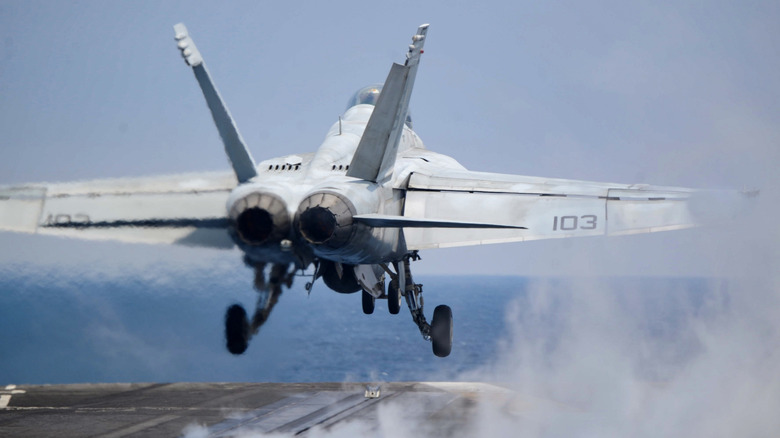
The months-long investigation into the accident revealed that, like most aviation and military accidents, it was a string of failures that led to the aircraft being lost. The ship's hard turn may have been what sent the jet sliding, but the primary blame for the incident was placed largely on the Super Hornet's insufficient brakes, along with poor communication between the bridge and deck crews that didn't allow time for preparation. Additionally, blame was also placed on the condition of the hangar deck's surface itself, which had not had its non-skid coating replaced since 2018.
The loss of this Super Hornet was just one of several incidents involving the USS Truman and its aircraft over the last year. In December 2024, one of the Truman's Super Hornets was accidentally shot down by a U.S. Navy missile cruiser, with both of the F/A-18's pilots being able to escape. In February of 2025, the carrier collided with a merchant vessel in the Mediterranean. The damage from the collision wasn't significant, but months later, the Truman was still waiting to be repaired. Then, in May, shortly after the hangar deck incident, another F/A-18 was lost after an arresting cable failure while landing.
While no lives were lost in any of these incidents, losing $180 million worth of fighter planes in less than six months is not an ideal situation for the U.S. Navy and shows how stressful combat operations can have a high cost even without direct wartime casualties.