

China's 'Manhattan Project' Could Close The Gap In AI Race With The West
In the broad global AI race, the first names that usually come to mind are Nvidia, the maker of GPUs that form the foundation of data centers, and TSMC, which offers the factories where these chips are fabricated. Then we have labels like Samsung, Micron, and SK Hynix that supply memory chips. Google has recently emerged as a rising name thanks to its TPU chips. Interestingly, not many are aware of ASML, a Dutch company that is, quite literally, the backbone of every cutting-edge chip on the planet. ASML makes advanced lithography machines used to make semiconductor chips, and it's the only company currently offering state-of-the-art EUV lithography machines. And this is where things get interesting.
ASML isn't allowed to sell these machines to China. The US has imposed a broad set of restrictions on China so that the country can't get its hands on the fundamental tech — advanced chips — that can allow it to be at the AI frontier. The ban on the sale of Nvidia chips and other critical software was imposed with the same objective. But thanks to stockpiling of older chips and a bit of illicit smuggling, China still managed to develop top-tier AI models such as DeepSeek and Qwen. The recent success of Huawei, which has continued progress with locally made Kirin chips, alongside the rise of local semiconductor startups, has raised further concerns.
Needless to say, the trade restrictions haven't really stalled China's progress. The bigger threat is the progress in chipmaking, and that's where ASML comes into the picture. How so? Well, AMSL is the sole supplier of the machines that allow China to make chips. If ASML's gear is off limits, China's semiconductor progress should stall at a critical point. In theory, that should work. In reality, it didn't.
A true chip war
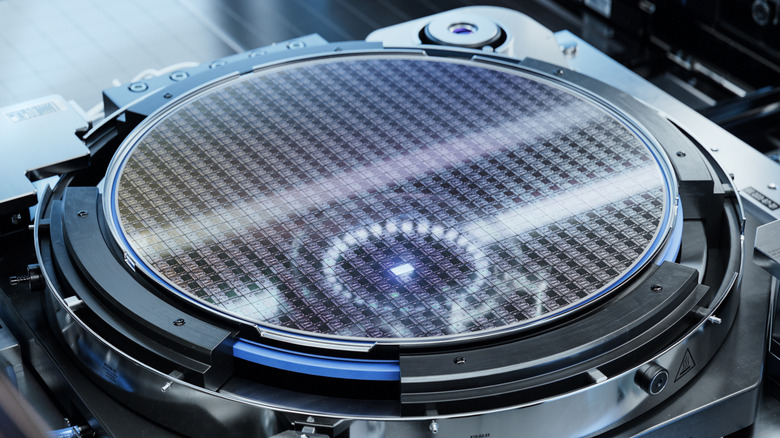
Chinese scientists have developed a prototype machine that can produce advanced semiconductor chips, and it is currently undergoing testing, reports Reuters. Interestingly, it was built by a team that includes former ASML engineers. "China's machine is operational and successfully generating extreme ultraviolet light, but has not yet produced working chips," says the report. The target is to produce a working chip by 2030, well before analyst estimates based on the perceived semiconductor tech laggardness of China.
The secretive project has been likened to China's own Manhattan Project, the historical US initiative that culminated in the development of nuclear weapons during the World War II era. Multiple former ASML scientists and engineers are involved in the project, which is shrouded in such secrecy that employees are issued fake IDs and are strictly surveilled. Notably, two years ago, it was reported that an ASML employee stole technical secrets. It was these ASML expats who reverse-engineered the EUV and DUV machine tech, allowing China to eventually build a functioning prototype.
The Chinese government reportedly offered handsome compensation and housing benefits to lure them away from ASML and work on the stealth program. Local talent is offered "uncapped" compensation and research grants of up to half a million dollars to work on the project, which involves salvaging and reverse-engineering older ASML machines.
Financial Times separately reports that Chinese companies, Semiconductor Manufacturing International Corporation (SMIC) and Huawei, are upgrading older semiconductor machines supplied by ASML and making significant progress. The prototype lithography system built by Chinese scientists is said to be functionally "crude" and much bigger in footprint than an average ASML kit of its kind. Parts are often bought at auctions or in second-hand markets under concealed identities, while Huawei is intimately involved in the development process.
What next?
Huawei's involvement in China's semiconductor "Manhattan Project" is a crucial part of the equation. Despite being blacklisted and having its business crippled, the company has continued to make brisk progress. Despite being effectively blocked from using Qualcomm or Intel processors, Huawei continues to launch top-tier phones and laptops with its in-house Kirin silicon running its own deeply interconnected Harmony operating system. Additionally, the company's in-house Ascend AI chips are outperforming Nvidia's AI chips in running models such as DeepSeek R1. The company has even built its own Nvidia NVLink rival called SuperPod Connect, which allows thousands of compute units, including Huawei's own Ascend chips, to boost inter-chip connectivity and multiply the firepower available for tasks such as AI training.
Even Nvidia has acknowledged the competitive heat coming from Huawei. The Chinese tech giant's chief, Ren Zhengfei, however, claims that Huawei's semiconductor is still a generation behind. Separately, Chinese chip design companies such as Cambricon are rising rapidly, while the likes of Moore Threads are building their own GPUs capable of running DeepSeek and Qwen models. The big picture here is that China is readying the entire stack, from chip design and GPUs to AI models, at home. The dial ultimately stops at making lithography machines to skirt past the ASML trade restrictions.
It's no easy task, especially reaching an industrial scale of production. Despite technical and supply challenges, Chinese scientists have developed workarounds to increase production on ASML's DUV machines, boosting chip output. Notably, Hauwei has already patented a novel quadruple patterning tech that relies on older DUV machines (instead of ASML's newer EUV kit) to make 2-nanometer chips, the most advanced node available for making AI and computing chips. The real challenge is how soon these ideas can yield functional chips, and more importantly, at scale.