

Turning Right On Red Can Get You A Ticket In These US Cities
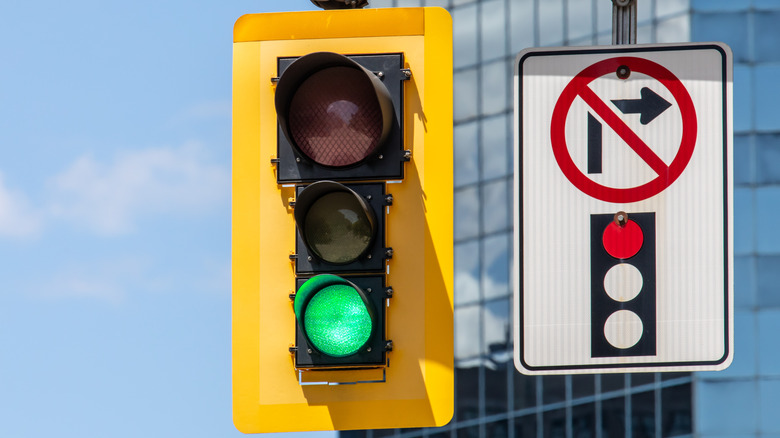
Through games like "Red Light, Green Light," books, and songs, children learn at a young age that green means go and red means stop. In much of the world, a solid red light at an intersection means that you stop and remain stopped until the light turns green. If you've driven in Europe or other parts of the world, you probably realized fairly quickly that drivers do not turn on red.
However, we do things a bit differently here in the U.S. All 50 states allow right turns on red lights after drivers first make a full stop to ensure it's safe — unless signs explicitly state that the maneuver is not allowed. Some cities, however, have city-wide or considerable restrictions on right turns on red, including New York City, Washington, D.C., large swaths of San Francisco, three central neighborhoods in Atlanta, and parts of Seattle.
Why? It mostly has to do with safety, especially for the millions of pedestrians and cyclists that take to city streets every day. While drivers look left to make sure the path is clear for their right-hand turn, they don't always remember to look right to ensure nobody is in the crosswalk or darting across the street on a bicycle. If you ignore city restrictions, the consequences can be considerable. In New York, you'll be fined at least $190 and have points added to your driving record. In D.C., the fine is $100, while the maximum penalty in Atlanta is $170.
Why other regions allow turns on red lights
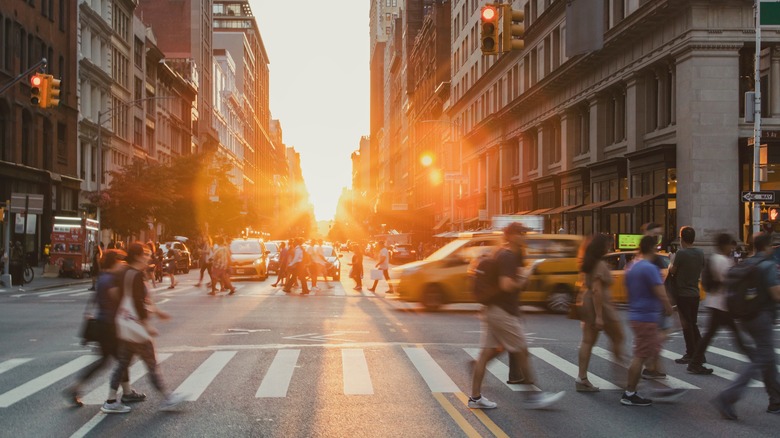
If so much of the world prohibits red-light turns, why does every state in the U.S. allow them? Parts of the U.S. have allowed right-hand turns on red lights since the 1950s, but most of the country didn't allow it until the 1970s. The oil embargo at the time didn't just change how cars were made, but also how we drive.
In 1973, the Organization of Petroleum Exporting Countries (OPEC) imposed an oil embargo, cutting exports to the U.S. in response to military aid provided to Israel. The move caused a severe shortage of gasoline, and prices skyrocketed. In response, the federal government enacted the Energy Policy and Conservation Act of 1975. In addition to establishing fuel economy standards, this legislation also directed all states to allow right turns on red lights, even tying federal highway money to the mandate. The reasoning? Cars that spend less time idling at red lights would consume less fuel.
The science may be questionable, and some studies prove that pedestrians and bicyclists are safer when right turns on red lights are outlawed. There's not a lot of recent data, but a 2022 study by the Institute of Transportation Engineers found that implementing a rule that prohibits a right turn on red in some intersections in Washington, D.C. resulted in a 92% reduction in drivers failing to yield to pedestrians. In most of the U.S., you're still allowed to make a right-hand turn on red, but keep an eye out for signs prohibiting the move, especially in big cities.