

Milwaukee Vs DeWalt: How The Brands' FUEL & Max XR Oscillating Tools Compare
We may receive a commission on purchases made from links.
Oscillating multi-tools can be an invaluable part of your toolkit, not least because they can be used for so many different applications. Depending on the attachment, you can use oscillating multi-tools for plunge and flush cuts, detail sanding, scraping, grinding, and more, whether you're working with wood, drywall, plastic, PVC, or even softer metals. Anyone looking to remove caulk, rust, or grout would also get a lot of use out of an oscillating tool, as would those trimming fiberglass, undercutting tile, or flush-cutting screws or nails.
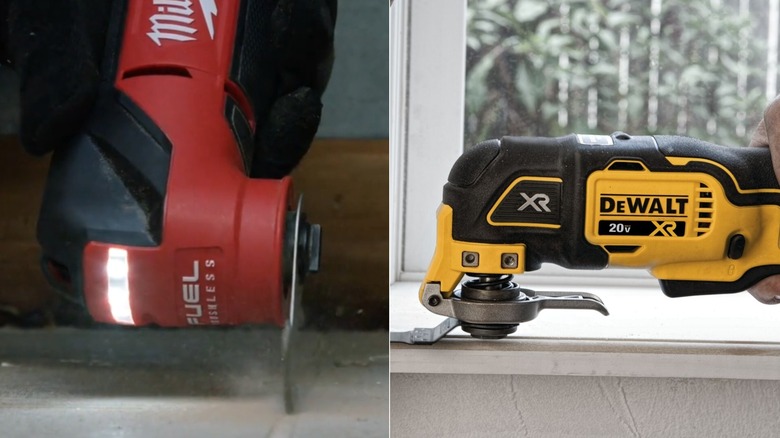
You can find oscillating tools from most major power tool brands, including two of the best — Milwaukee and DeWalt. Both offer multiple models, including the Milwaukee M18 Fuel 2836-20 and DeWalt 20V Max XR DCS356B. Both are powerful cordless tools running on brushless motors; the XR on DeWalt tools signifies they are brushless, while all M18 Fuel tools are brushless (though not all brushless Milwaukee tools are M18 Fuel).
While both motors use electronic controllers rather than physical brushes, there are some differences between the two tools. For one thing, Milwaukee's is more expensive — the M18 Fuel Oscillating Multi-Tool sells for $249 at Home Depot, while the DeWalt 20V Max XR 3-Speed Oscillating Multi-Tool is $50 less. But a cheaper tool doesn't necessarily offer more value. Here's a closer look at how Milwaukee's and DeWalt's brushless, cordless multi-tools compare.
One tool has a wider oscillation arc than the other
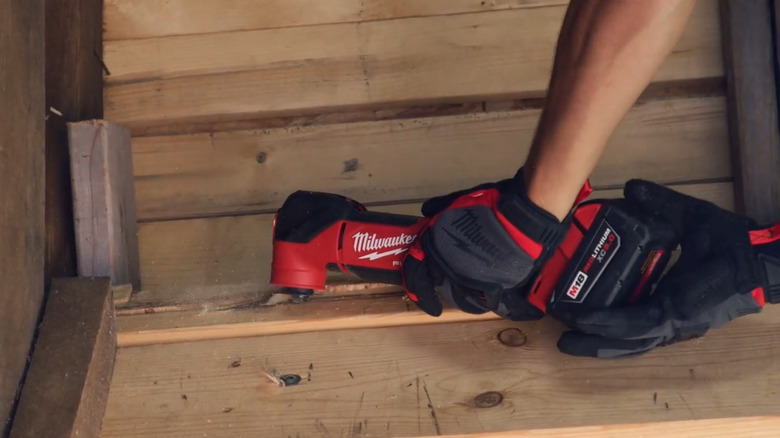
The Milwaukee M18 Fuel Oscillating Multi-Tool is slightly larger and heavier than the DeWalt 20V Max XR DCS356B, though not by much. Both tools have similar amounts of power, as 20V max batteries are essentially identical to 18V batteries. Milwaukee claims, however, that its batteries' proprietary technology allows for better runtime and tool safety. Either way, Milwaukee's M18 Fuel oscillating tool delivers up to 10,000 to 20,000 oscillations per minute. DeWalt's XR oscillating tool matches this cutting speed, with a max of 20,000 opm.
Milwaukee's 2836-20 uses a variable-speed dial, allowing you to adjust its cutting speed precisely. DeWalt's DCS356B also has variable-speed control but only offers low, medium, or high-speed settings — important to know when learning how to use DeWalt's cordless oscillating tool. Milwaukee has an auto-load feature that automatically ramps up the speed once you're cutting under load, which DeWalt's tool doesn't offer. Milwaukee also has a wider oscillation angle of 4.2 degrees compared to DeWalt's 3.2 degrees. Both have on-board LED lighting for work in darker spaces.
The Milwaukee M18 Fuel Oscillating Multi-Tool allows for blade changes without additional tools. DeWalt's offering does as well, though it includes a universal adapter you may need when attaching certain accessories. Some users have reported issues when using third-party accessories with both brands, though, and you may need a hex key or screwdriver when attaching certain blades. Other than the difference in oscillation arcs, the differences between the two multi-tools are relatively small.
Swapping accessories could be improved for both tools
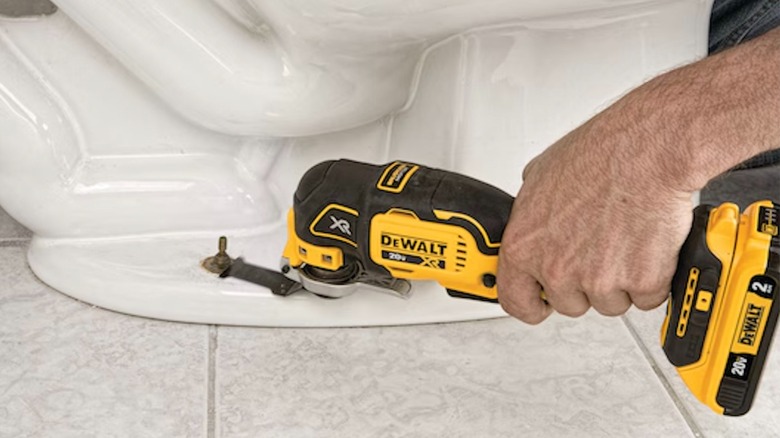
Based on both professional and user reviews, the accessory-change systems of both tools could be improved. After spending hands-on time with each, Pro Tool Reviews scored Milwaukee's 2836-20 an excellent 9.6 out of 10, only slightly higher than the 9.2 score it awarded to DeWalt's DCS356B. The publication praised the cutting speeds and low vibration of each device, as well as Milwaukee's Auto-Load feature and DeWalt's three-speed control, while criticizing the aforementioned accessory-change systems.
User opinions are similar, and both oscillating tools have very high overall customer scores from several hundred customer reviews on Home Depot. The Milwaukee M18 Fuel Oscillating Multi-Tool's blade attachment mechanism is, however, cited as a drawback in multiple reviews. In a Reddit thread on r/Tools, where multiple commenters recommend DeWalt's DCS356B over Milwaukee's 2836-20, u/ZealousidealState127 echoes Pro Tool Reviews' conclusions, stating that accessory swapping on Milwaukee's tool is slow but "fairly bulletproof," whereas the DeWalt's system can get stuck and require "a fair bit of force even when it [is] cleaned." Home Depot users don't have as many problems with the accessory change system of DeWalt's 20V Max XR 3-Speed Oscillating Multi-Tool, though at least one 1-star review claims that the former's blades wear out too quickly.