

How Long You Can Expect Your New OLED TV To Last
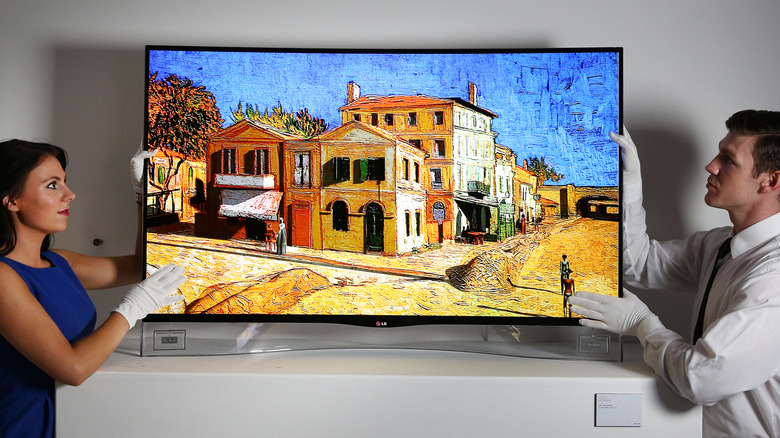
The TV landscape is going to change dramatically as we head into 2026, and in a rather confusing fashion, thanks to the engineering progress and development of new panel types. We've moved into an era where Samsung and LG have already started singing the virtues of Micro RGB TVs, joining an already crowded line-up of QNED, QLED, mini-LED, LED, QD-OLED, and more, because the alphabet jumble isn't confusing enough already.
For most buyers, if they're chasing the absolute best in terms of color quality, viewing angle, brightness output, and deep blacks, OLED TVs are the default pick — at a price. However, they are not without their fair share of problems.
Localized tinting, color fringing, and banding are some of the relatively minor problems that owners have reported over the years. However, the most well-known issue is burn-in. In the simplest terms, think of it as a visual artifact, image retention, or a ghost image that appears on the screen. It's like a mark left at the pixel level on the screen, and it usually happens when an object appears at the same spot on the screen for a very long time, without any pixel refresh.
How soon can this happen, and what does it mean for the average lifespan of an OLED TV? According to Sony, they should last as long as an average LCD TV. TCL puts the average life span at eight to 10 years, Samsung puts the numbers between 50,000 and 100,000 hours of watching time, which translates to roughly 10 to 20 years of "normal viewing." LG, on the other hand, promised way back in 2016 that its OLED TVs can handle 100,000 hours of viewing time, or approximately 30 years of regular usage at home.
What do tests say?

It's worth noting that over the years, brands have developed solutions that can mitigate or prevent burn-in on OLED TVs using methods such as periodic pixel refreshing, panel-wide reset, and screen shifting, among others. Burn-in can be fixed to a certain extent, but there are situations where it's permanent, leading to permanent panel damage. The folks over at RTINGS put over 100 TV models to the test and simulated a test equalling ten years of usage at home and three years in a lab setting.
"All OLED TVs are now showing signs of permanent burn-in," the outlet reported after 18 months into the accelerated longevity test. Samsung's OLED panel fared the best at this stage, while OLED TVs by Hisense and Vizio showed the worst form of burn-in damage. By the end of the three-year test in September, the team reported that LG's G2 OLED TV stopped working after 24 months due to dead pixels, while Samsung and Sony's OLED TVs conked out after 4 months due to power supply and internet component failures, respectively.
"Every OLED tested also experienced burn-in within the first few months of the test," concluded the team behind the tests. There is, however, a bright side to the OLED TVs that were put through the grueling process. At the end of the analysis, RTINGS mentioned that OLEDs generally outlast other display types and show the fewest problems.
In a nutshell, if you are looking for TVs that offer the longest life span, and price is not a concern, OLEDs are the safest, and arguably the most visually pleasing option. Additionally, with the advancements in display safety features and considerate usage, you shouldn't really encounter many issues on current-gen OLED TVs.