

The 2026 Pathfinder Desperately Needed An Update, But Did Nissan Go Far Enough?
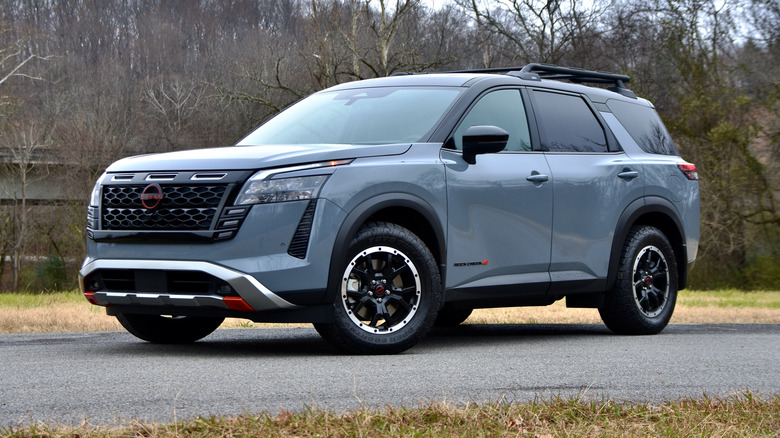
Few cars are as aptly named as the Nissan Pathfinder. As part of the original cadre of more-civilized SUVs, it helped bring utility vehicles from the wilderness into the mainstream. Those early Pathfinders counted the original Toyota 4Runner, Mitsubishi Montero, Jeep Cherokee, and Ford Explorer among their boxy brethren, but it's the latter that Nissan's midsize SUV has hewed most closely to in the ensuing decades.
Like the Explorer, the Pathfinder got bigger in the 2000s, went crossover in the 2010s, and was last redesigned around the start of the current decade. The Pathfinder's crossover makeover wasn't as successful, though, and in a move that's unfortunately typical of Nissan in recent times, an update that arrived didn't arrive soon enough.
The current-generation Pathfinder made up some ground with handsome styling and a thoughtfully-designed interior, but having launched for the 2021 model year it's now starting to show its age as well. And with Nissan recovering from financial near-death, small updates are all it gets for the 2026 model year. But those updates should be enough to keep it rolling down the right path.
Styling exudes SUV solidity
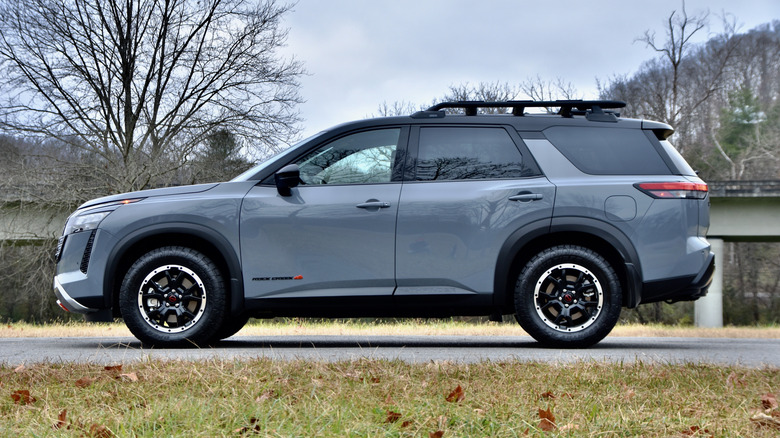
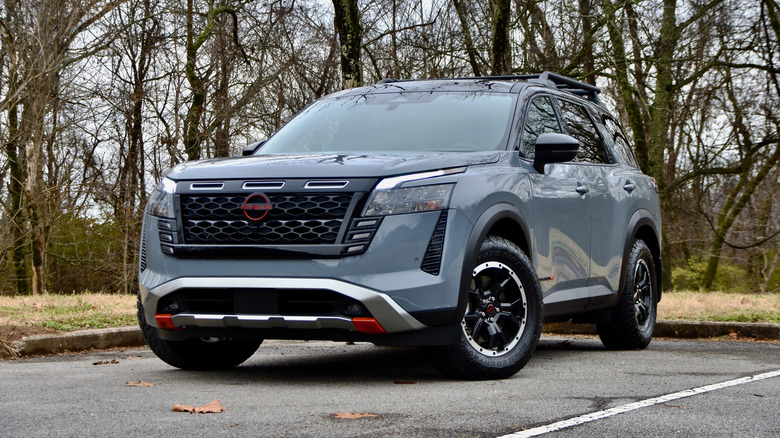
Nissan made small styling changes for 2026, including new front and rear fasciae, a new 20-inch wheel design for the top Platinum grade (S, SV, Rock Creek, and SL models are also available), and detail changes like satin exterior badging. But this doesn't impact the overall look, which nods to the Pathfinder's off-road past while acknowledging its crossover construction.
Like countless other SUVs, the Pathfinder has a tall front fascia and flat hood that make room for a broad grille. But wing-like headlights mounted high at the corners of the front end give it a distinctive appearance and a confident air. The body sides flatten out near the fenders, but taper inward elsewhere, so the Pathfinder isn't just another box. The fenders also have mini flares that separate the lower body from the greenhouse, especially when viewed from the front or back.
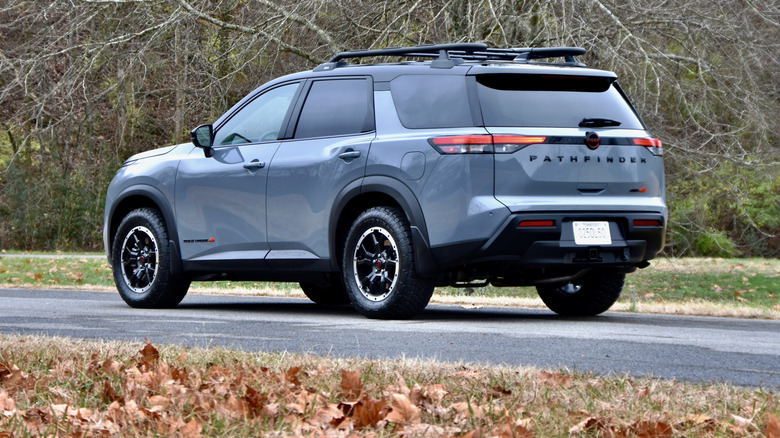
Horizontal taillights that extend past the tailgate glass are another nice design touch at the back, creating a sense of visual heft without undefined boxiness. All of these elements come together for a design that doesn't look it's six years old. The only flaw is a black roof that, when combined with lighter colors, makes the C-pillar look like it's disappearing into nothing.
Tech updates don't go far enough
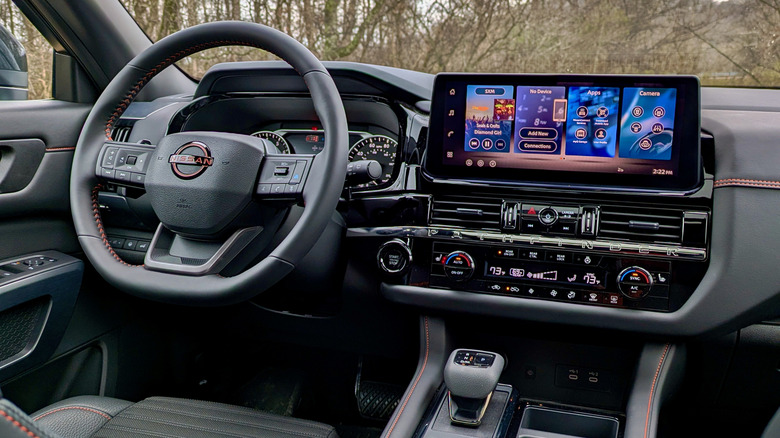
The interior is where the Pathfinder was really starting to look dated—but also where Nissan made the biggest changes for 2026. Last year's 8-inch and 9-inch touchscreens are replaced by a standard 12.3-inch touchscreen with wireless Apple CarPlay and Android Auto. The 12.3-inch digital instrument cluster that was previously exclusive to the Platinum trim level is now available on the Pathfinder SL too.
The new screen doesn't look that big situated in a dashboard that still features many analog controls, as well as air vents that are functional but style-free. Nissan adopted a sensible three-column layout for the main menu, but with graphics that look like packaging for accounting software circa 2002. The wider screen is at least well-suited to the available surround-view camera system, adapted from the Nissan Armada, that includes ultra-wide front and through-the-hood views.
One more small addition could make a big difference—depending on what kind of phone you have. The wireless device charger can now deliver 15 watts of power and has a cooling fan to ensure maximum power is available for longer. It's also magnetic, which is great if you have a compatible phone. Otherwise, the large magnet puck makes the charger pretty much unusable.
Spacious and well-designed interior
The rest of the interior is mostly standard fare for the segment. Seven- or eight-seat versions are available, depending on whether you opt for second-row captain's chairs or a bench seat. Upholstery materials range from cloth on the S and SV, to leatherette on the Rock Creek, to TailorFit (a higher-grade artificial leather) on the SL and semi-aniline leather on the Platinum. On the SL and Platinum, the real or simulated hide only covers the first and second rows, though.
Space is one of the main reasons to buy a vehicle like this, and the Pathfinder doesn't have a decisive advantage. First-row and second-row headroom are pretty generous by segment standards, but the Honda Pilot gives third-row passengers an extra 1.5 inches. Similarly, the Pathfinder leads rivals in first-row legroom, but second-row legroom is average, and the Nissan is tied with the Toyota Highlander for last place in third-row legroom. Second-row seats that can tumble forward with child seats installed make accessing the back seats easier, though.
At 16.6 cubic feet behind the third row, 45 cubic feet behind the second row, and 80.5 cubic feet behind the first row, the Pathfinder offers cargo space where it counts. Space behind the third and first rows trails many rivals, but it's average with just the second row folded—likely a more common configuration. An underfloor storage bin also returns to add a bit more space with all seats in place.
Powertrain is unchanged—and that's a good thing

One unchanged area is the powertrain. The 2026 Pathfinder continues with a 3.5-liter V6 making 284 horsepower and 259 pound-feet of torque, connected to a nine-speed automatic transmission. All-wheel drive is standard on the Rock Creek model and optional on other trim levels, which are front-wheel drive by default.
A naturally-aspirated V6 is not as trendy as a turbocharged four-cylinder engine or hybrid powertrain, but it's easy to see why Nissan stuck with it. The V6's easygoing power delivery was a perfect match for this generously-proportioned crossover, getting it where it needed to go smoothly and with a satisfying sound. It was quite the contrast with the Infiniti QX60 that was also on hand for this test drive. This luxury version of the Pathfinder has a 2.0-liter turbo-four with more torque than the Nissan's V6, but lumpy power deliver and a coarse sound made it feel like a downgrade. Both SUVs can tow up to 6,000 pounds when properly equipped, but we bet the experience will be much more pleasant in the Nissan.
That being said, the Pathfinder's maximum EPA-estimated fuel economy of 23 mpg combined (with front-wheel drive or all-wheel drive, excluding Rock Creek and Platinum models) is nothing to brag about. Not when you can get a Toyota Highlander Hybrid rated at 35 mpg combined.
Slow and steady wins the race

Today's midsize crossover segment is full of entries masquerading as rugged trucks and ignoring the dynamic potential of their car-like architectures. The Pathfinder fits right in.
Generous damping produced a comfortable ride on paved roads—even with the Pathfinder Platinum's larger 20-inch wheels. Body control was not the best, but the ride wasn't sickness-inducingly sloppy either. Slow steering contributed to that balance, as it was difficult to spur the Pathfinder into quick changes of direction that unsettled the chassis. At a relaxed pace, the chassis exuded the same big-SUV solidity as the styling.
That meant the Pathfinder drove like a big vehicle, though, which made it a bit of a chore to direct through twisty roads. None of this is out of the ordinary, though. It's hard to think of another SUV in the Pathfinder's competitive set that is genuinely fun. And when it comes to performance, manufacturers are generally thinking about surfaces other than pavement. Nissan's got something for that, too.
Dipping a toe into Rock Creek

In addition to the Platinum, we test drove a Pathfinder Rock Creek, the off-road model of the lineup. The proliferation of competitors like the Chevrolet Traverse Z71, Ford Explorer Tremor, Honda Pilot TrailSport, and Volkswagen Atlas Peak Edition make it an essential one.
The things that make the Rock Creek special are unchanged for 2026. The suspension is tuned for off-roading, according to Nissan, the tires are all-terrains, and the ride height is lifted, granting the Rock Creek an extra 0.6 inch of ground clearance for 7.7 inches total. A tubular roof rack, LED fog lights, and a different grille advertise its off-road pretensions.
We didn't get the chance to put the Rock Creek's off-road capability to the test, but even with its extra ground clearance, the lower bodywork looks like it would be pretty vulnerable on a trail. All-terrain tires are a necessity off-road, but on the road they make lots of noise and contribute to a lower EPA-estimated fuel economy rating—21 mpg combined—than other Pathfinder models. A mild bump in capability isn't worth these compromises, but that's also the case with the more rugged versions of the Pathfinder's rivals.
2026 Nissan Pathfinder verdict
The base price goes up by $1,100 for 2026, to $38,995 for the entry-level Pathfinder S with front-wheel drive. The SV, SL, and Platinum start at $41,395, $43,995, and $50,895 with front-wheel drive, respectively. All-wheel drive is a $2,000 option on those trim levels and standard on the $46,495 Rock Creek.
That puts the starting price of a 2026 Pathfinder above those of the Hyundai Santa Fe and Kia Sorento, below the Honda Pilot and Toyota Highlander, and about even with the Ford Explorer. The SUV whose development the Pathfinder matches most closely has more sophisticated tech, and a more powerful engine, but the standard turbo-four has to work a lot harder than the Nissan's V6. Ford also offers more options—like a sporty ST model—but when it comes to core models, the Nissan makes a good case for itself.
After decades of twists and turns, the Pathfinder is following a well-trodden path rather than finding a new one, but that can also describe most of the competition. Class-appropriate interior space and a driving experience perfect for road trips get the Pathfinder into the conversation, while above-average towing capability and thoughtful touches like a rear underfloor storage bin keep it there. For beleaguered Nissan, that's a win.