

Meet The K3 Concept: Korea's Hydrogen-Powered, Next-Gen Stealth Tank
Military tanks have been a part of warfare since the early 1900s, when necessity drove the innovation of tank design during World War I. Since their introduction, militaries around the world have developed and employed all manner of tracked, armored vehicles. The Republic of Korea (ROK), for instance, is well known for its brilliant tank design. Korea's K2 Black Panther is a beast of a tank, and it's utilized by the ROK Army as well as the Polish Land Forces.
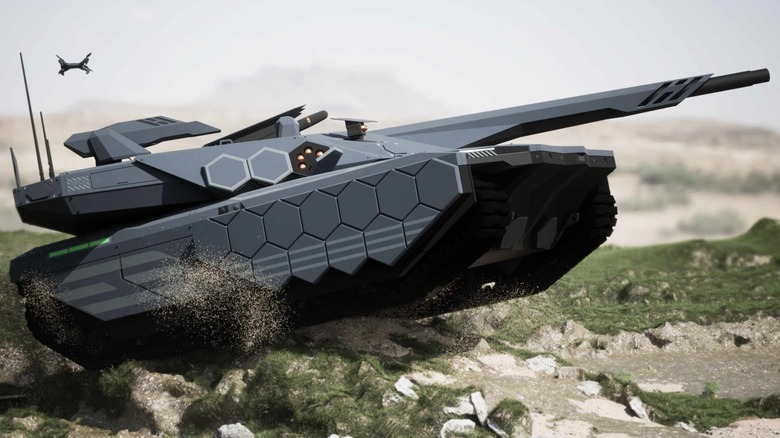
Korea's next-generation tank concept, initially dubbed the K3, is a fully redesigned armored vehicle that looks like it rolled right out of a futuristic video game. Not only does the tank's exterior appear like a science-fiction game asset, but it's also loaded with all manner of offensive and defensive capabilities that make it a major contender should it be deployed in combat. Additionally, its propulsion system is a step ahead of what exists in modern tanks, as it's hydrogen-powered and utilizes stealth technology.
The K3 next-generation main battle tank debuted as a model at a defense expo in Poland in September 2025. This makes sense, seeing as Poland is the number one purchaser of Korean tanks, and the K3's next-gen capabilities are sure to entice the Polish government into being one of the first in line to order a few of their own. The tank is being developed by South Korea's Hyundai-Rotem Corporation (HRC), which also produces the K2. The company is working alongside Korea's Agency for Defense Development (ADD) and the Defense Agency for Technology and Quality. Some of the tank's more notable features include its massive 130-mm main gun, its AI-based fire controls, and its angular design.
The K3 Next-Generation Main Battle Tank
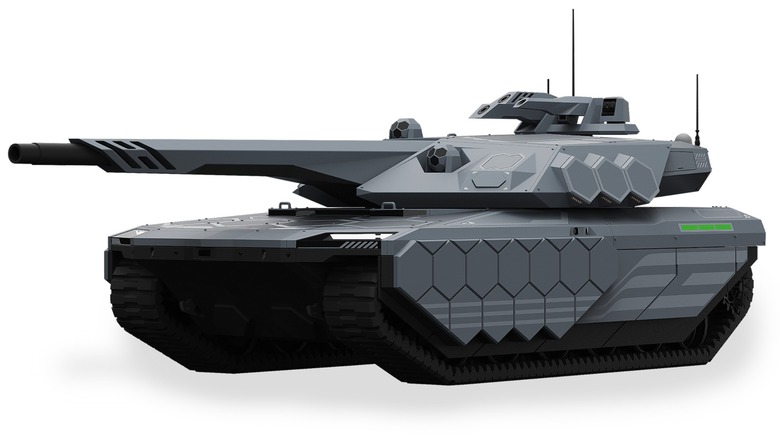
As of writing, the tank is still being developed, and it won't be made available until at least 2040. Still, there's a lot of information about its specifications and capabilities, based on what's been revealed by HRC. The K3 will be quiet, tough, and use a networked C4ISR system, which is military speak for "Command, Control, Communications, Computers, Intelligence, Surveillance, and Reconnaissance." The tank's 130 mm main gun will have greater velocity and improved armor penetration over the K2's 120 mm main gun. It will also use programmable Advanced Multi-Purpose (AMP) ammunition similar to those used in the U.S. Army's M1 Abrams.
Additional armaments for the K3 include a remotely-operated 30-mm-type autocannon or chain gun for defense against other tanks or enemy UAVs. It could also utilize precision missiles and "loitering munition" drones of its own, be equipped with thermal/night vision optics, and offer the tank's commander a 360-degree VR-enabled panoramic view for better combat awareness. The whole thing is being designed with a digital network architecture in mind, ensuring interoperability with other systems both within the tank and in other units.
The K3's most impressive feature is its power plant, which is slated to use a hybrid diesel-electric system designed to be eventually replaced by hydrogen fuel cells to provide the electricity needed for the tank's operation. The idea with the propulsion system is to eliminate as much mobility sound as possible, and if you've ever been around a tank in operation, you know how loud they are. Reducing the amount of sound a tank makes is an ideal way to mask its approach, making the K3 a truly viable "stealth" tank. This is aided via the use of radar-absorbent materials in the tank's external armor, showing how far tank design has evolved since their introduction.