

5 Things About The James Webb Telescope They Didn't Teach You In School
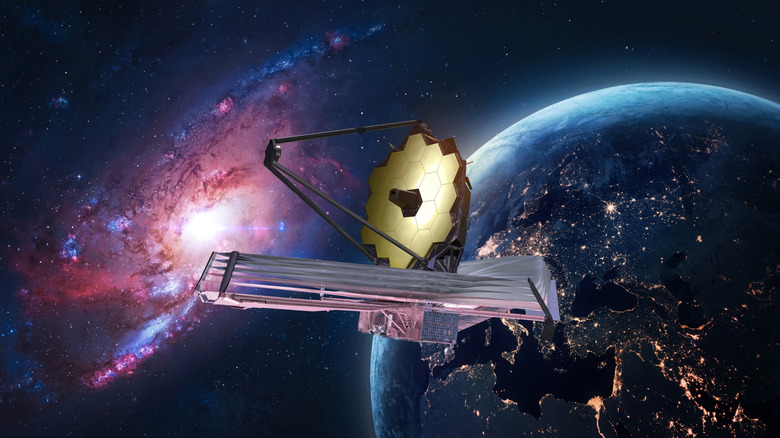
In order for NASA to study the mysteries of the universe, the scientists there need to be able to look out into the cosmos. The Hubble Space Telescope did this for a time, giving humanity some beautiful images of stars and planets that have allowed physicists and astronomers to get a better understanding of the universe, but a space observatory that's been around since the early '90s isn't anything compared to one built from scratch with all new and updated technology.
The James Webb Space Telescope (JWST) was launched into space on December 25, 2021, by the Ariane 5 rocket, a contribution from the European Space Agency, along with the launch site in French Guiana. Since its arrival in space, the JWST has given the people of Earth a glimpse at the creation of a new solar system and a slew of absolutely stunning images, all of which provide a better understanding of the universe.
Scientists can use the JWST to look anywhere without obstruction and, thanks to its advanced cameras and sensors, get incredibly clear snapshots of celestial bodies hundreds of light-years away.
It can see the oldest stars
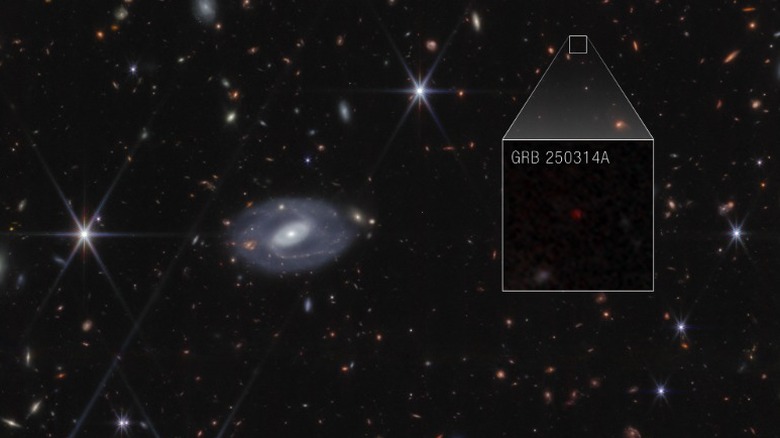
Thanks to James Webb's infrared cameras, the telescope was able to observe a supernova that took place when the universe was only 730 million years old. Before that it had witnessed a supernova that happened when the universe was 1.8 billion years old, so much more recently. This was possible because of the JWST's near-infrared camera, or NIRCam, which is a hefty piece of technology that sets the JWST apart from other telescopes. It's the only NIRCam with coronagraphic and time-series imaging capabilities, a vital component for studying planets outside of our solar system.
NASA was also able to find evidence of ancient stars that weren't only old, but massive, having a mass 10,000 times more than our sun's. More importantly, these stars are 12.7 billion light-years away in a galaxy dubbed GS 3073. Since those stars no longer exist, the scientists involved have to work forensically and draw reasonable conclusions. In this case, a nitrogen and oxygen imbalance. That imbalance can't be caused by any type of star that scientists are aware of.
Devesh Nandal from the Center for Astrophysics (CfA), Harvard and Smithsonian, said (via Space), "Chemical abundances act like a cosmic fingerprint, and the pattern in GS3073 is unlike anything ordinary stars can produce. Its extreme nitrogen matches only one kind of source we know of — primordial stars thousands of times more massive than our sun."
It's a million miles from Earth

Unlike its predecessor, the Hubble Telescope, the James Webb Space Telescope isn't in orbit around Earth. It's a little farther away than that. Around one million miles away, the JWST is nestled in a place called the second Lagrange point, or L2, which is in an orbit around the sun. It's located here because this gives the infrared cameras an unobstructed view of the galaxy. The Hubble, on the other hand, is obstructed by Earth's shadow every 90 minutes, which would pose issues for the telescope.
To avoid being in any celestial shadows as it orbits the sun, the JWST revolves around L2, as well, rather than sitting stationary. This revolution takes about six months to complete, which NASA compares to the Moon's orbit around Earth. There are five Lagrange points in total, named after mathematician Joseph-Louis Lagrange, who solved the "three-body problem" — no, it's not just a novel and Netflix series.
The Lagrange points are locations in space where, according to NASA, "...the gravitational pull of two large masses precisely equals the centripetal force required for a small object to move with them." This isn't the first satellite to be sent to L2. Prior to the JWST's arrival, the Wilkinson Microwave Anisotropy Probe (WMAP) and others had used L2. This position also makes it easy for scientists to communicate with the JWST at any time of day, using a Deep Space Network of three antennas positioned around Earth.
It hides from the sun

It's freezing in space. Sure, it's a little warmer if you're caught in the sun's direct light, but it's still incredibly cold out there in the final frontier, and for the JWST to function properly, taking the coolest pictures Earth has seen, it has to be around negative 370 degrees Fahrenheit. In fact, NASA positioned the telescope in an orbit around the sun where it won't be hit by the sun's light directly, which would heat it up. Since the JWST uses infrared light to see great distances, it has to avoid heat as much as it can, or its cameras will be rendered useless. That includes any heat it itself might produce.
The JWST's near-infrared sensors, like the NIRCam and NIRISS, need to be kept around negative 389 degrees Fahrenheit, while the mid-infrared instrument needs to be even colder at negative 447 degrees Fahrenheit. To protect those instruments from the sun's heat, NASA scientists built the satellite with five layers of sunshields that can face the sun, giving the observatory a stable environment.
Its solar panel, communications antennas, computer, and steering instruments are kept on the hot side of the telescope, with the sensors, detectors, filters, and mirrors on the cold side. The sunshields absorb the light from the sun and disperse the heat out of its sides, so very little of it gets to the cold side.
Its mirrors are the lightest ever used
In order for a telescope like the James Webb Space Telescope to see as great a distance as it does with as much detail as it does, it needs a significantly large mirror...or two, or even four. The JWST has its primary mirror — which is split into 18 hexagonal segments — a round mirror at the end of the booms, and a third mirror that reflects light to a fine steering mirror, its fourth. Each section of its large mirror has a mass of 46 pounds, which adds up to the primary mirror weighing a total of 828 pounds. While that's not an insignificant number, it amounts to a small percentage of the JWST's total 14,300-pound weight.
To put it in context, the Hubble Telescope's primary mirror weighs 1,825 pounds, and the whole thing weighs about 24,000 pounds when it was first launched, a mass that only increased as upgrades were made throughout its tenure, adding up to roughly 27,000 pounds. And before you go thinking that makes sense because the Hubble must be larger than the JWST, think again. At its widest, the Hubble Telescope was only 14 feet in diameter, whereas its predecessor's segmented mirror was 21.3 feet in diameter.
Not only does the JWST utilize the lightest mirror of all time, but it's also lighter than the Hubble Telescope, despite being larger. NASA achieved this in part by having the primary mirror made out of beryllium, a light yet strong substance that also holds its shape in a wide range of temperatures.
When JWST runs out of fuel, that's it

The James Webb telescope wasn't intended to last more than 10 years on its mission. NASA designed it to last five years and had a goal to get it to last for 10. However, its launch was so successful that it actually ended up with enough propellant to last a little more than 20 years. Once it's out of fuel, though, that's it, and it uses fuel every time NASA needs to point it in a specific direction, move it so it remains in its L2 orbit, and correct its course when necessary.
Unfortunately, since the telescope is so far from Earth, it's not feasible for astronauts to go out to it and top off its fuel tanks. So once it's out of fuel and incapable of completing any scientific tasks it's used for, NASA will put it in a graveyard orbit around the sun, where it will remain indefinitely.
Perhaps we're getting ahead of ourselves, saying that "once" it's out of fuel, the JWST will be useless because there is a refueling port. So there's always a possibility that NASA or some other space agency, like SpaceX or Blue Origin, will develop and send up an uncrewed mission to refuel the telescope.