

What An HDMI Audio Extractor Does – And Why You Might Need One
We may receive a commission on purchases made from links.
HDMI has simplified home entertainment by streamlining the way devices connect. You now no longer need two separate cables to route audio and video signals — a single HDMI cable handles them both. With the right HDMI cable, it becomes incredibly convenient to hook up computers to monitors or game consoles to TVs. Problems, however, start creeping up if your audio and video setup doesn't fit into this chain nicely.
Say you're rocking an audio setup that doesn't accept input via HDMI. Your video signal to your display will be sent without any issues, but you'll likely not have a good experience watching movies or playing games without any sound. This is where an HDMI audio extractor comes in. It's a device that separates the audio and video signals from an HDMI input, leaving you with two outputs.
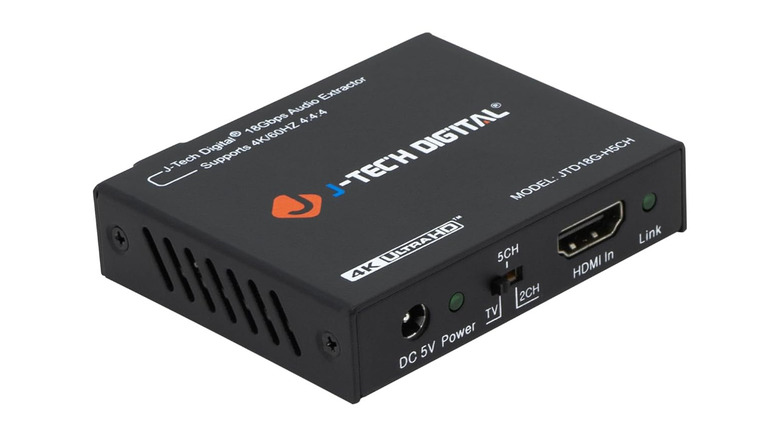
The video signal can be carried forward via another HDMI cable, and you can route the audio signal through a different output, such as optical or coaxial. This way, you can use laptops, consoles, or computers in setups that don't support HDMI audio input. There are several options in the market, and the audio extractor best suited for you will depend on your AV setup. The J-Tech Digital HDMI Audio Extractor, which retails at $36, is Amazon's overall pick, with over 7,500 reviews and a 4.2-star rating. It supports video output up to 4K 60Hz and splits audio to provide both S/PDIF and 3.5mm outputs.
When an HDMI audio extractor makes sense
1440p gaming monitors strike the perfect balance between price and performance and often deliver a much better gaming experience than televisions do, especially for competitive titles. However, unlike TVs, most monitors don't come with built-in speakers — and even if they do, they likely do not sound very good. If you're hooking up a PS5 to a monitor via HDMI, you would need an audio extractor so you could route the audio output to a dedicated pair of speakers.
Older audio equipment may also not support HDMI audio input, but this doesn't mean they become e-waste all of a sudden. If anything, legacy audio systems like powered bookshelf speakers, receivers, and amplifiers outperform many modern budget alternatives — they just need the right tool to act as a bridge.
The right HDMI audio extractor fills this role by allowing these systems to accept audio from modern HDMI sources. However, if you're rocking a semi-complex AV environment, you might end up having to dig around to find the right HDMI audio extractor that supports features like HDMI ARC and specific formats like Dolby Digital.
You will also need to pay close attention to the specifications of the HDMI audio extractor that you're eyeing. For instance, the Amazon Basics HDMI Audio Extractor is another popular pick, but only supports up to 4K 30Hz, or 1080p 60Hz. While this would be fine for streaming content, you would be seriously bottlenecking gaming performance going with this option.