

American Vs. European DeWalt Batteries: Is There A Difference?
Like many of the biggest names in power tools, DeWalt is a global brand, with products sold in various countries. That includes its batteries, which are sold in the United States, Europe, and elsewhere. Given that they're sold in different consumer markets, one might imagine that DeWalt batteries in the U.S. are different from those found on store shelves in Europe. The fact of the matter is, performance and build-wise, there aren't any real differences between those sold in the two markets. The only place these batteries differ is in their labeling.
In the U.S., the average DeWalt battery is advertised as being 20 volts, while the equivalent battery in Europe will bear 18-volt branding. Internally, these batteries are the same, though their regional branding regulations cause them to be marketed differently. In the U.S., DeWalt battery marketing is based on their maximum output voltage, or the highest voltage they can reach. Meanwhile, European marketing for DeWalt batteries is based on nominal output voltage, which is the average, sustained operating voltage. This also means that 60V batteries in the U.S. are the same as 54V batteries in Europe and other regions.
Since they're basically one and the same, DeWalt's U.S. and European batteries should have no issues with compatibility, right? In truth, just like there are limits to which non-DeWalt tools can use DeWalt batteries, there are limits to one's regional battery mixing and matching.
Mixing and matching of DeWalt batteries from different regions stops at chargers
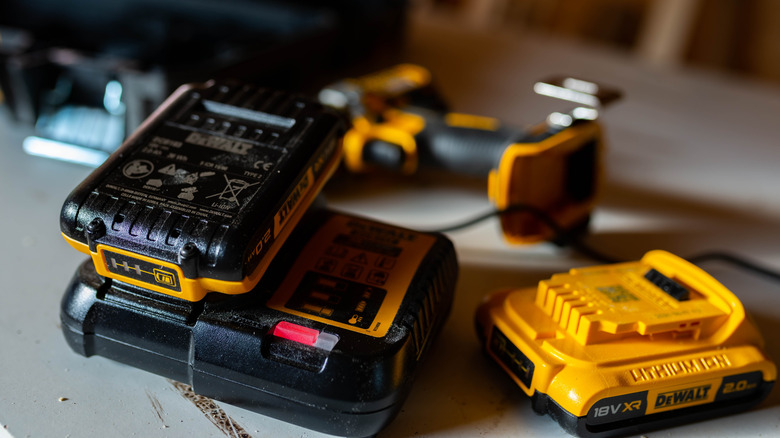
Given that they're basically the exact same battery, from the overall design to their connection points, DeWalt's U.S. and European batteries can work with each other's tools. They connect the same and deliver power without issue, further proving that their only difference is a matter of semantics. With that said, while you can power American tools with European batteries and vice versa, as far as getting a battery charged using a charger from outside its region, this isn't possible. Given the physical and financial risks of trying to do so, this type of mixing and matching isn't worth attempting.
The lack of swappability between U.S. and European DeWalt batteries boils down to regional differences in power outlet output. In the U.S., standard wall outlets release approximately 110 to 120 volts, so U.S. DeWalt chargers are designed to withstand that level of voltage. Meanwhile, European outlets sit around 230 volts, which, naturally, would make quick work of a U.S.-designed DeWalt charger and the battery attached to it. Therefore, using a European charger in the U.S. means insufficient power, while plugging in a U.S. charger in Europe is more likely to fry both the charger and the battery connected to it. If the battery is harmed, you're better off buying a new one than attempting to rebuild or refurbish your ruined DeWalt battery. Given their high cost and versatility, the last thing you want to do is damage your DeWalt batteries and tools. Fortunately, so long as they're used with their designated chargers, mixing U.S. and European tools and batteries — different labels and all — shouldn't give you any trouble.