

5 Car Battery Models To Steer Clear Of, According To Consumer Reports
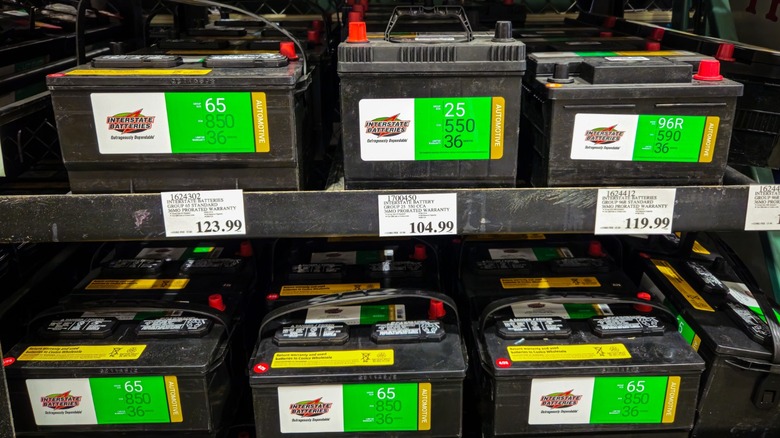
When it comes to consumer advice, there aren't many publications as renowned — or even as old — as Consumer Reports. This nonprofit has been giving consumers honest advice on what to buy for the better part of a century. With world-class testing facilities, tried-and-tested methodologies, and over 6 million members across the U.S., when Consumer Reports talks, people tend to listen — and that includes us at SlashGear.
Luckily for car owners, car batteries rank among the things Consumer Reports tracks. The battery is an often-overlooked car part, but it's very important since you can't even start a car without one. Consumer Reports maintains a list of car batteries across BCI group sizes, ranking them in each group according to how well they perform in three major categories: life, reserve capacity, and cold-cranking performance. Life represents charge-discharge cycles at high under-hood temperatures; reserve capacity is how long it runs when the alternator is "dead," and cold-cranking performance measures cold-cranking amps (CCA) at low temperatures. All these elements come together to give a "score," ultimately determining how well the battery does on CR's list.
We decided to break down this list and choose five batteries you should avoid from various BCI groups. These groups determine the size of the battery, and the wrong size could be one of the reasons your car battery keeps dying. We chose them by weighing their performance in Consumer Reports' reviews against feedback from users and other high-authority sources. This should give you an idea of what models you might want to avoid.
Econocraft 24F-E -- Group 24 & 24F
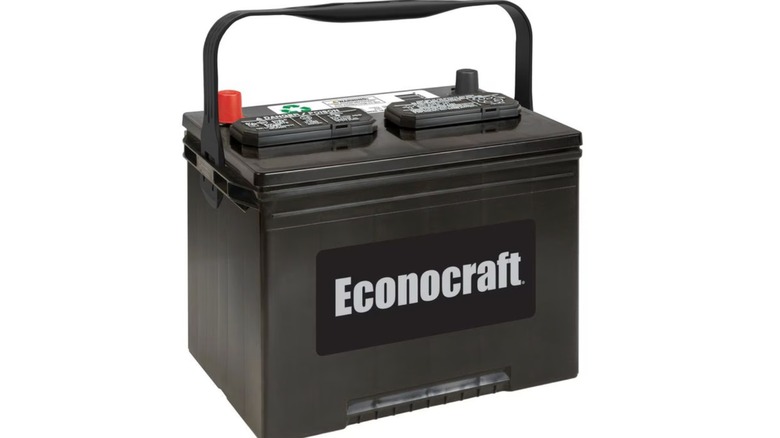
Econocraft is AutoZone's own economy battery line, built for it by major OEM suppliers such as Clarios, with major emphasis on the "economy" part. Econocraft batteries are cheaply-made, cheaply-sold, and sometimes don't last longer than the three-month warranty. The Econocraft 24F-E is a perfect example of this, scoring average points in battery life and reserve capacity, but woefully below average in cold-weather performance. The latter part is of no surprise, seeing as it has a CCA of just about 585 amps, which is the lowest of CR's Group 24 & 24F list, and 124.25 amps below the group's average.
Interestingly, the 24F-E does relatively well on customer reviews outside Consumer Reports, but the bulk of that comes down to its cheap $90 price tag. People say it's a great battery if you just need something to put in your car temporarily. A good choice if you plan to sell the car, for instance, or you just need a battery to plug in the gap till you can get your hands on a good one. With a 90-day warranty, this is clearly not a battery you want to use in the long run — especially when you consider that the next lowest warranty on CR's list goes as high as 12 months.
If money is your greatest concern, you'll likely be better served buying the EverStart Maxx-24S (South). It costs the same $90, beats the Econocraft in every metric, and even offers 36 months of warranty.
Econocraft 35E -- Group 35
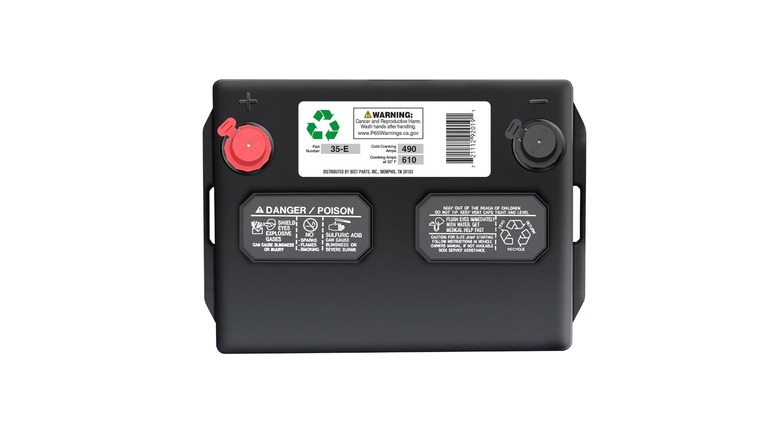
Econocraft strikes again in the BCI 35 group, but this time, arguably worse. Consumer Reports ranks the Econocraft 35E the lowest in the group for poor longevity, underwhelming cold-weather performance, and woeful reserve capacity. According to CR's lab tests, the reserve capacity in this battery is so low that it's the outright worst in the entirety of the list. So, if you have a problematic car that you know has alternator issues or doesn't reliably charge batteries, you certainly don't want this one sitting in your engine bay. It also comes with Econocraft's infamous three-month-long warranty, indicating the manufacturer doesn't have much faith in its longevity as well.
However, just like the 24F-E, it does decently well for reviews on AutoZone's shop, scoring upward of four stars with reviews saying it's cheap and gets the job done. The few negative reviews point out the same issues of longevity and power that overlap with CR's lab assessments. Some say the battery didn't crank their cars at all, which could be partly caused by its low 490 CCA. Once again, Econocraft's battery has a CCA so low that it's the lowest in the group, and here it's about 140 amps below the group average.
Granted, there are pretty much no other BCI 35 batteries from reputable brands that are as cheap as the Econocraft 35E at $100. But Interstate Mega-Tron Plus MTP-35 offers good value at $125 and soundly beats Econocraft in every metric.
EverStart AGM H5 - Group 47 (H5)
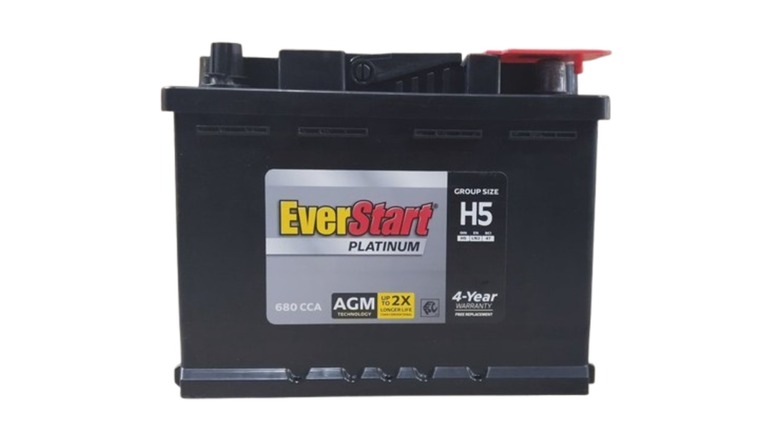
EverStart is Walmart's in-house car-battery brand, which typically offers batteries in three tiers: Value (cheapest), Maxx (mid-range), and Platinum (premium). As a brand, EverStart ranks last on SlashGear's rankings of major car battery brands, even though it generally sells well and gets positive reviews from owners. But it might be because many of these reviews are short-term feedback instead of extended reviews spanning years.
Still, it can make some good batteries. The EverStart Platinum AGM H5/47, for instance, is one of Consumer Reports' recommended batteries, with good performance in all of the battery tests. Consumer Reports' testing shows a split within the EverStart lineup. The EverStart Platinum AGM H5/47 is listed as one of CR's recommended Group 47/H5 batteries, performing well across their standardized tests. In contrast, the non-Platinum EverStart AGM H5 earns one of the lowest scores in its group due to its weak life-cycle performance, middling cold-weather results, and only modest reserve-capacity strength compared with competing H5 batteries.
Customer reviews on Walmart for EverStart AGM H5 tend to be favorable in the short term, with many buyers reporting that the battery immediately resolved low-voltage or no-start symptoms. This also aligns with forum discussions on vehicles such as the Ford Maverick Hybrid and Hyundai Ioniq 5, where owners describe installing an EverStart AGM H5 as a practical AGM replacement for a weak factory 12-V battery. These owner reports generally cover a few months to a year of use, which is a much shorter evaluation window than Consumer Reports' multi-cycle laboratory life testing.
Econocraft H6-E -- Group 48
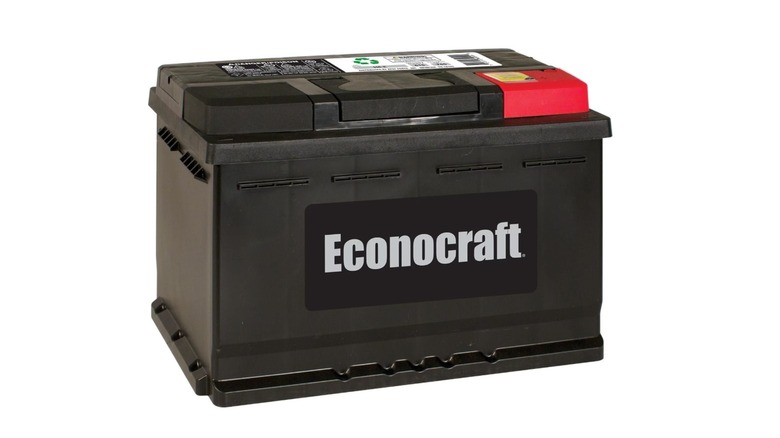
Unfortunately, the pattern of weak Econocraft batteries continues in Consumer Reports' ranking of BCI group 48. It's clear that AutoZone positions Econocraft batteries as "emergency budget" options, and the Econocraft H6-E leans very much into that. On its product page, the H6-E is a flooded Group 48/H6 battery rated at 615 cold cranking amps, 755 cranking amps, and about 75 minutes of reserve capacity at a 25-amp load, with a 3-month free replacement warranty and a price of $100 plus a core charge. On that same page, it is marketed with all the usual reassurances about "ample cranking power" and "reliable starting performance," but CR's tests suggest you shouldn't mistake it for a long-haul premium unit.
In CR's Group 48 (H6) table, the Econocraft H6-E sits toward the bottom of the pack, with a projected life that scores at the very low end of CR's scale and only middle-of-the-road marks for reserve capacity and cold-weather performance when compared with other H6 batteries. In other words, it will usually start the car, but CR's lab testing suggests it is not the one to pick if you are hoping to forget about your battery for several years. This seems to be a running theme among CR's low-ranking batteries, and that also explains why they could have good reviews despite these low test results. That said, for this battery, AutoZone's own AI-generated review summary flags a recurring theme of shorter-than-expected lifespans, with some buyers reporting that their H6-E failed in under a year.
Duralast Platinum 51R-AGM -- Group 51R
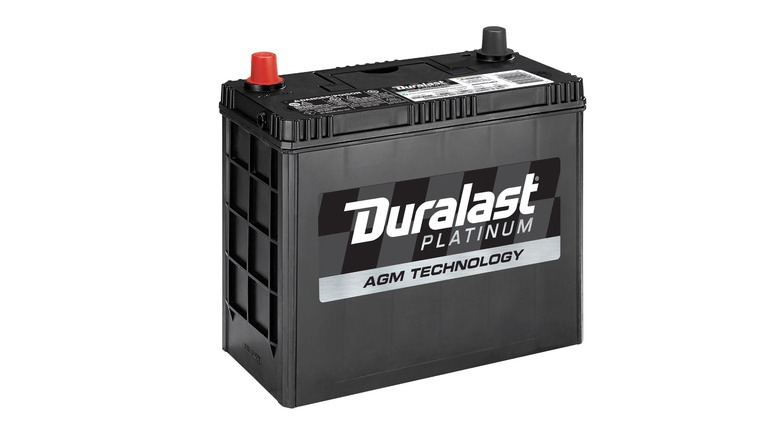
On paper, the Duralast Platinum 51R-AGM looks like the kind of battery you would hook up and never worry about again. It is AutoZone's premium AGM option in the 51R size, with a four-year free replacement warranty, a listed 435 cold cranking amps, 540 cranking amps, 45 minutes of reserve capacity, and a price of about $250-260 before core charges on AutoZone's site. However, Consumer Reports' Group 51R testing shows that the Duralast Platinum 51R-AGM may crank well in the cold but does not hold up nearly as long as its marketing or price might suggest.
Customer feedback seems to tell a more flattering story, at least in the short term. On AutoZone, the 51R-AGM holds a 4.7 out of 5 rating from more than 300 reviews, with over 270 of those being five-star scores. Owners praise its strong starting power and reliability in everyday use. A Nissan Leaf owner documented swapping to a Duralast Platinum 51R AGM because it was cheaper than a highly recommended Optima YellowTop while still offering a three-year replacement warranty, and reported good results. Another Civic owner on Mechanics Stack Exchange found that a previous owner had upgraded to a Duralast Platinum 51R AGM to support an aftermarket subwoofer.
The problem is, for a small 51R battery, paying around 260 dollars for a model that Consumer Reports rates poorly on life is hard to justify when alternatives exist. If you want an AGM battery in the same BCI group without any of the potential longevity issues, CR recommends the Super Start Platinum AGM, which retails around the same price.