

You Don't Need A Pilot License To Fly This Jetson Aircraft (And That's Terrifying)
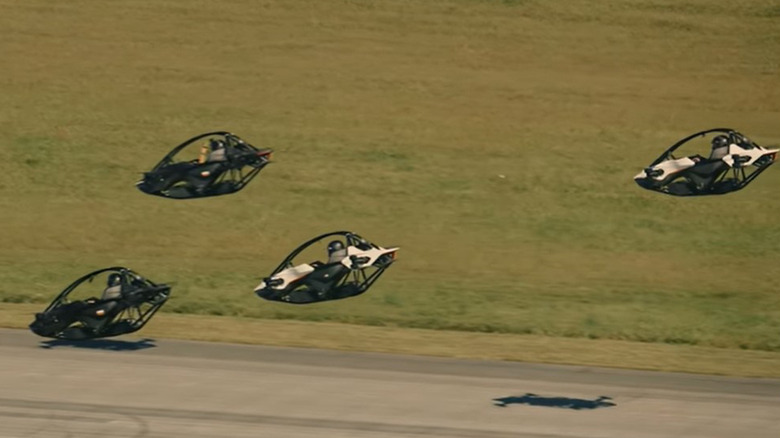
The Jetson ONE might look like something from a sci-fi cartoon, but beneath its cartoonish facade lies a craft with the credentials to be a practical personal aerial vehicle. The Jetson is a lightweight eight-propellered aircraft that boasts a flight time of 20 minutes, a maximum ceiling of 1,500 feet, and a top speed of 63 mph. It's also worth noting that this is not a vague concept sitting unrealized on an engineer's computer. Jetson is a going commercial concern with a healthy order book that, earlier this year, delivered its first aircraft to Oculus founder Palmer Luckey.
The aircraft is classified as an electric vertical takeoff and landing aircraft (eVTOL), and at the time of writing, there are over 600 orders for the Jetson ONE. Perhaps the scariest thing about the craft is that the company claims anyone can become a pilot in under five minutes and can fly it without a pilot's license. To understand why you're allowed to zoom about the sky in a craft that Jetson describes as a "Formula One car for the sky", we need to look at FAA Regulation Part 103.
This stipulates that for a powered aircraft to be classified as an ultralight (no pilot's license is required to fly an ultralight), it has to weigh less than 254 pounds. As it happens, the Jetson ONE weighs in at a rather convenient 253 pounds. And, as we discover next, this isn't the only metric where the Jetson ONE plays with the ultralight limits.
The loophole, the rules, and why this is all legally allowed
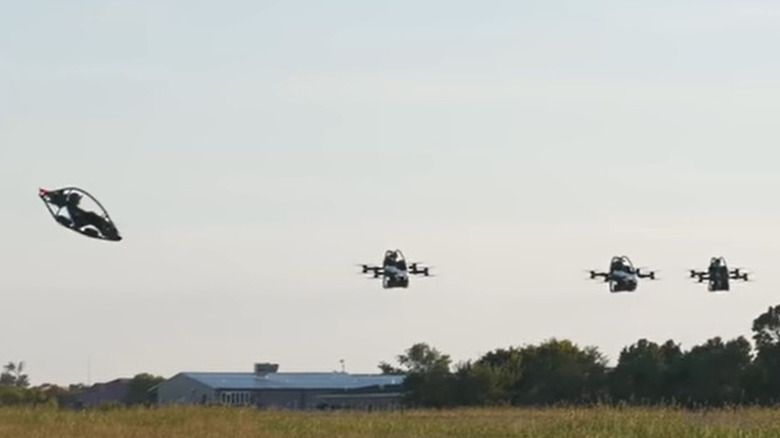
The 253-pound weight of the Jetson ONE is either a feat of precise engineering or some formidable luck. But, the weight of an aircraft is only one metric that the Jetson ONE had to meet to be classified as an ultralight, and it isn't the only example of where the Jetson ONE only just landed within the regulations. FAA Part 103 regulations also stipulate a top speed of 55 knots (63 mph). The Jetson eVTOL has a software-limited top speed of 63 mph, presumably set to exactly match this. The regulations also state that an ultralight must be intended for a single occupant only, which is another box the Jetson ONE happily ticks.
However, for us ground travellers, the good news is that skies above our cities are unlikely to become full of Jetson-flying commuters skipping the traffic jams. The same regulation that defines what constitutes an ultralight also dictates where and when these aircraft can be flown. More specifically, Part 103.15 states that no person may fly an ultralight aircraft over any congested area of a town, or over any area where there is an open-air assembly of people. So, we're unlikely to see them zooming people to and from their workplaces just yet.
Ultimately, while the Jetson ONE may not be an actual flying car like the Chinese XPENG, it is bringing the dream of personal flying machines closer to reality.
How safe is the Jetson ONE
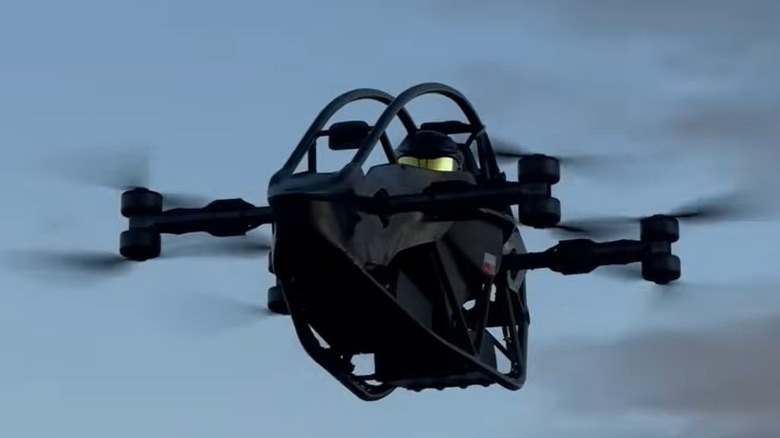
The terrifying thought of city skies full of five-minute-trained, unlicensed pilots zipping about at 60 mph is thankfully, simply not practical — at least, for the foreseeable future. However, with a full order book for the entire 2026 and 2027 production run, the Jetson ONE has seemingly found a market comfortable with its $148,000 price tag. So, the chances of seeing one somewhere above our heads are growing.
Ultimately, what you're flying is a lightweight carbon fiber frame powered by eight electric motors. If this sounds like something to be avoided by the faint-hearted, it might be reassuring to hear that Jetson has engineered various safety systems. These include a racecar-style safety cell, the ability to keep flying if a motor fails, a hands-free hover mode, and a ballistic parachute similar to the genius safety feature used by Cirrus aircraft. The company also stresses that its flight computer allows the pilot to control the aircraft with a single joystick and a throttle. In practice, this simplicity allowed Jetson's first customer to take to the air after 50 minutes of flight training.
While this is undeniably impressive, it is slightly unnerving. Jetson's claim that the basics of flight control can be learned in under five minutes may be true from a mechanical standpoint. However, simply mastering flight controls doesn't teach you how to judge wind, gauge wind, or know your own limits before taking off in a "Formula One race car for the sky."