

This WWII Aircraft Carrier Is Now One Of America's Coolest Museums
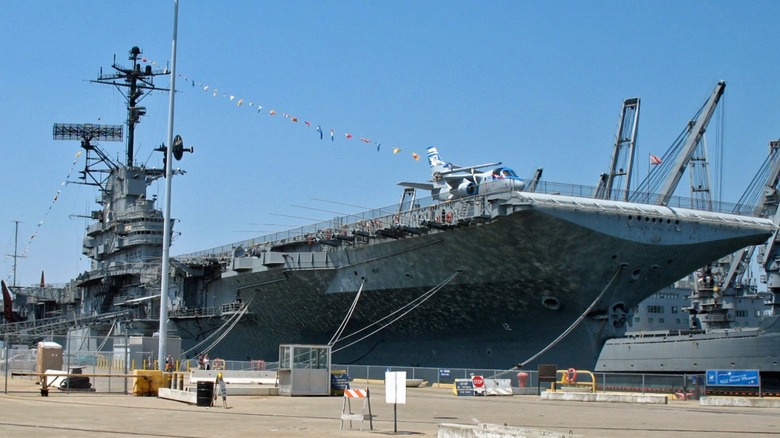
The United States is home to an enormous range of museums. In 2015, The Washington Post reported that the country has about 35,000 of them. Needless to say, not all these establishments will appeal to all tastes, but when it comes to making learning fun and engaging, some subjects just lend themselves much better. The U.S., always a nation fond of spectacle, utilizes some of its largest naval vessels as museums. These ships, such as aircraft carriers, are awe-inspiring sights, and the chance to board one and take in some of its rich history while contributing to its preservation makes them must-visit tourist attractions.
The acclaimed USS Hornet is one such ship museum, found in Alameda Point in California. It's a fitting home, as this used to be the location of Naval Air Station Almada. When it was closed in 1997, the station had been operating for 57 years and was one of the world's largest. The Hornet (CV-12) had been a vital part of the base's operations during World War II and far beyond, and when it retired itself in June 1970, the breadth of its service experience meant it was perfect for a new life as (to use its official name) the USS Hornet Sea, Air and Space Museum.
The ship's extraordinary career during World War II, the Cold War and the Vietnam War, and the vital part it played in retrieving Neil Armstrong and his pioneering colleagues on Apollo 11 and 12 when they returned to Earth, are all celebrated at the museum, making it one of the coolest, grandest, and most fascinating museums you could hope to visit. Here's a closer look at what you can find there, as well as further details about its remarkable service life.
The wonders of the USS Hornet Sea, Air and Space Museum
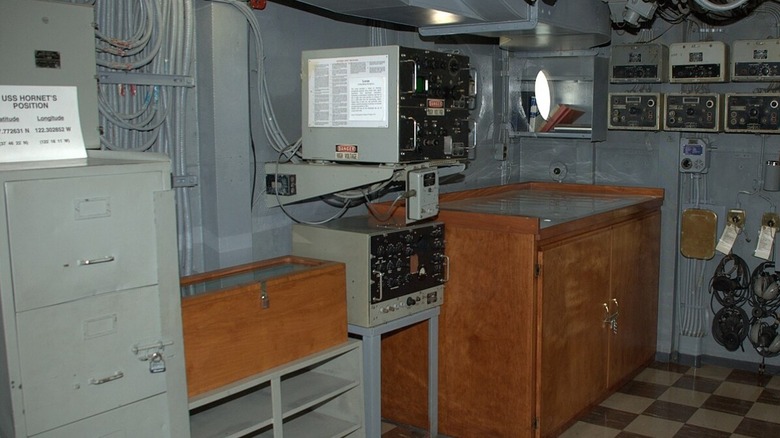
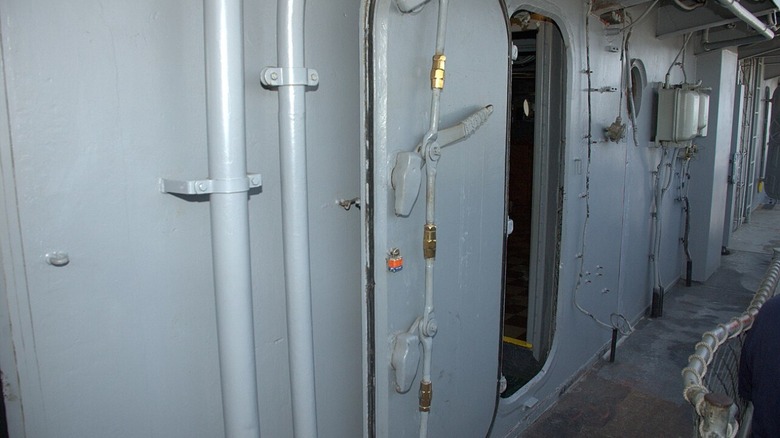
At the USS Hornet Sea, Air and Space Museum, visitors have considerable freedom to tour the vessel. At 872 feet long and with a flight deck 147 feet wide, the Hornet CV-12 was not one of the biggest aircraft carriers ever built, but it's nonetheless a gigantic vessel with so much to see. Today, visitors to the museum can access the hangar, flight decks, and engineering areas, giving a unique insight into what aircraft carriers are capable of, how they worked and were maintained, and simply the absurd scale of them. To read about these vessels, watch them in action in documentaries, or see replica components at other museums is not quite the same as the chance to get up close and personal. Tours give visitors additional insight and access, but there's much more than just that to see at this particular museum.
Aircraft carriers are designed to serve a contingent of aircraft. As such, it's not just the carrier itself that visitors can admire, but a range of U.S. Navy aircraft from across its decades in service too. The collection continues to evolve, with the USS Hornet Sea, Air and Space Museum reporting on Facebook in April 2025 that an F/A-18C, a variant of an aircraft also named Hornet, was being added to the collection of aircraft on display. Whether you're interested in military history, aviation, or naval vessels, then there's something incredible to experience here. Beyond that, there are also displays dedicated to the Apollo 11 and 12 missions, because the USS Hornet had a critical role to play in those missions too over its long history in service.
The USS Hornet's long career
If there's one thing the military always admires, it's long and distinguished careers. Servicepeople and vehicles alike often retire with honor, and the USS Hornet certainly did just that. It was commissioned in November 1943, with CV-12 being the latest in a long line of vessels to be named Hornet. In this case, it was named for its predecessor, USS Hornet CV-8, which had been sunk by a Japanese assault in October 1942. The new Hornet arrived rather late in the course of World War II, but it proved to be an invaluable asset for the rest of the conflict. By its end, Hornet (or more specifically the VF-2 Hellcats and other aircraft at its disposal) had downed 1,410 opposing planes while surviving 59 Japanese attacks itself. It was also instrumental in the attack that resulted in the sinking of the mighty battleship Yamato, one of Japan's most formidable naval assets. The latter was the result of strikes using its own potent guns, which it had in 20 mm, 40 mm, and 5" capacities.
CV-12 Hornet was a huge asset throughout World War II, then was decommissioned in January 1947. Throughout the 1950s, though, it would return to use, first as an attack carrier and then as an anti-submarine warfare support carrier. It would continue to be used for training and other purposes, as well as being on duty for a period during the Vietnam War. In July and November 1969, the vessel fulfilled a very different role in the recovery of the astronauts of Apollo 11 and 12 respectively when they landed back on Earth in the Pacific Ocean. Shortly after that came the vessel's retirement. In 1991, it officially became a National Historic Landmark, opening as a museum in October 1998.