

How Many Devices Is Too Many For One Outlet? Here's The Safety Cutoff
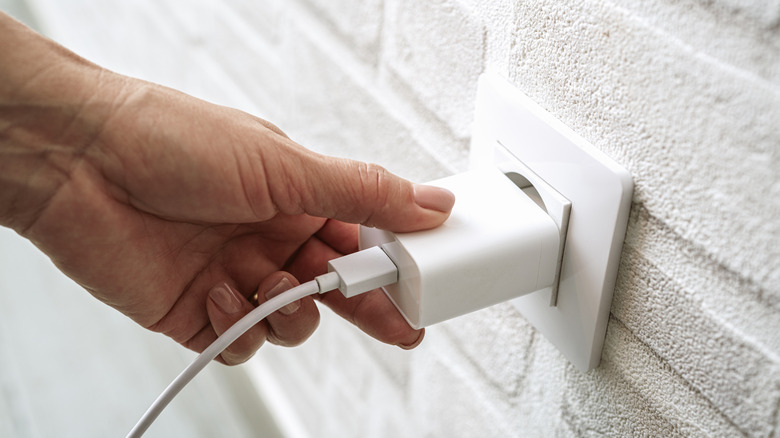
Electricity is still something of a marvel. It allows us to power lights, computers, TVs, and a whole lot more, simply by plugging them into a wall outlet. But it's worth remembering that electrical circuitry has limits that you shouldn't push past. Generally, wall outlets only have between two and, in some instances, four spots to plug in your devices. With the aid of accessories like power strips, however, their capabilities can be expanded while simultaneously increasing the risks of overloading.
Added hardware or not, it's crucial to know the limits of what an outlet can handle. The safety cut-off lies in what your home's electrical system can realistically handle. Some suggest that 1,500 watts is the safe limit for a single 15-amp outlet, while others suggest that the maximum for a single outlet is around 1,800 watts. Outlets with higher amperages can withstand more.
Thus, it's wise to check the wattage of each device you plan to plug in before doing so. Plugging in several device chargers, for example, which draw 45 watts and 140 watts each, should be fine. Conversely, running multiple hairdryers or space heaters, which can draw 1,500 watts or more each, is more of a risk. Knowing how much wattage you're about to ask of your home's electrical system is just the start of the conversation, of course. There are other elements to consider to keep yourself and your house safe.
What about power strips and extension cords?
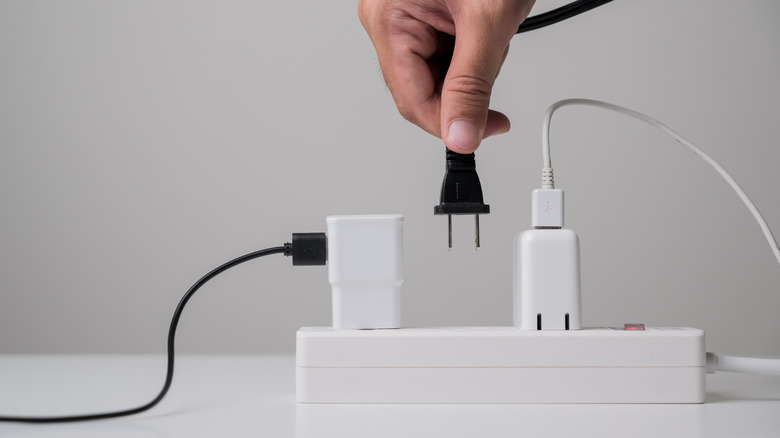
There are a lot of ways using an electrical outlet can go wrong, so it's key to know what not to do in the name of safety. For one, there's the matter of power strips. Small appliances like lamps and phone chargers are fine to plug into power strips, while larger ones, such as stoves and refrigerators, are no-gos. They draw too much power and can become fire hazards should they draw too much power. These should only be plugged into wall outlets directly, with one major appliance per outlet. You also shouldn't chain power strips, as this too can overload a circuit in short order.
Adjacent to power strips are extension cords. These too should be used responsibly once plugged into a wall outlet. This entails not plugging multiple extension cords together, not using extension cords to power appliances like space heaters, and not attempting to power multiple appliances with one cord. These follies set the stage for dangerous electrical heating and subsequent fires. Additionally, there are also certain devices you should never plug into ground fault circuit interrupter outlets, or GFCI outlets. Overall, there's a lot to be aware of when connecting devices to wall plugs, and it's worth it to be aware of best practices for your safety.