

New NASA Satellite Photos Could Change The Way We Understand Tsunamis
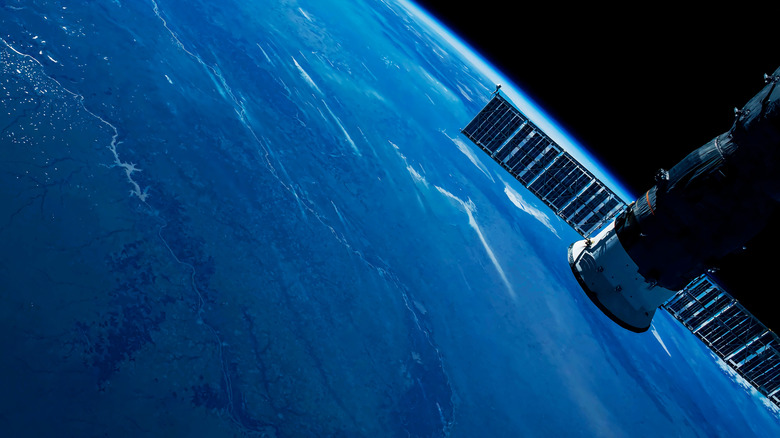
The most recent breakthrough in human understanding of extreme weather events happened by accident. Tsunami physics has always been difficult to study, both because of their infrequency and the hazards they pose. One does not simply walk into a tsunami to have a look around. It was therefore serendipitous that, just as a NASA satellite designed to observe ocean topography was passing overhead, a massive tsunami broke out in the Pacific Ocean. The photographs taken by the spacecraft revealed a never-before-seen pattern that could prove invaluable to understanding these deadly ocean waves.
The satellite that took the photos belongs to Surface Water and Ocean Topography (SWOT), a joint venture between NASA and the French space agency CNES. It's outfitted with a range of sensors (a radar interferometer, GPS, laser retroreflector, and two-beam microwave radiometer, among several others) to measure the change in water surface height. After a tsunami occurred off the Russian coast, the satellite finally got its hero shot.
On July 29, 2025, an underwater earthquake off the Kamchatka Peninsula in southeastern Russia registered at a magnitude of 8.8. Undersea earthquakes are to an ocean like a kid doing a cannonball into a swimming pool, and the ensuing tsunami ripped through the Pacific with waves stretching from the sea floor to 1.5 feet above the ocean's surface. The SWOT satellite happened to pass overhead just 70 minutes after the earthquake, capturing the tsunami in motion. What it found seems to immediately disprove old models about not only tsunamis, but water itself.
Satellite data show that water doesn't move as a single force
When looking at the high-resolution images taken by the SWOT satellite, scientists saw something that seems to contradict what they thought they knew about these extreme weather events. Until now, it has been widely believed that tsunamis move as a single force rather than being comprised of many smaller waves — non-dispersive, in academic parlance. However, SWOT data reviewed by scientists did not line up with a non-dispersive model. As they wrote in a paper published by The Seismic Record, it seemed to line up much better with a dispersive one. That means the main wave was followed by a "wavetrain," or in other words, a series of smaller waves behind it.
With this new understanding, scientists are hopeful that they will be able to develop new models to identify, track, and predict tsunami patterns more accurately. This could lead to improvements not only in research but in threat preparedness and safety, as well. In a quote provided by NASA, Earth lead and SWOT scientist Nadya Vinogradova Shiffer said, "The power of SWOT's broad, paintbrush-like strokes over the ocean is in providing crucial real-world validation, unlocking new physics, and marking a leap towards more accurate early warnings and safer futures."
Tsunami breakthrough highlights the continued need for public space exploration
These latest breakthroughs in tsunami research from SWOT are only the latest to emerge from NASA this year. The first clear radar images of Earth's surface were taken by a NASA satellite in August 2025, the result of another international scientific partnership with India. They were captured as part of the NISRO, another program helping to identify and prepare for natural disasters. But despite the many demonstrable fruits of NASA's scientific labor, the agency has never been more imperiled. A November report from NPR concluded after interviewing seven people at the Goddard Space Center and reviewing internal documents that NASA is under direct attack.
The report described "a campaign of disruption from the highest levels of leadership — an information blackout, buildings closed, labs and projects moved without warning, staff rotated off projects and reorganized chaotically." As reported in June by the Carl Sagan-founded non-profit The Planetary Society, the White House Office of Management and Budget aims to slash NASA's budget by 47%, reducing what was once the crown jewel of American innovation to a shell of itself.
The cuts are hardly a drop in the bucket in terms of overall government spending, but they would shutter 41 planned missions involving innovative technology NASA is exploring. Among those set to be slashed are a Mars mission in preparation for a crewed exploration, a space telescope for observing black holes and exoplanets, missions to study the possibility of oceans and life on Venus, and even an effort to study a giant asteroid that has a chance of hitting Earth in 2029. And last month, NASA said goodbye to the International Space Station, set to retire this decade. The ISS will be replaced with commercially operated space stations.