

What That Notch On The End Of A Wrench Handle Is Actually For

Even though power tools can get most jobs done with ease, a good hand tool is still a valid option. The ever-reliable wrench, for example, is one of the most helpful and versatile hand tools around. You can use a wrench for unconventional tasks like organizing wires to more typical endeavors like tightening or loosening nuts and bolts. Combination wrenches up the ante, with one end featuring a socket-like grip for more stubborn fasteners while the other maintains that classic open-ended design. In some cases, the latter end has an additional use, as denoted by a small notch toward the bottom.
This isn't just a design quirk or a bit of visual flair. This end of the wrench can actually be used like a ratchet, allowing for smoother movement while working on nuts and bolts. This is demonstrated in the above video by SATA Tools EMEA on YouTube, where it's used to loosen a bolt. Unlike a standard open-end wrench head, this design allows the wrench to stay in place on the fastener head, with the user repositioning the wrench to the initial angle after each rotation. This is a convenient addition to an already versatile tool, but there are some situations where this ratcheting wrench feature won't do you much good.
Ratchet-style wrench heads have their limitations
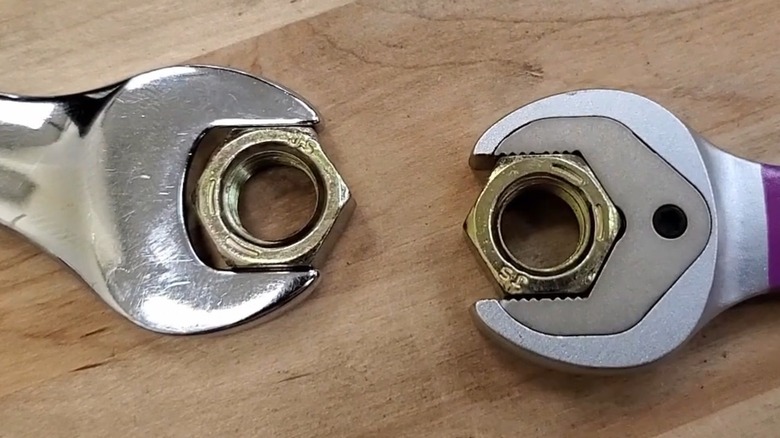
While having this small yet effective notch on the open end of a wrench is a net benefit, it's no miracle addition. There are some situations where this feature isn't helpful and may even hinder you. For one, if the fastener you're trying to move is incredibly tight and requires a lot of torque to get moving, this shouldn't be the tool you reach for. Not only could you damage this end of the wrench by warping and stripping it, but you could strain your wrist should you push or pull too hard on a fastener that's just not letting go.
Ironically, some folks who've used these wrenches also recommend against using them for already loosened fasteners. The fasteners will move with the wrench too well, preventing it from tightening or loosening as it should. Other users have highlighted that they won't do much good if the edges of the fastener are rounded, either. Like with any wrench on a stripped nut or bolt, you run the risk of further smoothing out the corners and preventing movement in any direction. At that point, you'll likely need to look into acquiring one of the screw extractor sets that can help remove stripped hardware. Though it has its limitations, the ratchet-like notch on the open end of some wrenches generally makes the overall tool a bit more handy. It's a fine yet overlooked addition that can come to the rescue in a pinch.