

What Is That Little Boomerang On The Back Of Old Limos Actually For?
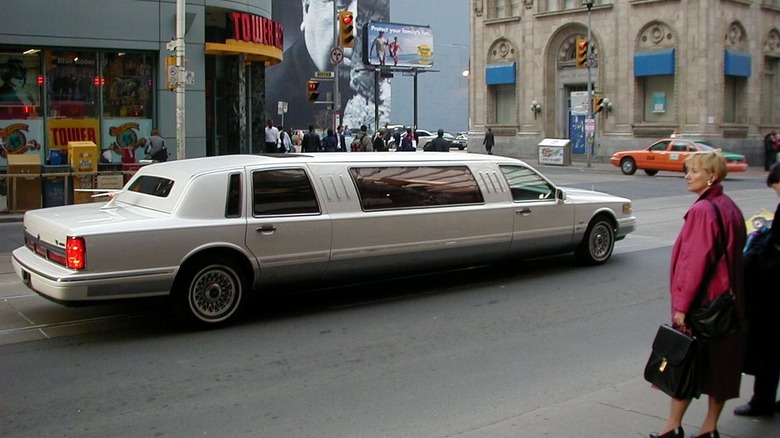
There was once a time when riding to your high school prom in a limousine made for the ultimate swag move. Keep in mind, this was in the 1980s and '90s, before automobiles came standard with an assortment of gizmos and entertainment features (like screens built into headrests). Limos were so big back then that in 1988, Lincoln sold over 200,000 Town Cars, making it the company's top-selling model. And not because regular consumers were buying them, but because transportation companies were buying them in droves and converting them.
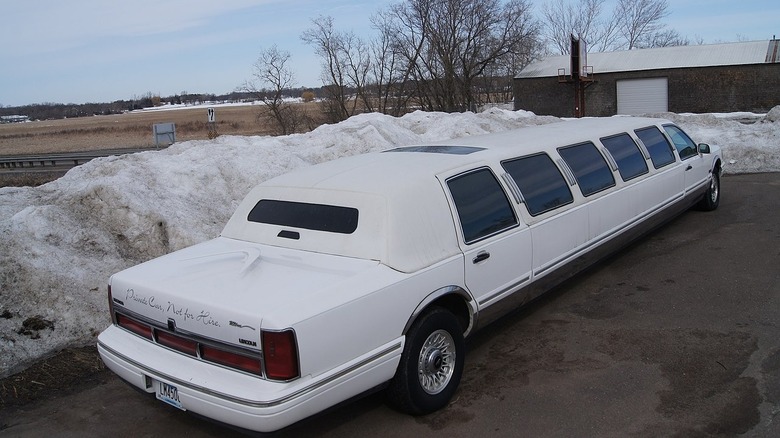
Part of that excitement was based on all the cool things one might find inside, like swimming in yards of (usually maroon) leather seats and blasting the stereo through a multitude of speakers while standing up in the sunroof and screaming how cool you were as you drove past the masses. Another was being able to watch a television — from a moving car! This feat wouldn't have been possible without the little boomerang sitting on the back of the trunk lid. Although often mistaken for a car phone antenna (another gadget considered très chic in the 80s), the piece of equipment with its swept-back arms wasn't some weird aerodynamic spoiler but a rather graceful-looking analog TV antenna. It was even more extravagant than having a cell phone in your car.
Before the rise of the digital age, TV stations only broadcast signals over-the-air (OTA) using Very High Frequency (VHF) and Ultra High Frequency (UHF) bands. Think of it as early Wi-Fi. They still do today, and you can pick it up in High Definition if you use the right kind of antenna.
UHF, VHF, and the Big Band Era
Very High Frequency (VHF) signals sit between 30 MHz and 300 MHz, have longer wavelengths, span two different frequency bands, and can travel farther. However, they're not good at penetrating obstacles, can bleed into other channels, and thus are better used in open areas. Ultra High Frequency (UHF) signals transmit between 300 MHz and 3 GHz but have a shorter range. Since they can get through concrete, steel, and wood, they're the better choice for indoor use. In the U.S., the VHF band runs from 54 to 216 MHz (channels 2-13), while the UHF band runs from 470 to 608 MHz (channels 14 and up).
The history of limousines is actually quite interesting. During the 1700s, the rich and famous in the Limousin region of France began using horse-drawn carriages with a chauffeur. These early posh rides were designed so the driver sat outside, apart from their passengers, and was often tasked with looking after the horses. To protect themselves from inclement weather, drivers would wear cloaks referred to as a "limousine."
The first motorized limo came to life in 1902, but the chauffeur — still wearing his black Limousin-style cloak — sat outside the passenger compartment driving the vehicle. In 1928, Arkansas-based coach builder Armbruster came up with the idea of making a vehicle big enough to haul Big Band members (and all their equipment) around. Two of the biggest headliners from that era — Glenn Miller and Benny Goodman — used them and, consequently, made stretch limos an indelible part of Americana, including the world's longest.