

This Deep Sea Orb Find Baffled Scientists: 'It's Like The Beginning Of A Horror Movie
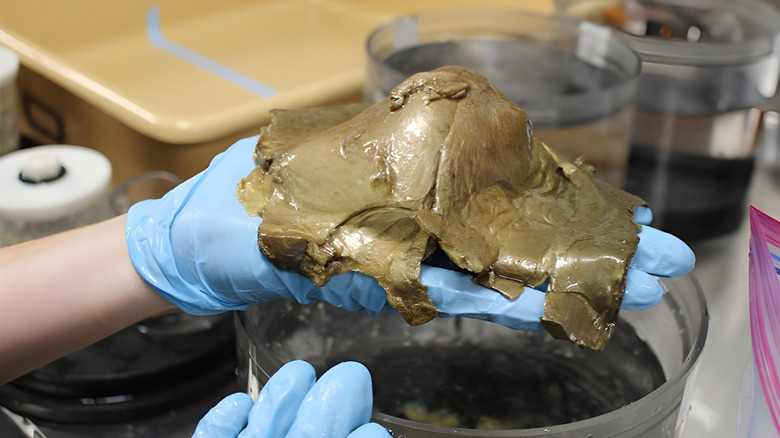
Sometimes, real life is stranger than fiction, a fact made clear during the National Oceanic and Atmospheric Administration's Seascape Alaska 5 expedition in August 2023. While on the deep ocean expedition, scientists were left genuinely unsettled when a strange, glossy orb appeared on their remote operated vehicle's (ROV) camera nearly two miles below the surface. Scientists have predicted that deep-sea life would reveal new forms of life, and if this object turns out to be biological, it would certainly prove them right. The unusual object sat alone on a rocky ledge in the Gulf of Alaska and was nicknamed the "golden orb" because of its color and spherical shape. Despite its rocky location, it wasn't a mineral or even metallic; instead, it appeared to be soft and organic with a single circular opening on one side, yet oddly intact.
This unsettling feature prompted one researcher to remark that the moment felt "like the beginning of a horror movie." When observed closer, its eerie symmetry and skin-like texture immediately raised questions about if it was something living, something that was once alive, or something belonging to a stage in life, science hasn't discovered before. The anomaly was brought onboard the vessel to be examined on deck, where no one could definitively identify what it was. It didn't resemble or match any of the known hard-shelled characteristics of deep-ocean eggs or have the familiar texture of a sponge or coral. According to NOAA.gov, the orb couldn't be identified or put into any known category, serving as an example of the undiscovered secrets hidden at the bottom of the deep sea.
Strange find on the Seascape Alaska 5 expedition
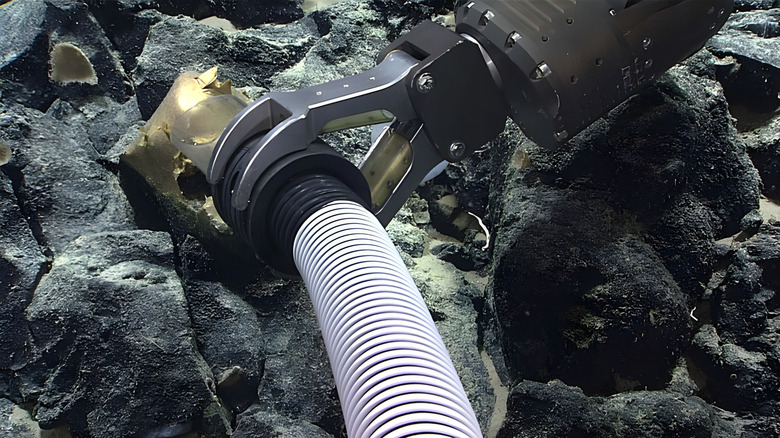
Aside from NASA's role in deep-sea research, the National Oceanic and Atmospheric Administration (NOAA) Ocean Exploration is a U.S. federal program dedicated to exploring the unknown parts of the world's oceans. On the Seascape Alaska 5 mission in 2023, the NOAA Ship Okeanos Explorer sailed from Kodiak to Seward, Alaska, where a team was tasked to complete mapping operations in addition to remotely operated vehicle (ROV) dives in the deep waters of the Gulf of Alaska and coastal fjords. Using an ROV equipped with high-resolution imaging, scientists onboard the ship were surveying a seamount over 10,500 feet beneath the Gulf of Alaska when the camera spotted a smooth, golden-brown sphere perched against a rock covered in pale sponges.
Once the ROV approached, researchers recognized the orb's thin and malleable surface and had the pilot extend the subsea robot's 7-function manipulator arm. On contact, the orb had skin-like tissue, confirming it was soft and not a mineral. The surface of the object was not damaged by the contact, besides the single opening that was already there, so the team decided to collect it. To bring the orb onboard the ship safely, they used a suction sampler, which is a device that acts like an underwater vacuum cleaner, designed to collect biological or sediment samples using negative pressure.
Once onboard, scientists confirmed it was indeed biological, but it still had no obvious clues as to what it could be: no skeleton, no spines, no identifiable tissue structures. An article in LiveScience emphasizes that even after handling the four-inch golden dome-shaped specimen directly, specialists remained perplexed, with the Guardian's early reporting notes how unusual the object appeared even in a region known for strange deep-sea life.
The mystery remains

Theories have been tossed around in an attempt to figure out what the orb may be, with researchers' hypotheses from early investigations covering a myriad of possibilities ranging from a sponge, to coral, to an unusual egg casing. The egg theory aligns with a Guardian report, noting that the opening could indicate something is growing inside, but it doesn't have several of the typical known features of a deep-sea egg.
Smithsonian magazine wrote that the specimen was smooth and soft with and has no defining anatomy that can be seen with the naked eye, making even wide categorization difficult, and without DNA linking results being made public, scientists can't figure out if it belongs to a known species, represents a new life stage, or is something completely undiscovered. Currently, there's no indication of whether this mystery will be solved anytime soon, and stands as proof that despite decades of deep-sea exploration, it's still one of Earth's least understood environments. But with companies like Google introducing new technologies like street view deep-sea imagery it's making the job much more easier.