

How Icebreaker Ships Plow Through Frozen Seas
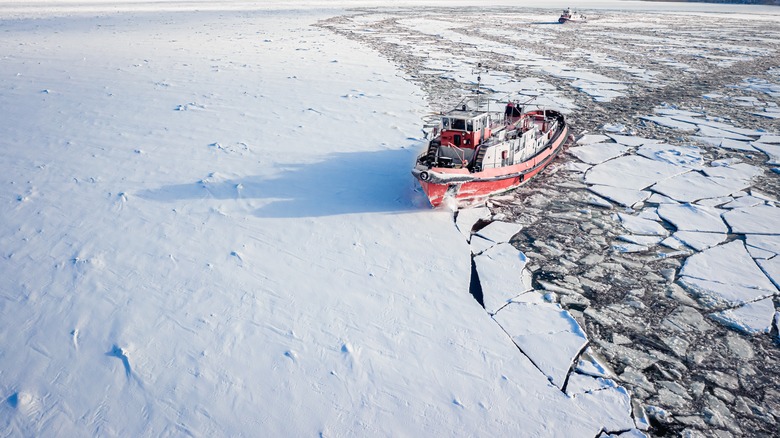
In much colder parts of the world where oceans tend to freeze over, conventional vessels are essentially immobilized without the help of icebreaker ships. These vessels break, crush, and clear frozen sea ice, making routes accessible for regular ships. These specialized ships don't slice through the water with sharp bows. Instead they're built with a rounded, sloped bow designed to ride up onto the ice, fracturing it under the vessel's massive weight. In order for this lift-and-crush method to work effectively, these vessels use extreme propulsion power and hulls that are structurally reinforced. They also use specialized systems that reduce friction between the ship and the surrounding ice it's sailing through. It's common practice for modern icebreakers to rescue other vessels that become trapped in frozen waters; other duties include escorting commercial ships, supporting scientific expeditions, and maintaining Arctic and Antarctic supply lines.
Not all icebreakers are built the same; their configurations are dependent on the vessel's specific role, resulting in various power plants and configurations. Some are powered by diesel-electric plants, while the heaviest-duty models use nuclear reactors for virtually unlimited range and sustained high output. An icebreaker's secret weapons are its advanced hull designs, air-bubbling systems, and azimuthing propulsors, helping it maintain momentum even in multiyear ice and pressure ridges — ice ridges that are thicker and stronger than the surrounding flat ice– and can sometimes extend several feet above and below the surface. The U.S. Coast Guard is trying to expand its icebreaker fleet as global interest in the Arctic grows due to shipping access needs and research activity.
Icebreakers are the key to Arctic dominance
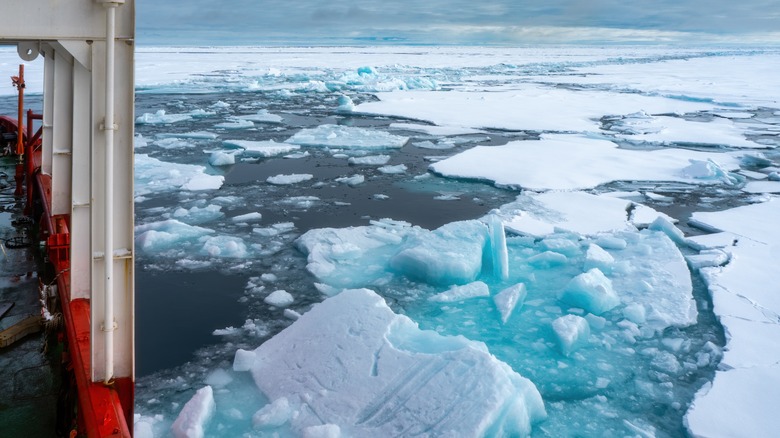
Despite sea ice in the Arctic retreating, icebreakers are becoming more important, a vital piece in the geopolitical competition to control the region. Countries with established icebreaking fleets are pushing for influence, access, and control in an area that is slowly becoming more navigable due to global warming. As it stands now, Russia holds the cards as the dominant power in Arctic water locations, possessing the majority of the world's fleet, which is estimated to be over 50 icebreakers and ice-capable patrol ships, including operational nuclear-powered vessels, which is significantly more than any other nation or alliance. The country is capable of deploying powerful, heavily armored vessels that support both commercial and strategic operations. On the other hand, the United States is seriously behind, with Arctic experts and policy analysis pointing to its aging icebreaker fleet as a major vulnerability.
Due to its limited number of active polar-capable ships, sustaining year-round operations is a big hurdle. In an effort to address this weakness, the U.S., Canada, and Finland have initiated a collaborative program called the "Ice Pact," with the purpose of jointly designing and building modern icebreakers to reinforce their Arctic presence. The objective is to directly counter Russia's icebreaker dominance and, to some extent, China also. Melting polar routes unlock economic opportunities, including shipping, resource extraction, and military access, and beyond that, a military dimension linked to national security, such as search-and-rescue, enforcement of maritime law, and emergency response.
The future of icebreakers
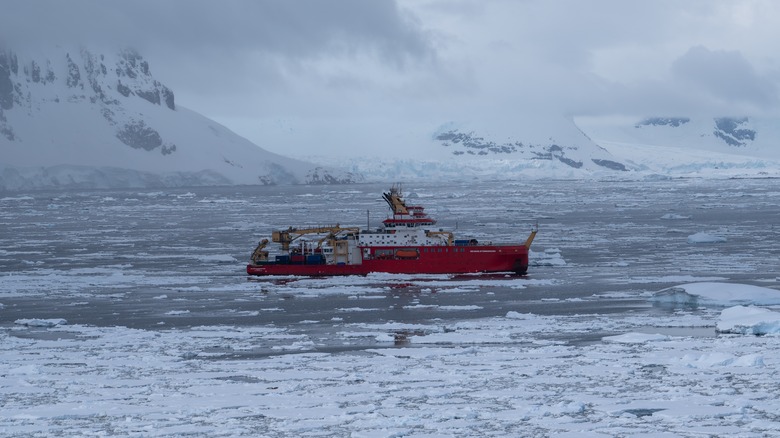
As nations race to match Russia's polar fleet, the competition is shaping the innovations behind the next generation, and creating one of the most complex military craft. Future icebreakers are being built with a focus on better propulsion, higher efficiency, and advanced ice-handling abilities. Finnish engineers are developing next-gen vessels with hybrid diesel-electric configurations and battery-assisted power, while exploring bio-methanol and hydrotreated vegetable oil (HVO) as alternative fuels, to reduce emissions while maintaining the extreme power required for operations in polar areas. Hull optimization and model-tested ice channel widths are being studied to ensure effective navigation through thick ice.
New designs from Aker Arctic incorporate refined hull forms, upgraded azimuthing thrusters, and air‑bubbling systems to reduce friction in ice. On the heavy-ice side, nuclear propulsion remains the way forward. Modern reactors used in vessels like Russia's Arktika-class prove this by demonstrating a compact, more efficient nuclear system capable of delivering sustained high output, without frequent refueling, making long-range polar fleets an inevitability.