

Amazon Loses 40 Satellites In Botched Vulcan Rocket Launch
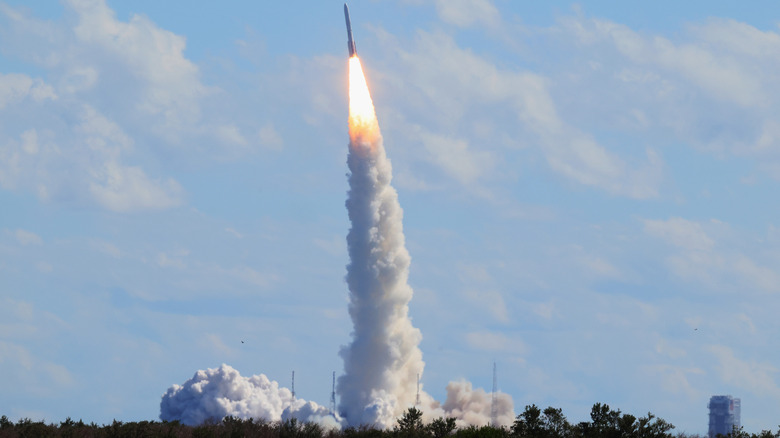
On Sunday, November 15, 2026, a United Launch Alliance (ULA) Vulcan rocket failed shortly after takeoff and destroyed its payload, which included 40 satellites from Amazon's Leo network. The failure marks the first in 20 years for ULA, and while the cause was initially unknown, we now have a little more information about what happened. According to ULA, preliminary findings suggest the first-stage rocket booster didn't produce enough thrust because its engines weren't receiving enough fuel. However, ULA clarifies that it wasn't a problem with the rocket's engines, which were operating nominally.
The rocket began experiencing problems shortly after takeoff, but it wasn't until approximately 10 minutes into the flight that telemetry was lost. ULA says "early indications" point to a loss in booster performance, which caused a stage separation while the rocket was at low altitude and below the speed it needed to reach orbit. The second stage operated as planned but couldn't make up for the performance loss.
The rocket in question is the Vulcan Centaur, a two-stage system that has had prior issues, including an instance where a solid rocket booster's nozzle fell off after takeoff. However, in those prior instances, the missions were still successful, and the rockets were able to deploy their payloads. The recent launch was less fortunate. ULA later addressed those problems with improvements to the booster nozzles. Although ULA did issue an update for the latest flight, a deeper investigation is needed to understand the underlying problem with the rocket and what, ultimately, caused the failure.
Here's why the failure is a big deal
Losing the 40 satellites in the payload is big, with each satellite costing an estimated $1.5 million to $2 million, according to a Quilty Space analysis cited by GeekWire. That's a loss of up to $80 million by our calculations, for the satellites alone. However, this failure is perhaps more problematic because of the implications for future missions, and not just with ULA. The BE-4 engine used in the Vulcan Centaur also powers Blue Origin's New Glenn rocket in its first stage. Moreover, NASA is also considering using a modified Centaur V upper stage for its Space Launch System and the Artemis program.
That means ULA's findings may or may not influence future missions depending on why this latest rocket failure occurred. Both Vulcan and New Glenn are currently grounded. That also explains why ULA was explicitly pointing out that the engines were not the problem and were instead functioning normally. It sets the current failure apart from some of the issues that occurred during earlier testing of the BE-4 engine, including a time when an explosion destroyed the engine and damaged the surrounding infrastructure.
Amazon tapped ULA as one of its rides into space for 'Project Kuiper' back in 2022 — now called Amazon Leo — and also struck deals with Blue Origin and Arianespace. ULA will continue to update its announcement on the Vulcan Leo 1, which means that as soon as more details on its findings are available, they will be shared publicly.