

What Does 'All Way' Mean On A Stop Sign?
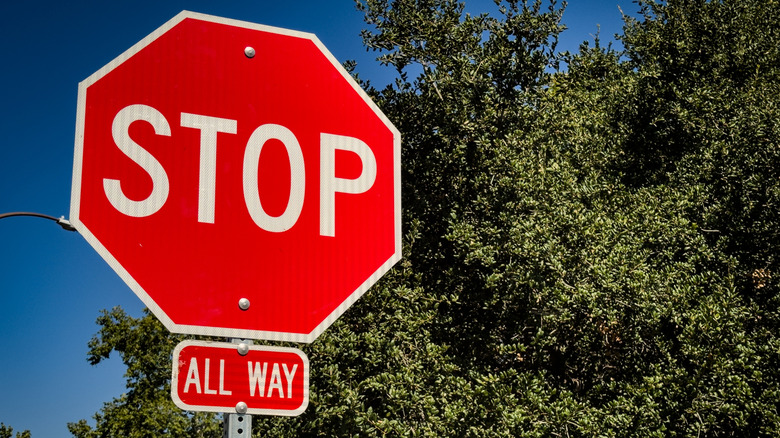
Whether you just got your driver's license or you've logged thousands of miles behind the wheel, we all know what to do at a stop sign. You stop or risk causing an accident – and no, a rolling stop does not count. Stop signs look the same no matter where you live, but new drivers may be surprised by the supplemental plaque that's often found just below that octagonal warning.
These small signs offer vital information, telling drivers how traffic is controlled at this intersection. These plaques typically read "2-Way," "3-Way," "4-Way," or "All-Way" to tell drivers how many sides of the intersection are required to stop. A sign that says "All-Way" indicates that drivers in all directions must stop, no matter how many sides there are to the intersection. It can be used in place of a "4-Way" sign, but it can also technically replace any of these supplemental plaques.
These smaller signs are the same red and white as stop signs and are reflective so drivers can easily spot them at night. Once a driver knows that cross-traffic is also expected to stop, however, they should also understand who has the right of way. It may be a long time since you took a driver's education course, but the rules are fairly simple. Typically, the first vehicle to arrive at the intersection is the first to move. But don't tap the brakes just yet — there's more to the stop sign than meets the eye.
Why road signs always look the same
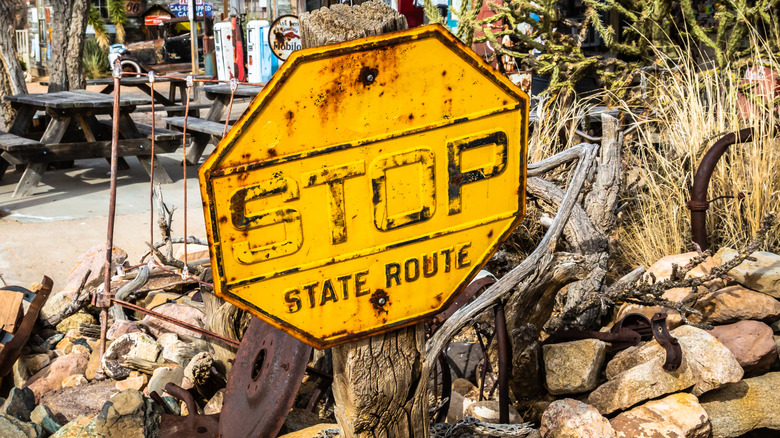
If you hit the road before 1910 or so, road signs were placed by automobile clubs, if there were any at all. There was no standardization, and it was easy to get lost or confused. As automobile ownership surged, it became apparent that standard traffic control devices were a necessity. Today, the Manual on Uniform Traffic Control Devices (MUTCD) controls how road signs are designed and used on "streets, highways, pedestrian and bicycle facilities, and site roadways open to public travel." Traffic regulations may differ state to state, but federal law requires all signs to conform to these standards.
The octagon shape — outlined in the MUTCD as R1-1 — is used exclusively for stop signs, making it one of the most recognizable traffic signs in the world. If you hit an All-Way stop sign, the first vehicle to stop is the first vehicle to proceed through the intersection. If two cars stop at the same time, the driver on the left should yield to the driver on the right. If two vehicles are facing each other and one driver is turning left, they should yield to the driver going straight or turning right. Also, be sure to let pedestrians cross first.
You can expect even the supplemental signs to look similar no matter where in the U.S. you travel. Sign makers play by the same standardized playbook as the drivers who read them. The smaller, supplemental plaques indicating "All-Way" or providing other vital information must also follow MUTCD guidelines in regard to size, letter height, reflective material, and usage with only standard R1-1 stop signs.