

What Does A Solid Red Swallowtail Flag Mean In Boating?
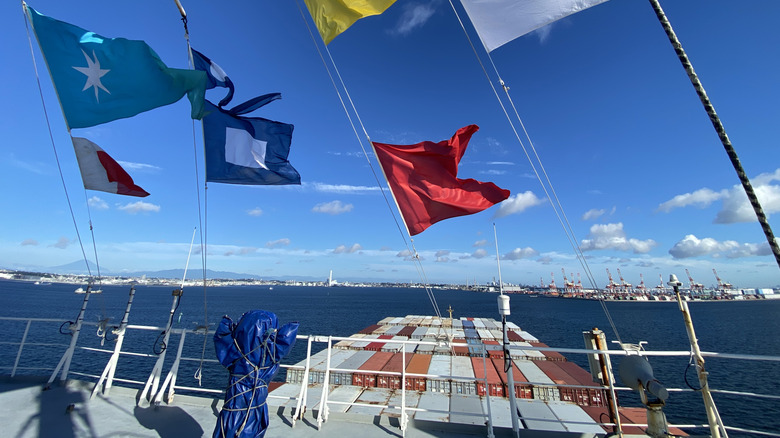
Code flags are officially categorized under the International Code of Signals (ICS), a standardized set of visual flags used by ships and boats in both U.S. and international waters. Long before the advent of radios and other modern, high-tech equipment, boats used flags to pass along messages, warnings, and emergency information to one another. These flags became the language of the sea.
There are 26 flags, which each represent a different letter of the alphabet. Each code flag serves a dual function: They can be used collectively to spell out words, but single flags also have standalone meanings. For example, the flag for "Z" is is used when a vessel needs a tugboat (not to be confused with a towboat), while the "V" flag signals a need for assistance. Twenty-four of these flags are square-shaped, and each has its own pattern. For example, the "Z" flag is square with four different-colored triangles (yellow, blue, red, and black) inside, while the "X" flag is square and white with a blue cross in the center.
The two non-square flags representing letters "A" and "B" are the only two with the "swallowtail" appearance, having a V-shaped notch on the right side of the flag. The letter "A" is white on the left side and blue on the right tail side. It's the international signal for "diver down," and it means the immediate area should be avoided. The North American version we're more accustomed to seeing for "diver down" is red with a white stripe running from the upper left corner to the lower right corner. The letter "B" is represented by a solid red swallowtail flag. Sometimes called a "Bravo flag," it means the vessel is taking in, discharging, or carrying dangerous cargo.
A red swallowtail flag means dangerous cargo
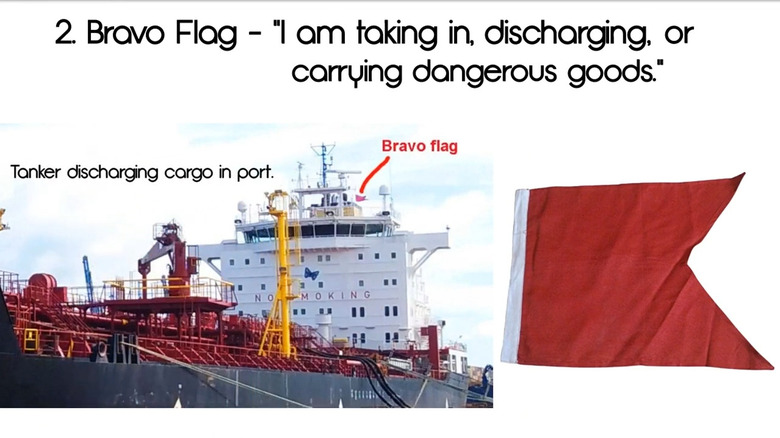
Ships flying the solid red swallowtail "B" flag carry dangerous cargo. Sometimes this is also referred to as Certain Dangerous Cargo (CDC). It can include anything from explosives (like munitions and fireworks) to fuel oil, gasoline, crude oil, or other flammable liquids. Compressed liquefied gases, bulk acids, or liquefied chemicals also qualify. Basically, anything that poses a risk to health, safety, property, or the marine environment.
The International Maritime Dangerous Goods (IMDG) Code and International Convention for the Safety of Life at Sea (SOLAS) Chapter VII break down dangerous goods into nine hazard classes: Class 1 (Explosives), Class 2 (Gases), Class 3 (Flammable Liquids), Class 4 (Flammable Solids), Class 5 (Oxidizing Substances and Organic Peroxides), Class 6 (Toxic, Poisonous, and Infectious Substances), Class 7 (Radioactive Materials), Class 8 (Corrosive Substances), and Class 9 (Miscellaneous Dangerous Goods and Articles). These items are hazardous because they can sink a ship and take the captain down with it.
The ICS was first drafted in 1855 by a committee from the British Board of Trade. Originally published in 1857, the system had 70,000 signals and used 18 flags. Today, the ICS uses long, triangular, pennant-shaped number flags that represent a number system along with the 26 alphabetic signal flags. As mentioned, flags can be used alone to convey one meaning. However, when they appear in a group with other flags, they can have a completely different coded interpretation. This system serves as its own complex language system at sea.