

Dremel Vs Ryobi USB Lithium Rotary Tool Kits: How Do They Really Compare?
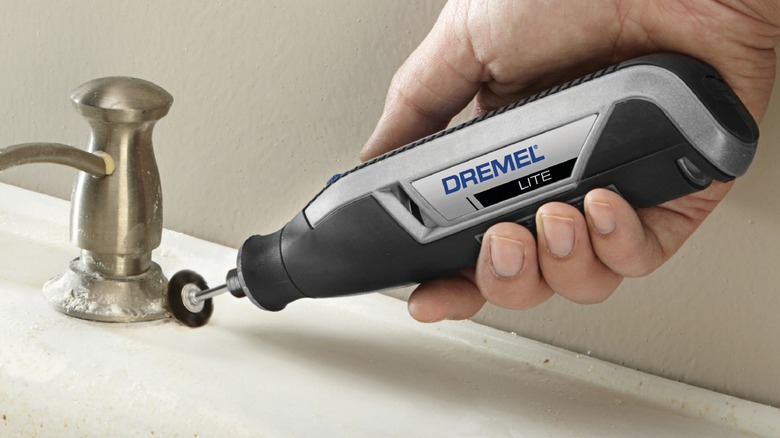
No matter the tool you're shopping for, it's always worth digging into what at least some of the biggest names in the market have to offer. For example, if you need a good rotary tool, taking a look at what some of the major brands in the game like Dremel and Ryobi have in their inventory is in your best interest. They have comparable products, the Ryobi USB lithium rotary tool kit and the Dremel model 7760 4-volt 2-amp cordless rotary tool kit, and while both kits come with several different attachments and run on USB-rechargeable batteries, they deviate in some key areas.
First and foremost, it's worth breaking down the kits themselves and their price points. Through Ryobi, you're paying $59.97 for the tool, its battery, 21-inch charging cord, 15 different bits with a storage case, and a wrench. Meanwhile, Dremel's offering retails for $64.99 through the Dremel website and covers the tool, battery, charging cord, storage case, 9 bits, and a wrench. Speaking to their warranties, Ryobi kit is covered for two years, while Dremel also tosses in a two-year warranty, so in either case, you're looking at similar workmanship defect coverage.
These tidbits of information already provide much to consider on your rotary tool hunt. Going deeper, though, there's more yet that sets Ryobi and Dremel's rotary tool kits and models apart from one another, as well as elements that make them appear even more similar.
How these rotary tools' performance levels match up
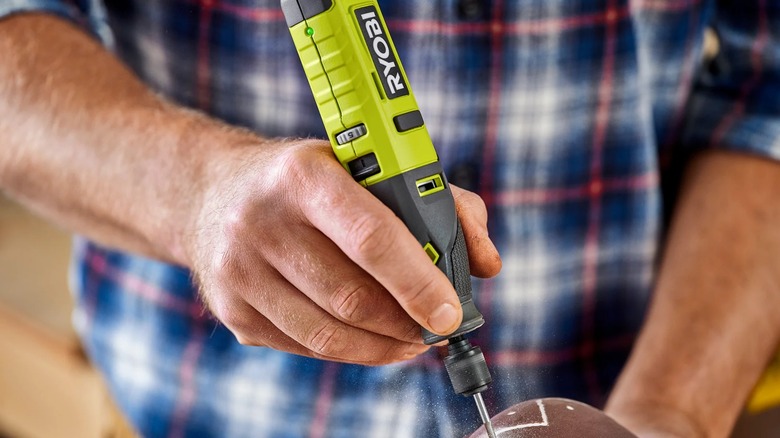
Beyond their respective piece counts, price points, and other basic information, there's more to discuss when it comes to these Ryobi and Dremel rotary tool kits. More specifically, there's the matter of their stats and performance levels. Starting with their batteries, they provide the same level of runtime at 2 amp hours, and they're at the same 4-volts voltage level. The batteries also communicate their remaining charge level with the built-in LED system on the tool, and, as mentioned before, charging of both is accomplished with the included USB-to-USB-C cable.
In terms of tool capabilities, their respective product listings spell out exactly what users can expect from both rotary tool models. According to Ryobi, its battery-powered tool achieves an RPM range between 5,000 and 25,000 across its five different speed settings. With these settings Ryobi recommends it for sanding, carving, engraving, cleaning, polishing, grinding, and sharpening. Meanwhile, Dremel's model ranges in speed between 8,000 and 25,000 RPM with four different speed abilities. Both rotary tools have a ⅛-inch chuck as well to accommodate their selection of bits.
On the whole, these two rotary tool kits aren't all that different, but which is right for you? For some users, Ryobi may be the better buy, seeing as you get a whole lot more and comparable tool performance at the lower of the two price points. Not to mention, many consider it one of several solid Dremel rotary tool alternatives. With that said, if you're beholden to the Dremel brand, and you're looking to save some money even with the loss of a handful of accessories, perhaps that kit is a better fit for you.