

How The US Air Force 'Catches' Fighter Jets With Malfunctioning Brakes
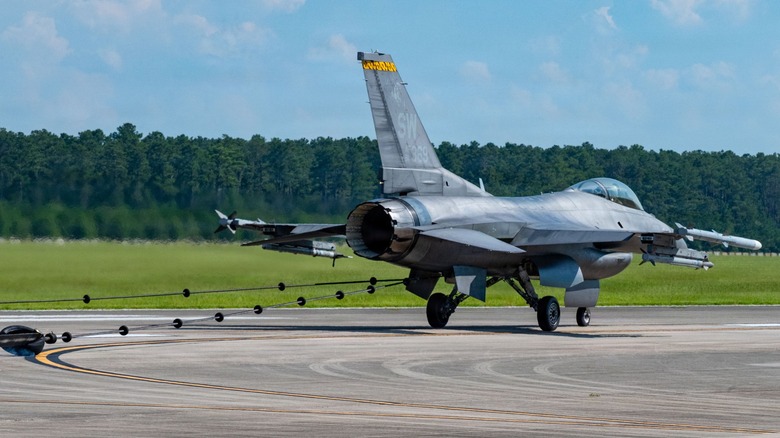
When a fighter jet lands on an aircraft carrier, it employs a tailhook that snags an arresting cable, causing it to stop before it falls over the side. While that puts a lot of pressure on the pilot(s), it's necessary because an aircraft carrier flight deck is so short. On land, arresting cables aren't necessary, since a fighter jet can come down and land the same way as a commercial passenger plane. It reduces speed, applies brakes, and touches down, and it all works quite well, but what about when it doesn't?
Landing with wonky brakes is one of the scariest things for a passenger aboard a commercial airliner because you have no idea how things will turn out. For fighter jets, the uncertainty is largely eliminated because, when the brakes malfunction, the U.S. Air Force (USAF) has a way to "catching" its fighter jets, improving safety for everyone involved. Believe it or not, the system in place, called a Barrier Arresting Kit, is almost exactly like the one employed on aircraft carriers, as it uses an arresting cable.
Like the U.S. Navy and U.S. Marine Corps' fighters, the USAF equips its jets with tailhooks, which serve several purposes. While they're effective for safe landings when the brakes malfunction, USAF fighter jet tailhooks are also used for engine testing and maintenance. That said, unlike the aircraft operated by its sister services, USAF fighter jet tailhooks are designed for only a single emergency use, while the other branches' aircraft tailhooks deploy repeatedly.
The Barrier Arresting Kit 12 (BAK-12)
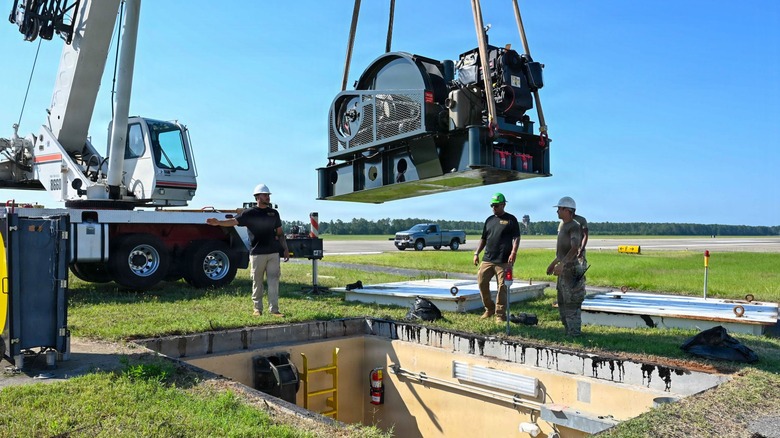
The United States Air Force uses the Barrier Arresting Kit 12 (BAK-12) as its standard means of safely catching a fighter jet during an emergency landing. It's also used for rejected takeoffs, and BAK-12 systems are installed throughout the USAF's many airstrips. They're installed above or below grade in concrete pits, and work to absorb the incredible energy produced from catching a fighter jet. It features a maximum 1,200-foot runout alongside a diesel-multi-fuel engine used to rewind the cable after its use.
In the above image, you can see members of the USAF 20th Civil Engineer Squadron replacing a BAK-12 at Shaw Air Force Base, South Carolina. It's primarily used to catch aircraft like the fast-moving F-16 Fighting Falcon if it can't stop on its own, whether due to a brake malfunction or another issue. Because they serve as a last line of defense in an emergency, the tailhooks on USAF aircraft don't require the same machinery to operate, which is why they're installed for single use.
The BAK-12 uses a 1.25-inch steel cable that's stretched across a runway. Once an aircraft is "caught," a storage reel drives a hydraulic pump to slow and stop the aircraft. It can stop a fighter traveling up to 180 knots, or 207 mph, while maintaining 175 pounds per square inch of pressure on the brakes. For aircraft lacking tailhooks, the BAK-15 system uses a barrier net to stop a fighter, so the USAF uses multiple methods depending on conditions and the aircraft involved.