

Can You Use A Level 3 Fast Charger For A Plug-In Hybrid Battery?
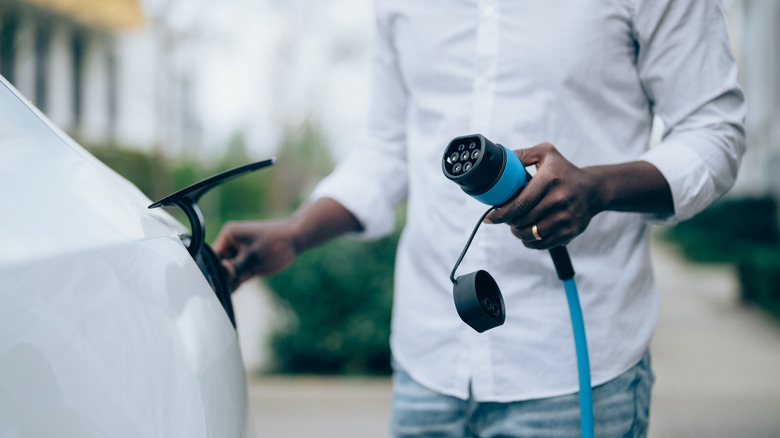
If you're new to EVs or if you've never researched deeper, you may not realize there are different types of chargers — more specifically, there are three EV charging levels. Each level represents a certain voltage limit, essentially ramping up in power and charging capabilities with each tier. The first level, or Level 1, uses 120V and allows you to plug into standard outlets, but it also charges high-power vehicles much slower. Level 3, by comparison, delivers between 300V and 800V thanks to special connectors and hardware rated for the higher power delivery. Level 3 also enables fast-charging for vehicle batteries, but only certain vehicles are meant to utilize these stations, which begs the question, can you use one to charge a plug-in hybrid?
The short and simple answer is no. Even if you somehow manage to plug in your hybrid or PHEV, it's not generally a good idea to do so. They aren't designed to utilize fast-charging or the higher power ratings. Moreover, Level 3 chargers are really for long trips or charging on-the-go in emergencies and require special equipment both in the vehicle itself and to do the charging at the station. Since a PHEV also runs on gasoline — it is a hybrid after all — you don't necessarily need to plug in the battery and keep it charged to full at all times.
Because of how Level 3 chargers, also known as DC fast chargers work, some warn against plugging in a PHEV at all. The system bypasses standard limitations, which could damage your vehicle's power systems and batteries over time. Kelly Blue Book reports repeated fast-charging can degrade a PHEV's battery about 10% over a span of eight years. It's best to stick to Level 1 and Level 2 chargers where applicable.
Some PHEVs can use Level 3 chargers
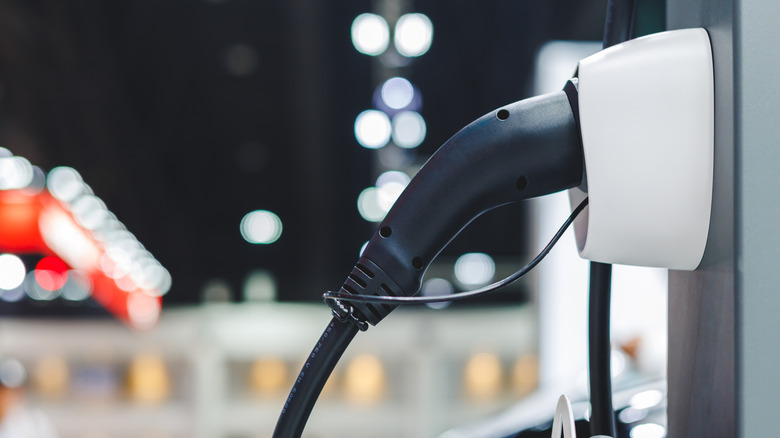
Nearly every American PHEV relies on the J1772 charging connector which is compatible only with Level 1 and Level 2 charging stations. It follows an international standard that every vehicle manufacturer adheres to. However, some modern vehicles have actually been equipped with the necessary hardware and connectors to work with Level 3 stations, even though they are inherently meant for full electric vehicles, versus plug-in hybrid.
Referred to as a CCS1 connector, they incorporate both the J1772 port and additional CCS1 pins for DC fast charging safely. Other Level 3 charging standards are NACS and CHAdeMO. If you really wanted to, you could track down a PHEV from a company that supports the technology. Bear in mind, it's not common, and you will probably pay more for vehicles with the feature. A lot of Chinese plug-in hybrids have introduced DC fast charging support in recent years, so it's only a matter of time before it becomes more common.
Some examples include the Mitsubishi Outlander PHEV in the SEL trim, select Mercedes-Benz PHEV models, and select models of the Toyota RAV4 plug-in hybrid. It's very important to specify that your vehicle should support the technology before you attempt plugging it into a Level 3 station. Since Level 3 stations cannot be installed at home, residential power solutions often do not meet the high power requirements, and they tend to be more for commercial use, you're more likely to find Level 2 chargers in abundance anyway. That's not really a big deal since Level 2 chargers can still charge PHEVs and other EVs fairly quickly under the right conditions.