

What Are Those Doors In Highway Sound Walls For?
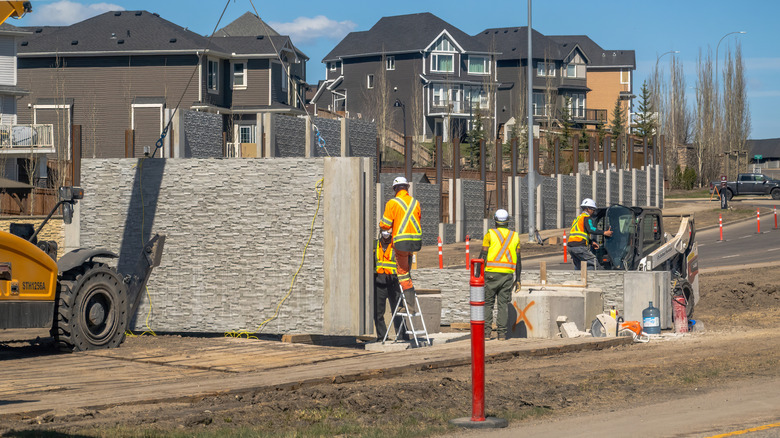
Those tall concrete noise barriers or sound walls along a highway are highly effective at keeping screeches and rumbles from engines and tires away from closely neighboring homes. You'll know how much louder your rolling tires sound to you when driving alongside one, especially if you have particularly lousy treads. But you might also be curious about the doors that appear along the way. You might've even seen one appear partway up the height of a wall panel. What's going on there?
As you might suspect, it's definitely not for residents to use, but rather for highway maintenance workers, construction contractors, and emergency responders. These doors, which are sealed to preserve noise dampening and often padlocked or keypadded, allow DOT staff to inspect the wall on both sides quickly as well as mow grass or de-ice panels as needed. But the main reason these access points (especially those floating ones) exist is to allow crews to access water from a hydrant on a nearby street. Fire trucks and similar work vehicles would be best equipped to reach a door high up and thread a hose right through it. In cases where water has been routed into sections of the wall, you'll see a hose coupling or valve embedded in it.
Combating highway noise pollution, one sound panel at a time

Work and responder vehicles usually access sites enclosed by a sound wall directly through the highway, but you may also see them stationed on the adjacent street behind one of those doors or, more likely, in an overlap section where a lateral gap in the wall exists. The Federal Highway Administration advises engineers that the overlap should run four times the length of the gap distance or, lacking that, implement dampening materials in the area to mitigate sound leakage that enters the neighborhood.
We know noise pollution stresses people (and animals) out. Living near a source such as a highway can contribute to ruined sleep, which leads to poor heart health. It's just one of the conditions — chief among them are respiratory issues like asthma — that have been observed in people living near freeways. An estimated 24 percent of the United States lives within one-third of a mile of high-volume roadways, with many of these residents being non-white and of low income. These patterns can be seen as a perpetuation of the impacts brought about by 1950s highway planning and redlining, with federal highway construction displacing more than 475,000 households and leaving countless others with noisy and dangerous highways cutting through previously peaceful neighborhoods. Sound walls help combat some of the negative effects of living so close to a major highway.