

Not Green, Not Red: This Is The Most Powerful Laser Pointer Color
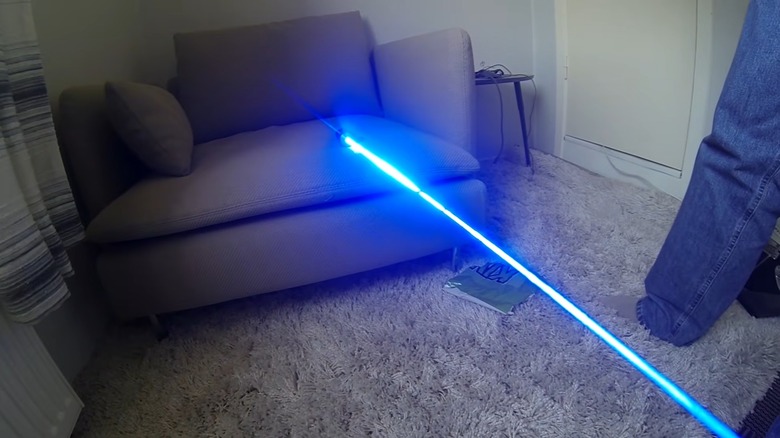
A laser, in itself an acronym for Light Amplification by Stimulated Emission of Radiation, is an artificially created, narrow beam of light useful across a range of industries. Light moves in a wave pattern with certain wavelengths producing a specific color. Natural sunlight is made up of all the visible colors of the spectrum and it emits several wavelengths at once, which creates light that appears white. However, lasers often emit just one wavelength, outputting a single color, with laser pointers common in both red and green. In fact, these two colors are often seen in construction tools as well, leading some to wonder when to use a red or green laser level.
The short answer, is that blue laser pointers are the most powerful. To understand why, it's important to know what a laser is and how it's measured. In addition, many make the mistake of equating brightness with power, which can be misleading. A less potent green laser pointer may appear much brighter than a blue one, for example.
In terms of power, both red and green don't emit as many milliwatts as a blue laser pointer, which can easily go beyond 1000 mW. The power generated by a laser depends on certain factors such as the type of diode used and to a lesser extent, the laser's measured wavelength.
Wavelength and diodes
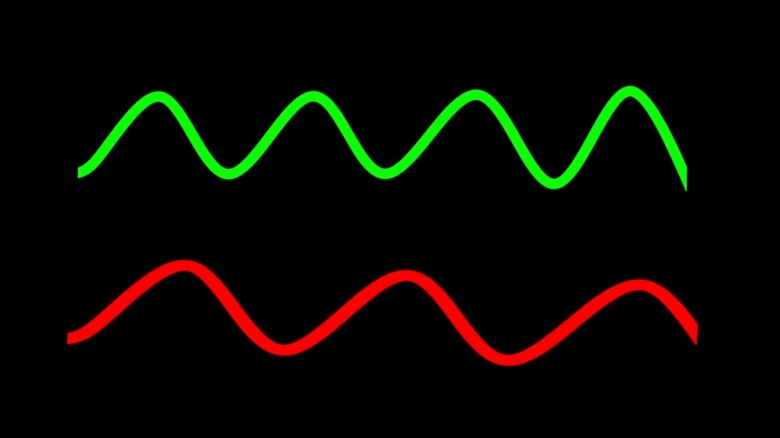
Wavelength is measured by how far apart the peaks of a wave are from each other in nanometers. In terms of visible light, wavelengths fall between around 400 and 700 nm. Red laser wavelength is in the neighborhood of 650 nm, green sits around 532 nm, and blue measures near 445 nm. The lower the nanometer, the shorter the wavelength. Per photon, shorter wavelengths like those produced by blue lasers carry more energy than longer wavelengths like those of red.
Lasers are also measured in milliwatts, in terms of how much power the light is emitting. This figure is significantly influenced by the type of laser diode being used. Blue lasers use a direct diode, which is a simpler process that more efficiently converts energy into light. DPSS or diode pumped solid-state configurations traditionally used to produce green lasers, include greater complexity, forcing the light through crystals in order to achieve the specific wavelength. There are now direct diode green lasers, however, being relatively new, they don't last long, and are only effective in very limited small-scale scenarios.
Brightness doesn't automatically equal power
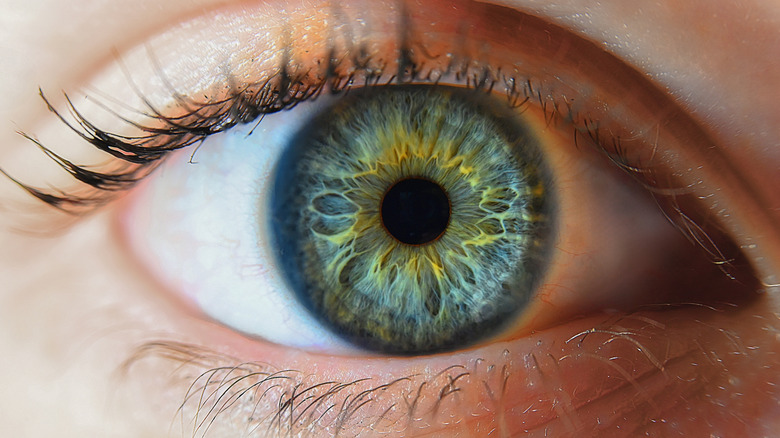
One of the misleading aspects of lasers, is that while one color may appear much brighter to the human eye, it has little to do with the amount of power being output by the beam. According to the FAA, when exposed to either a red or green laser of equal intensity after eyes have adapted to the dark, the latter can appear up to 30 times brighter to the human eye. This is because humans are more sensitive to the wavelength of a green laser, and far less so to the color red.
When talking about blue lasers, it gets even more interesting, as they produce greater power than either red or green, but don't appear as bright. A green laser will still seem brighter than a blue one regardless of the energy carried by the beam. While any laser can be dangerous to the eyes, it only requires minimal exposure to a blue beam to cause retina damage, according to a 2013 study per Ophthalmology Times. In addition, because blue light has a shorter wavelength and emits more milliwatts, the retina can experience burns as power translates into thermal energy. Not only can these focused beams damage the eye, a simple laser pointer can do a number on a security camera.