

What Does A Dethatcher Do & How Does It Compare To A Power Rake?
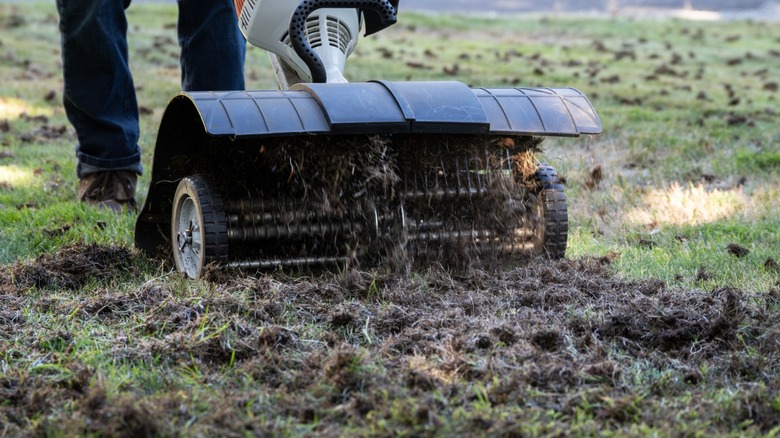
There was a time not too long ago when many people still relied on a tried-and-true rake to clear the yards of fallen leaves in the autumn, but leaf blowers have become cheap and efficient enough for most homeowners to take advantage of. Some people still use rakes, even as their primary tool, despite the backbreaking labor they typically involve.
If you were considering upgrading from a rake to a power tool, you might be tempted to opt for a power rake rather than a leaf blower, but that would be a mistake. Sure, rakes are better at piling leaves more precisely than shooting a bunch of air at them and hoping they go where you want, but — and this is very important — a power rake is not for raking leaves. Unlike some other power tools, such as a reciprocating saw or an electric screwdriver, a power rake is not simply a stronger, motorized version of its manual counterpart.
Instead, a power rake is used for clearing thatch — not leaves. Unlike leaves, thatch typically settles on your lawn for more than a few days and is a thicker, heavier layer of organic matter built from not just leaves but grass, stems, roots, and more. It intertwines as it develops naturally and can be a chore to remove — hence the power rake. This is probably where you're asking yourself why you wouldn't use a dethatcher to remove thatch, rather than a power rake. The answer is — you would use a dethatcher, too. But the two tools are not interchangeable — they're both for removing thatch, and they both serve different purposes.
What does a dethatcher do?
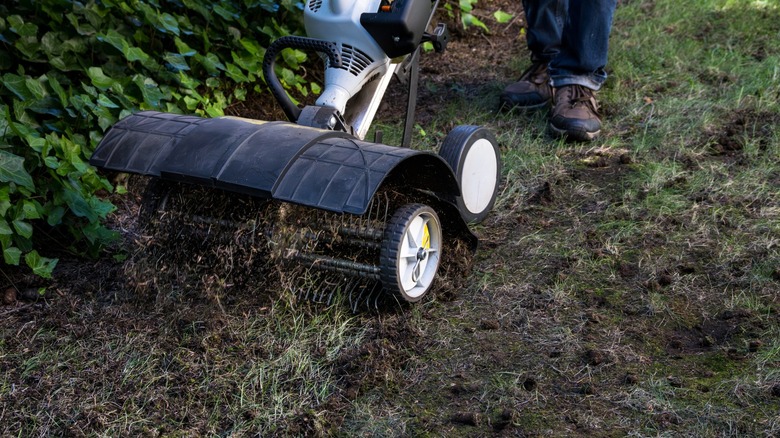
Some major tool brands make dethatchers, but despite that, it may be one of the Makita gardening tools you didn't realize existed, since it's not one of the more common ones. A dethatcher is for lighter-duty work than a power rake and can handle thatch up to ½-inch thick or so — any thicker will be tough for most dethatchers to handle. Many landscapers and homeowners intentionally leave thatch over a lawn for some period, since it can protect the lawn from heat and provide moisture and nutrients, but eventually — especially once your grass has grown to an inch or two long — you'll want to clear it and let your lawn breathe. Dethatching is also necessary if you want to reseed a lawn.
As with mowers and some other yard tools, there are walk-behind push dethatchers as well as pull-behind tractor attachments. There are also combo tools like Ryobi's 18V dethatcher/aerator. Like a typical hand rake, a dethatcher has metal tines or blades that comb across the top of your lawn, pulling and gathering thatch. In that sense, it's more of a rake than a power rake is.
But these tines can be rough on your lawn if you're not careful, which is why the height of the grass, thickness and wetness of the thatch, and the tool itself are all important considerations before running a dethatcher over your property. That said, it's not as risky to use as a power rake, because it can do less damage to your soil — that's because a power rake is for more heavy-duty dethatching.
The difference between a power rake and a dethatcher
The main difference between a power rake and a dethatcher is that a dethatcher is meant for lighter-duty work. This isn't just one difference, though — it's several. It means a dethatcher is generally cheaper than a power rake (especially manual ones), and that it's also easier to use for beginners. Because it's meant for less thatch, it may require multiple passes to get the job done, and won't be useful for thicker thatch. That's where a power rake comes in.
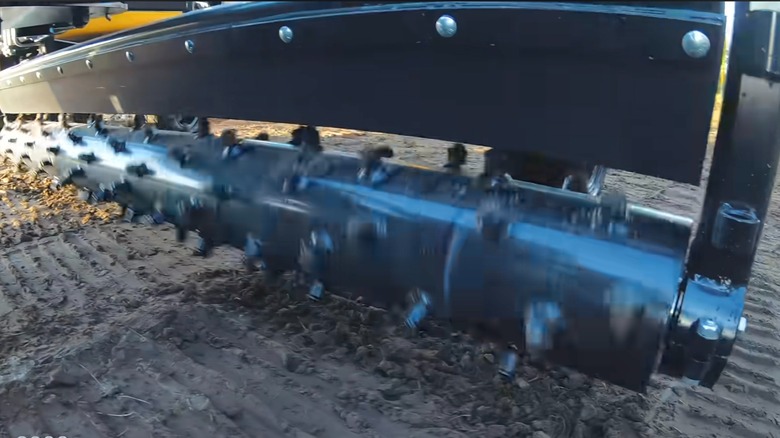
A power rake is meant to pry up thatch that's more than a half-inch thick. Whereas a dethatcher looks like a rake on steroids, a power rake, ironically, looks less like a rake and more like a rototiller, with sharp, rounded blades meant to really cut away at moist layers of organic material. Because it's a more serious tool, it can do more damage to your lawn (especially if thatch is thin), ripping up not only grass but also soil, roots, and even your lawn's microbiome. It's also probably overkill for small yards.
If this sounds intimidating, keep in mind that power rakes are typically used by professional landscapers — it's not a regular-use yard tool like a mower or blower. It takes a while for thatch to build up, so you wouldn't even need one more than once or twice a year — which is why, if you decide to use one yourself, a power rake is one of the lawn tools you should rent rather than buy — and save yourself money and storage space.