

What's The Difference Between A Lawn Scarifier And Dethatcher?
We may receive a commission on purchases made from links.
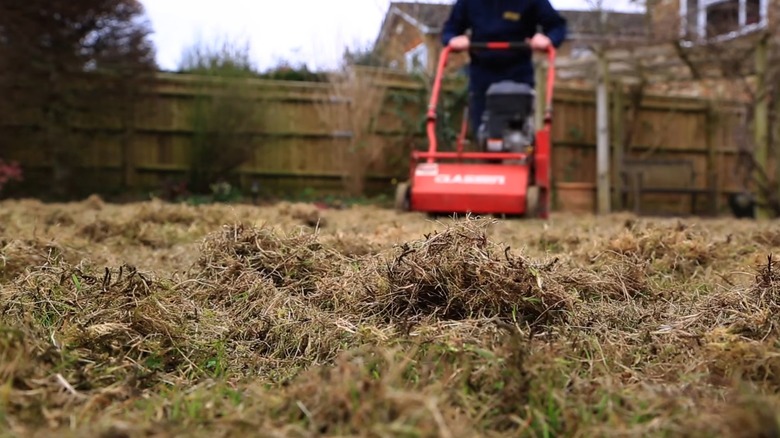
Grass thrives when airflow and essential nutrients can reach into the soil. Thatch is a layer of slowly decaying organic material that rests on the surface of the soil, made from things like roots and stems that don't break down quickly. When the layer gets thicker, it essentially forms a barrier over the soil, preventing vital oxygen and water from reaching it. A lawn suffering from thatch may exhibit unsightly yellowed areas and feel mushy when you walk across it.
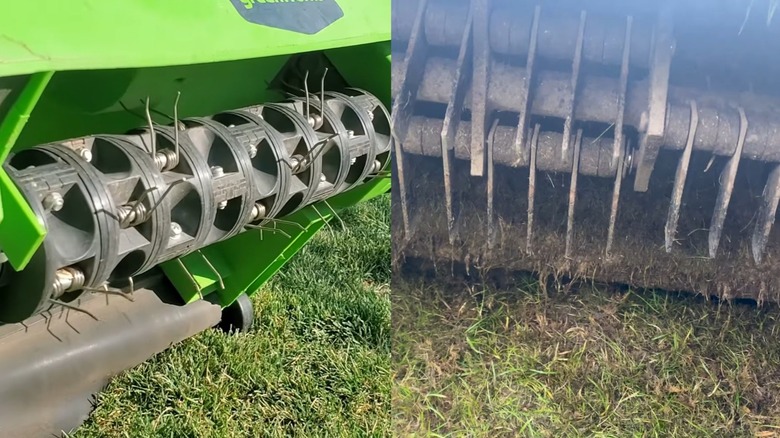
Fortunately, there is a type of tool called a dethatcher, which comes in many forms from manual rakes to more robust powered machines. Depending on the type of grass, there could be spans as great as five years in-between each treatment, making dethatching machines one of the lawn tools that make more sense to rent instead of own. Nevertheless, appearing similar to a small push mower, a dethatching machine features a horizontally rotating cylinder with many flexible, rake-like tines sticking out. These tines grab and pull at the thatch layer, breaking it up and bringing it above the grass blades, so you can pick it up.
Another lawn tool, called a scarifier, looks very similar to a dethatcher. In fact, many products offer multiple modes which include both a dethatcher and a scarifier. However, a scarifier works using many rigid blades, several inches long, affixed to a rotating cylinder mechanism. These blades are able to reach deeper than a typical dethatcher, making it the more powerful option of the two for when your lawn's thatch layer is significantly thicker.
How to know whether you need a dethatcher or a scarifier
In order to determine if your lawn needs to be dethatched or requires a scarifier, you first need to look at thatch depth. For this, you need to remove a small section of your lawn around a few inches deep, where you can essentially see the profile of your soil, thatch, and turf. An easy method is to use something like the Omesata Sod Plugger, available from Amazon for just under $17, which will produce a cylinder-shaped section of earth when extracted.
After retrieving the dug up section, locate the thatch layer and measure its thickness. If the layer is 1 inch or less, using a tool like the Ryobi 18V dethatcher/aerator should do the trick. However, if the layer is thicker, your lawn is in greater trouble and might need the extra power and results provided by a scarifier to get things back on track.
However, keep in mind that a scarifier is much harder on your lawn than a dethatcher. In fact, while your grass will require recovery time after using either lawn tool, a scarifier produces much more dramatic visual damage. Think of a dethatcher as a regular preventative measure and a scarifier as a course-corrective action after things have deteriorated. In fact, after using a scarifier, don't be surprised if it looks like you've completely destroyed your yard, as this is part of the process.