

3 Of The Coolest Land Speed Record Cars Ever Built
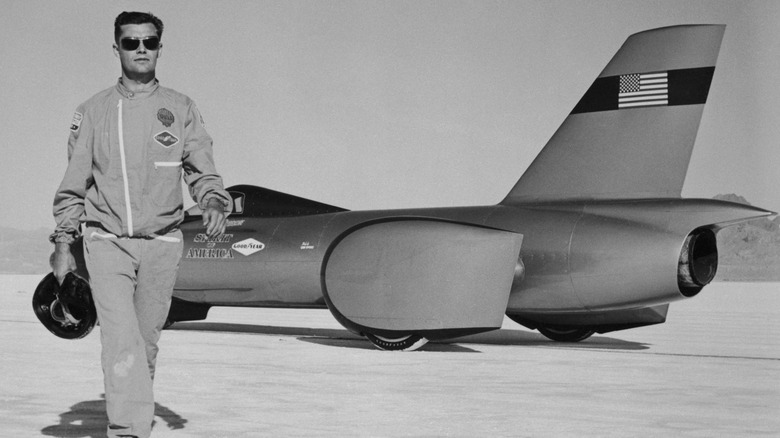
The quest to achieve the absolute greatest rate of speed in a land vehicle seems like a relatively straightforward idea. However, crowning the fastest car in the world can get complicated. In terms of land speed record cars, the sport requires extensive engineering know-how, outside-the-box thinking, and someone crazy enough to get behind the wheel. Since around 1935, the go-to venue for adrenaline junkies looking to shatter world speed records has been a massive, flat section of Utah called the Bonneville Salt Flats. A remnant of an ancient dried-up lake, this area has seen countless high-profile records.
Since the invention of the automobile, there have been some absolutely outrageous land speed builds from creative thrill-seeking teams. From one that wouldn't look out of place in a Wile E. Coyote and Road Runner cartoon, to what amounts to essentially a wingless fighter jet, certain land speed cars exude a "cool" factor and offer some of the fastest ways to travel on land. One of the cars on this list was even cited by the designer of the 1989 Batmobile, Julian Caldow, as a direct inspiration for the build seen in the Hollywood blockbuster.
Wingfoot Express 2
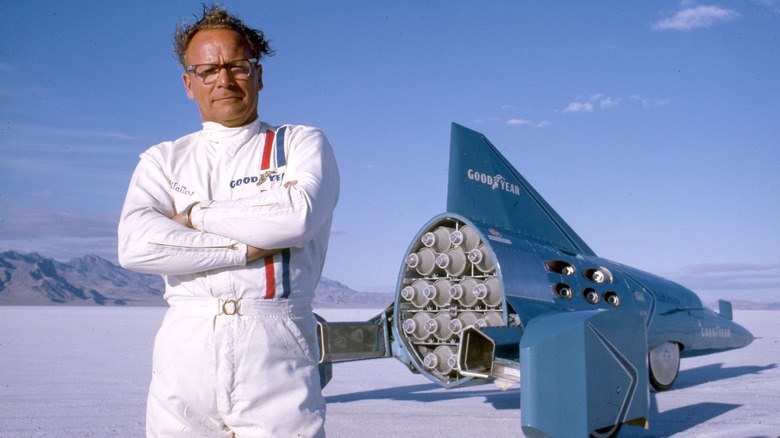
If you recall the classic Looney Tunes character Wile E. Coyote, he had a fascination with equipping ACME rockets to a variety of things, from roller skates to sleds. Of course, the result was always predictably a catastrophe. However, in real life, JATO (jet-assisted take-off) rockets were being used successfully by the military on early jet models to help assist with lift when taking off.
Walt Arfons, looking to nab the land speed record in the 1960s, crafted a series of vehicles, the Wingfoot Express and then Wingfoot Express 2. With a shape inspired by an arrowhead, the nose started at a point and gradually widened at the rear, which is where Arfons installed 15 JATO rockets for propulsion. Although this setup successfully reached 485 mph, competition at the time was stiff, and Arfons needed more speed. If JATO rockets aren't netting enough thrust, how does one make a land speed car even faster? Add more rockets; that's how. So Arfons fixed 10 more JATO rockets onto his creation in addition to the original 15, which didn't result in an official record but was cool nonetheless.
Spirit of America
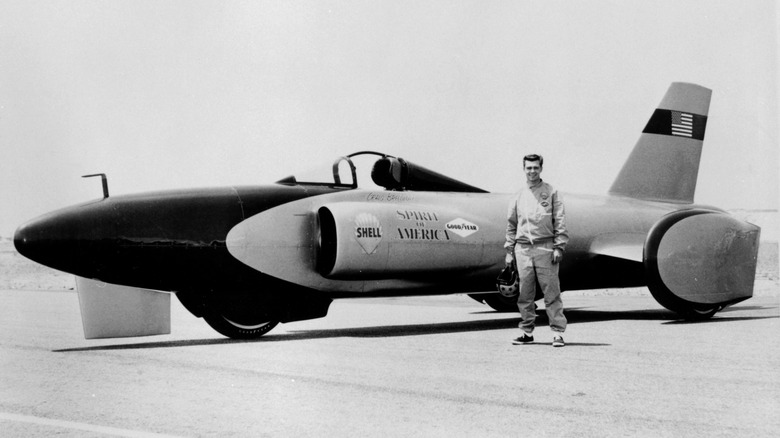
The 1960s saw several competing land speed cars and drivers surface, and Craig Breedlove was among the most elite at the time. When looking at the Spirit of America, it's clearly not inspired by any other land-based vehicle, but instead takes several cues from the era's jet fighters, even including a vertical fin at the rear. In fact, the engine used was from an F-86 Sabre, the first U.S. jet fighter with a swept-wing design. Only, in Breedlove's case, flight wasn't the goal, so the Spirit of America looks the part of a jet, just without wings.
Aside from the obvious sleek and tapered jet body design, the thing that made the Spirit of America cool was its innovation. Many land speed cars up to that point had experimented with many different shapes and engines. However, despite not being officially recognized for speed records (until much later), this car started the jet trend in the land speed record world, leading to the current record-holding, twin jet-powered Thrust SSC.
The Green Monster
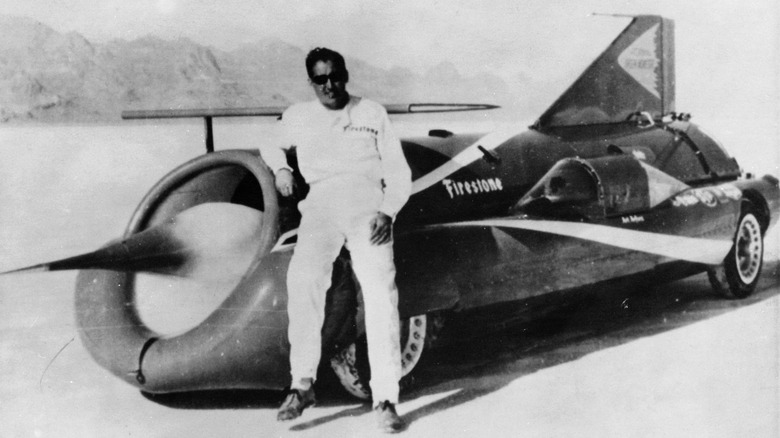
Art Arfons (the younger half-brother of Walt Arfons) wasn't content to let his sibling be the only member of the family involved in land speed records. While Craig Breedlove might have been the first out of the gate in terms of a jet-powered car, Art was working away to develop a vehicle that could utilize the engine from the supersonic F-104 Starfighter, a U.S. military interceptor. Designing something to harness around 17,000 pounds of thrust was a tall order, considering competitors were using jet engines that were far less potent.
Building the car with the jet engine running directly down the center and the cockpit to the left, he painted the exterior green, but later added some red after his sponsor insisted. Art took his creation to the famed Bonneville Salt Flats multiple times, securing a record over 576 mph. However, instead of surpassing the 600-mph record at the time set by Breedlove, Art set another he hadn't planned on, being the only person to wreck at over 600 mph and live to tell about it.
Looking at the Green Monster, you might see what aspect Hollywood designer Julian Caldow was inspired by when crafting the Batmobile in the 1989 film. It's the center-mounted jet engine turbine, a prominent feature of both vehicles, which is responsible for arguably the most striking version of the caped crusader's car to date.