

What Does A Road Sign That Says 'Quiet Sickness' Mean?
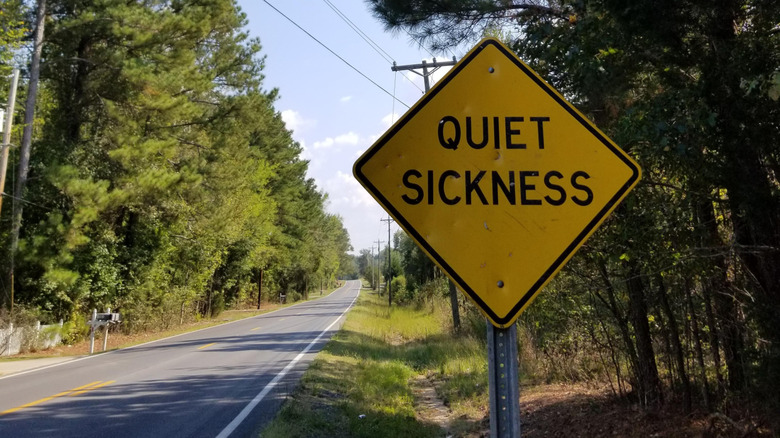
It's certainly one of the weirder road signs in the U.S., especially since you can't immediately tell what it means. So it comes as no surprise that people have been asking what they stand for on online threads for years now. Most reports come from towns in Georgia, even if the sign isn't particularly limited to that region. Regardless, at first glance, a "Quiet Sickness" sign might look like a hint that a hospital is nearby. However, you'd spot them more frequently along sleepy roads lined with houses and mobile homes, so clearly they've got nothing to do with hospitals.
Instead, the sign likely has more to do with the houses around. A clue arrives in the form of an old noise rule in Hattiesburg, Mississippi, from way back in 1941. The rule is designed to protect homes with a sick or injured person inside from unnecessary noise. All these residents have to do is post their own sign near the street. One that reads "Sickness, Quiet" counts as long as people can read it from 100 feet away.
Notice how this wording is basically the same as the signs seen in Georgia – it's just that the order is reversed. Regardless of the order, both signs stand near homes rather than hospitals. They also mean the exact same thing, where "Quiet" is the request while "Sickness" is the reason. In other words, drivers are asked to keep it down for someone sick in the vicinity.
Not to be confused with quiet sickness
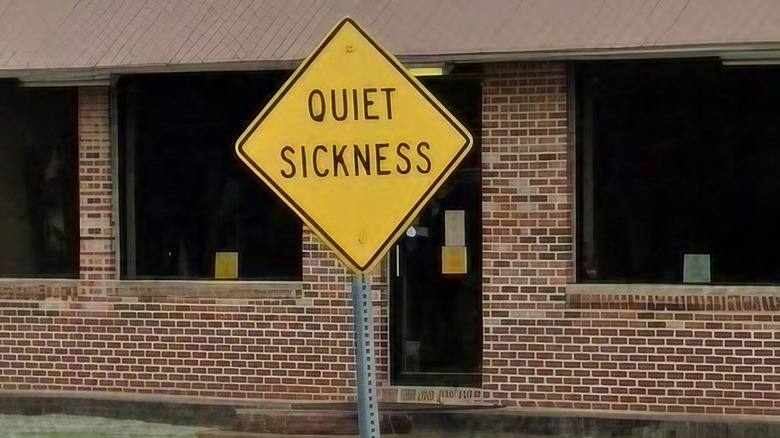
It's a rather simple, tidy answer. But look the sign up online by searching for terms like "quiet sickness," and you'd unearth something strange: a separate history tied to dangerous jobs. This could have something to do with the Centers for Disease Control and Prevention. The agency used The Quiet Sickness as the title of an exhibit in 2012 about workers in risky jobs. There are claims doing rounds that these signs are tied to that kind of work and have supposedly been put up for workers with black lung or brown lung diseases. They're said to be designed for those workers, helping quieten the traffic so that they slept on their porches to breathe easier. While this theory may have some truth to it, there are no records to prove it. Nevertheless, the sign does ask for quiet around sick neighbors.
Also worth noting is that Hattiesburg's 1941 rule isn't the only law around these signs. In several other cities, officials themselves post the signs instead of the residents, designating an area a quiet zone. As an example, in Asheville, North Carolina, a doctor can ask in writing for a quiet zone around a very sick patient's home. A traffic engineer then puts up a sign that marks 200 feet around that building with a sign. If you see it, you're banned from honking unless there's an emergency. A similar setup is seen in Quincy, Massachusetts. Here, signs add "Illness" ahead of "Quiet Zone," which you can argue is slightly less vague. Mufflers that make a car too loud obviously shouldn't be used in zones like these.