

Want To Stop Your Tires From Rubbing The Fender? This May Be A Solution
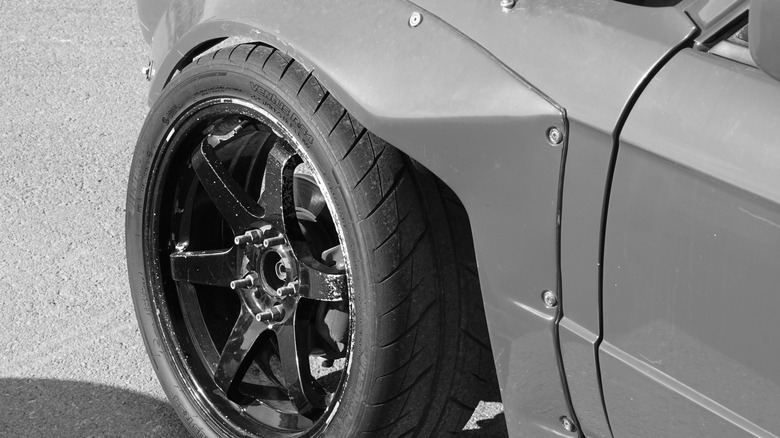
On a factory car, manufacturers leave enough clearance so the tires don't rub, even at a full suspension compression and full steering lock. However, common modifications like switching to wider tires or lowering the car height can throw off that balance. The result is the occasional scrape when the suspension compresses, like when you hit a speed bump too fast or turn over a dip.
However, to counter that, there's a fix, but it's not widely known, partly because it carries some risk. Most factory steel fenders have the edge of the wheel arch folded inward at roughly 90 degrees. This lip adds stiffness and gives the fender a clean, finished edge. The downside is that with bigger tires or a lower ride height, it sits right where the tire wants to go. What's worse is that its edge can be sharp enough to cut into the sidewall.
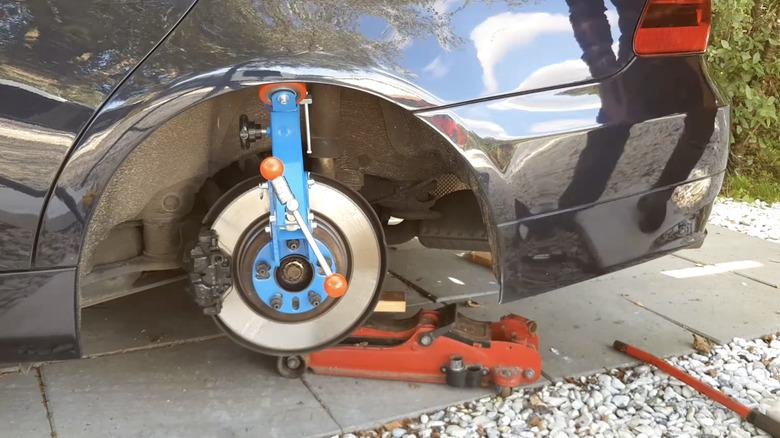
That's why many enthusiasts flatten it in the process called rolling the fender. This is usually done with a fender roller, a long steel arm that bolts to the wheel hub. First, the paint on the lip is warmed with a heat gun, a tool worth owning for far more than bodywork. This keeps the paint flexible so it's less likely to crack. The roller is then pressed against the lip and swung along the arch. A little more pressure is added with each pass, until the lip folds flat against the inside of the fender. This helps the arch keep its shape, while the tire gets more wiggle room.
Pros and cons of rolling your fenders and an alternative
It may not look like much, but folding back that small lip is usually enough to stop the scraping. When AutoRestorer, an American car restoration magazine, rolled the fenders on its own test car, it gained about 3/8 of an inch of extra clearance, though the result will vary from car to car. Also, since the lip sits inside the wheel arch, a well-done roll is hard to spot from the outside. Hence, your fender will look more or less the same.
That said, the process has its downsides. Even with careful heating, the paint can still crack. AutoRestorer recommends keeping the paint between 150 and 170 degrees Fahrenheit while rolling. A rushed or uneven job can also leave the metal warped, giving the area above the wheel arch a wavy look. Moreover, if the fender was ever repaired with body filler, that filler could crack too, since it can't flex the way metal does.
Also, it is important to note that the inner lip helps drain water and road dirt away from the panel. Once its folded, dirt and moisture can get trapped inside the fold, and rust can start to form on the car.
Given these risks, there's a second approach worth knowing. Instead of making room for the tire, you can stop the tire from reaching the lip in the first place. Your car's suspension has bump stops, small rubber or foam cushions that limit how far the suspension can compress. Swapping them for taller ones, or adding a spacer, reduces the suspension's travel so the tire never reaches the fender. The trade off for this approach is ride quality. With less travel, big bumps will feel harsher, and handling will also suffer.