

This Portable CD Player Evokes Discman Nostalgia With A MagSafe Twist
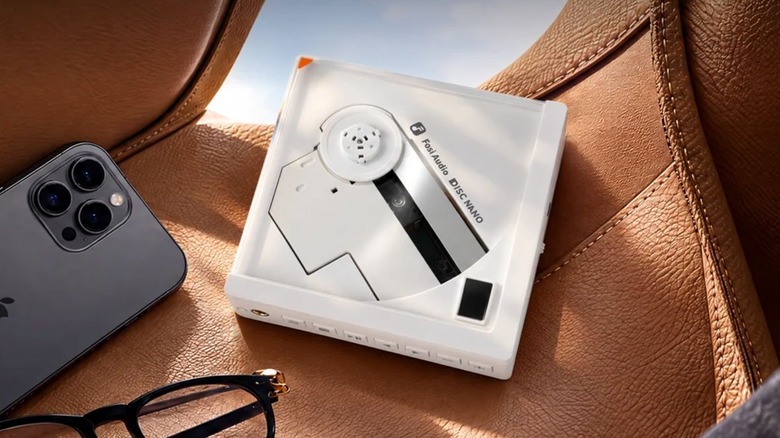
Portable CD players aren't exactly the first gadget you might associate with newer technological features like MagSafe or Bluetooth connectivity. Instead, they mostly conjure nostalgic memories of vintage audio tech and time spent balancing your player carefully so your CD didn't skip and scratch too much. Despite that, Fosi Audio's Disc Nano CD player aims to balance that sense of nostalgia with an assortment of modern features in a very small package.
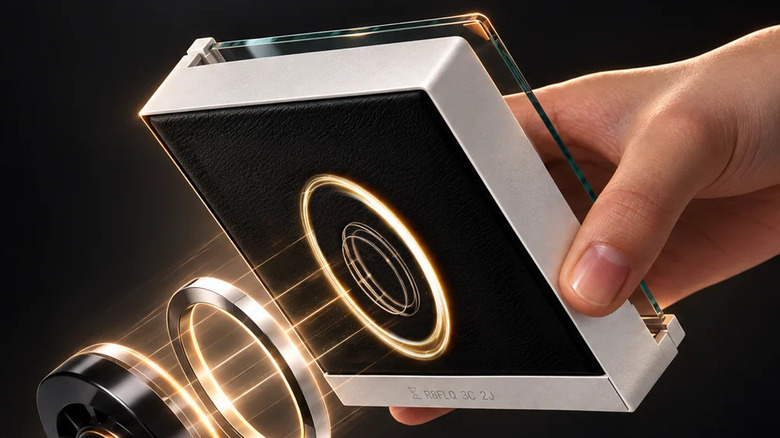
The player is designed to be MagSafe-compatible, with a built-in N52 magnet ring. There's a catch, though: this only works for mounting it onto other magnetized devices. So, you can stick your device onto your metal furniture, a desk stand, or any MagSafe-compatible accessory, like a wall mount, nice and easily — but you won't be able to charge it that way. Instead, you'll have to rely on the Disc Nano's USB-C port to keep its 800 mAh battery charged.
One way that Fosi Audio's tiny CD player is wireless-compatible is via its Bluetooth capabilities. You can connect the player to your Bluetooth headphones, earbuds, or speaker for easy wireless listening. If you prefer the sound of wired headphones, then you still have a couple of options to choose from. On one side of the CD player, you can find a 3.5 mm headphone/optical combo jack, while the other offers a 4.4 mm balanced headphone jack. The device itself doesn't have any integrated speakers, so no matter which connection type is your preference, you're going to need to rely on at least one of them to get the job done.
The Disc Nano is portable, but not for every situation
At around four inches across and an inch deep, the Disc Nano is exceptionally small for a CD player. More specifically, it's currently the smallest one on the market, per Fosi's website. It's light, too, at about seven ounces. That helps to make it a super portable gadget that you can easily throw into your bag or rucksack when you're on the move.
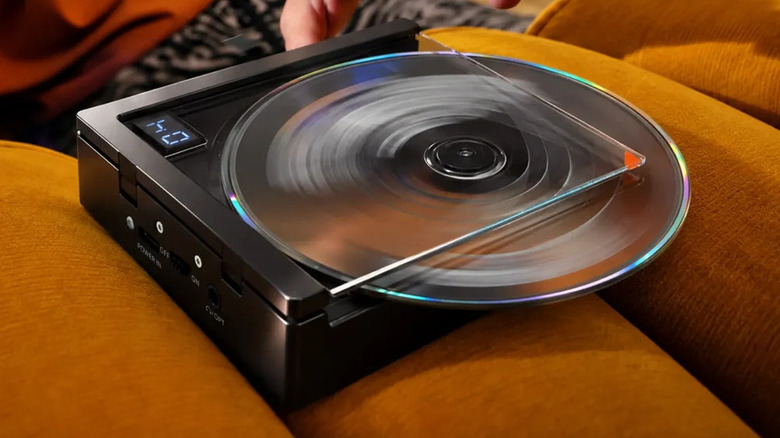
However, as you might have noticed, the player itself is slightly too small to fit a CD inside of it. It's designed to leave your discs half-exposed, allowing you to watch your CD spin while your music plays. While that looks charming, it does create a couple of problems, as your CD won't be protected from the elements. Not only does that put you at risk of accidentally scratching or scraping your disc if you make the wrong move, but it also means you probably won't want to use your CD player while you're on the go, à la the original Walkman.
The Disc Nano does have another feature that makes it somewhat more portable, even if you can't listen on the go. The player uses a snap-lock mount to help keep your CDs in place and secure, even if you have the whole device tilted precariously on a stand or tripod. On a similar note, it also has ESP electronic anti-shock skip protection, preventing any pesky skipping that could lead to your music dropping out if the machine is jogged or moves too much.
How does it sound?
Much like a number of other CD players, the Disc Nano uses a low-power Cirrus Logic CS43198 digital-to-analog converter (DAC). The DAC is designed to minimize the amount of artifacts — like pre-echoes, ringing, or unwanted distortion — while converting data as your CDs play. As a result, it plays an important role in making sure your CD player sounds the best it can.
The CS43198 can theoretically handle up to 32-bit audio, which can offer a massive dynamic range and therefore a lot of depth. However, CDs are generally 16-bit, so you might not be able to reap its full benefits in that regard. On the note of CDs, the player fully supports both the CDDA and SACD with CD layer format, and can partially read CD-Rs and CD-RWs.
There aren't many reviews of the product out there yet, but generally the ones that are out there praise the player's sound quality. Keep in mind, though, that exactly how good (or bad) it sounds is always going to be impacted by the quality of the headphones or speakers you run it through as well. It's compatible with a headphone impedance of 16 to 300 ohms, and has a maximum headphone output power of at least 86 mW + 86 mW at 32 ohms. The player also has a noise floor of 3 microvolts or lower, alongside a signal-to-noise ratio of a minimum of 100 decibels.