

How Many Solar Panels Would It Take To Replace Grid Electricity For A Data Center?
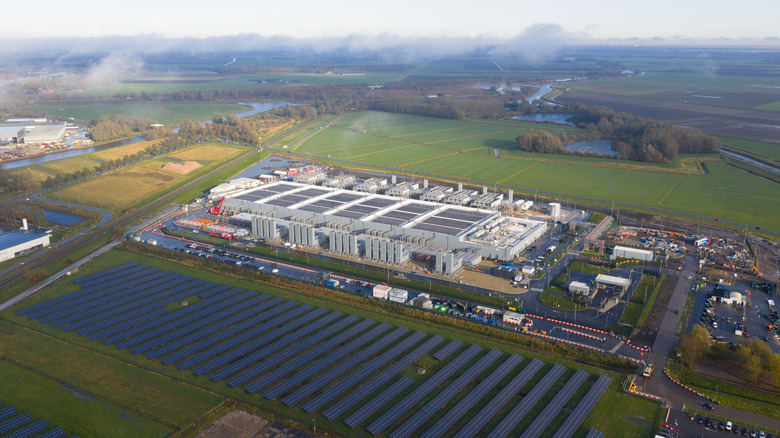
There is undoubted controversy and increasing community resistance surrounding the growing demand for new data centers. Recent figures compiled by Goldman Sachs suggest this controversy won't fade away either. One concern is the power these behemoths consume; Goldman Sachs data forecasts that US data-center power consumption will more than double to 66 gigawatts (GW) in 2027 from an already hefty 31 GW in 2025. This is largely driven by the demand for AI infrastructure. For context, one gigawatt is enough to power around 750,000 homes. This means the power needed to run our data centers is equivalent to what it takes to power just shy of 50 million homes.
So, couldn't we just build solar plants next to data centers and power them that way? Let's set some benchmarks and find out. To be fair, we'll rule out powering massive data centers run by companies like Amazon, which can continuously draw over 100 MW of power. Instead, let's consider how many it would take to power a medium-sized data center of 10 MW.
For solar panels, we can use the typical output of a commercial panel: about 500 watts. A 10 MW data center would consume about 240 MWh of energy in a day; under perfect conditions with 12 hours of sunlight, a 500-watt panel can theoretically produce at least 6 kWh of energy per day. That means you'd need around 40,000 solar panels to power the data center and charge the batteries to keep it running after dark.
Breaking down the calculation
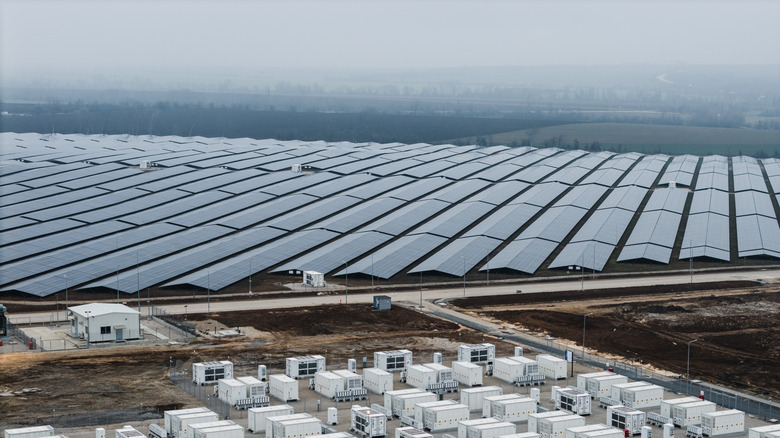
The figure above makes several assumptions that reality often doesn't match. Therefore, it's worth taking a deeper look at how that figure comes together. First, we assumed a 12-hour window every day, and unless the data center is on the Equator, that won't happen. However, for any location, we can assume an average of 12 hours of daylight per day over the course of a year. Even then, we're not accounting for factors like performance drops due to weather, which is one of the biggest drawbacks of solar power. In other words, just counting how many solar panels are needed to power a data center needs a little more than introducing some industry-average figures.
Perhaps the easiest way to show how this affects the calculation is to look at how a data center's location affects it. According to data published by Current Results, Phoenix, Arizona, has an average total annual sunshine of about 3,872 hours — or about 10.6 hours per day. By contrast, the average annual sunshine for Seattle is 2,170 hours, which equates to about 5.9 hours per day. While solar panels don't need piercing sunlight to work, according to PowerOutage.us, they lose between 23% and 67% of their output on cloudy days.
In practical terms, the number of panels needed can depend on geography. If we take a midpoint of about 45% efficiency loss from the Power Outage figures, then a data center in Seattle would lose nearly half the potential from each panel, pushing the number far beyond 40,000 and nearly doubling it.
Solar-powered data centers — a reality check

Data center workers don't lock the factory gates and shuffle off home when the whistle blows; these facilities run 24/7, 365 days a year. One of the main things enabling this is a reliable and continuous electricity supply. This is where solar-only designs come up short. Even under ideal conditions, fully off-grid solar-and-battery systems reach about 99% uptime. This might sound impressive, but it falls short of the near 100% availability needed for a data center to be classified as a Tier IV facility.
We also need to consider the footprint of such a facility. While the 40,000-plus solar panels figure sounds big, it isn't outrageous. For instance, China's Talatan Solar Park has around 7 million solar panels and has a footprint about seven times the size of Manhattan. As a side note, China's massive solar farm does more than just produce electricity. However, our more modest project will still take a lot of land. A solar farm capable of producing the required 10 MW of power would need about 40 to 50 acres of land. Of course, additional infrastructure, access roads, and battery storage facilities would increase this requirement.
So, while there are examples of solar-powered-only data centers, including a 100 MW capacity facility in Dubai, a more realistic model is to use a hybrid approach to powering data centers. Currently, about a third of planned data center capacity is planning some form of onsite power production. This isn't entirely centered on solar power (not everywhere gets as much sun as Dubai), but this approach is gathering momentum.