

This Is Considered The Quietest Harley-Davidson Ever Made
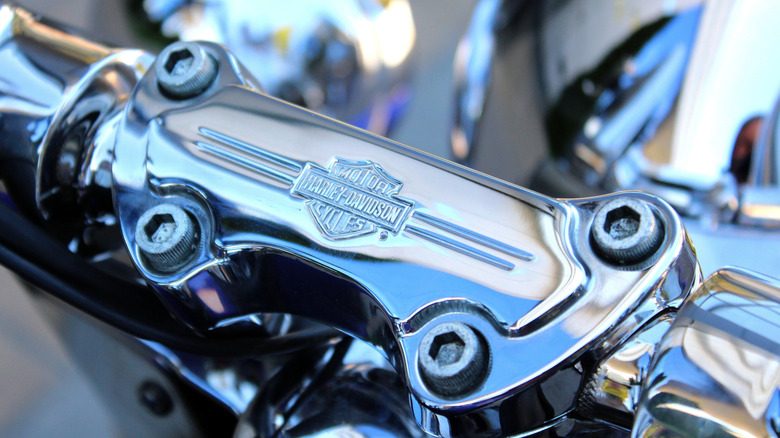
The LiveWire all-electric motorcycle is the quietest model Harley-Davidson has ever produced. Rather than the deep rumble of the air-cooled V-twin engine inextricably linked with the brand, this electric bike emits a subtle whine that grows in intensity with increased acceleration. The sound is a major sonic departure from typical Harley-Davidson motorcycles, especially when you consider that the LiveWire doesn't have traditional gears, so there is a complete absence of shifting and the sounds associated with it. However, since the electric bike's launch in 2019, Harley-Davidson has spun off LiveWire into its own brand. While there are LiveWire dealers located within certain Harley-Davidson dealerships, the electric motorcycles are decidedly their own thing now, so it's debatable whether the LiveWire actually counts as the quietest Harley-Davidson.
Harley-Davidsons today must comply with federal noise restrictions. Measured with a sound meter 50 feet away, according to an EPA mandate, a motorcycle can't exceed 80 decibels. This applies to all motorcycles from 1986 onward, which is fortunate for owners of vintage models, some of which were capable of hitting 100 decibels during idling. Beyond EPA restrictions, various states and cities across the country have cracked down even more on riders, setting thresholds even lower than federal standards in some cases.
There are plenty of boisterous examples from the brand, certainly including some of the most expensive custom Harley-Davidson motorcycles ever sold. But what about the quietest models aside from the all-electric LiveWire?
Newer Pan America, Nightster, and Sportster models are quietest
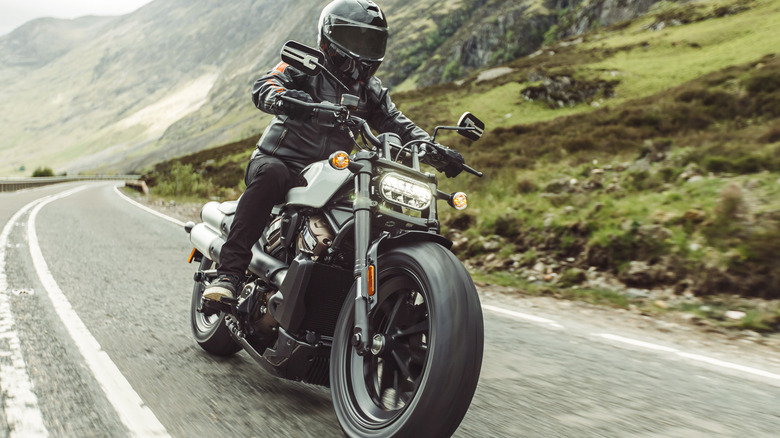
Since there are sound regulations that affect the entire lineup of Harley-Davidson models, it all comes down to which engines tamp down mechanical noise more than others. The Harley-Davidson Revolution Max engine series will grant you a quieter experience over classic models. The Revolution Max 975T can be found in 2022 and newer Nightster models, while the Pan America comes equipped with the Revolution Max 1250, and the Sportster S features a Revolution Max 1250T. The "T" in the Revolution Max 1250T simply denotes a tuning difference from the 1250, prioritizing torque for the street-based Sportster S.
Even though the Revolution Max engine series is a V-twin, it's liquid-cooled, rather than air-cooled like the classic engine. This alternative thermal management lowers the volume of engine internals by acting as a noise-dampening blanket, but it's not the only sound-reduction technology built into these engines. Revolution Max also includes hydraulic valve lifters, which maintain consistent gaps without needing manual valve adjustments and reduce cold-start engine noise emanating from the valve train. In addition, Harley-Davidson crafted a custom gear assembly that uses scissor gears to limit the sound of the gear teeth contacting each other (meshing).
Not every classic Harley-Davidson motorcycle was made loud
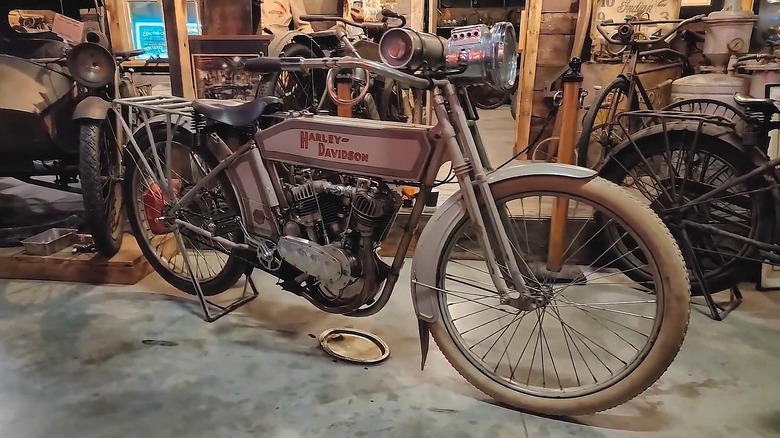
While the Harley-Davidson brand has long been associated with its loud signature sound, not every model throughout the company's history followed that pattern. Over a century ago, motorcycles were more like motorized bicycles, with the bicycle as a fundamental inspiration point. While Harley-Davidson competitors were busy building motorcycles that could be heard across a small community, the 1912 8A, also known as the "Silent Gray Fellow," went in a different direction. You see, horses were still widely prevalent during the era, with 1912 being the year that automobile numbers started outpacing animals on the streets in urban cities like New York. For those who don't know, horses can spook easily, triggered by sounds that send them into a flight state.
The 1912 Silent Gray Fellow featured a uniquely quiet muffler, deliberately designed in response to other brands that could be considered brash with their loud exhaust note. Harley-Davidson's model at the time let riders cruise through town without potentially scaring every horse nearby. While newer engines, like the Revolution Max series, offer multiple ways to reduce unwanted engine noise, the Silent Gray Fellow shows how much muffler design influences how many decibels a motorcycle produces. And today, there are compelling aftermarket systems that can make your motorcycle exhaust quieter, like the system from Dr. Jekill and Mr. Hyde.
Dr. Jekill and Mr. Hyde exhaust system explained
The Jekill and Hyde company (no, that's not a spelling error; it's "Jekill"), clearly indicates its inspiration from the classic 1886 novel. Established in the late 1990s in the Netherlands, the company specializes in custom exhaust systems for a variety of motorcycles, from Harley-Davidson to Japanese sport models.
Essentially, their unique system comes equipped with an electronic switch, enabling you to change the sound of your bike on the fly. For a number of Harley-Davidson models such as the Nightster, Cruiser Dyna, and Pan America, among others, you get to alternate between three different sound signatures. One lets out a forceful, unimpeded growl; another setting tames the sound a bit; and the final option makes the bike the quietest, which is the mode it defaults to every time you start the machine.
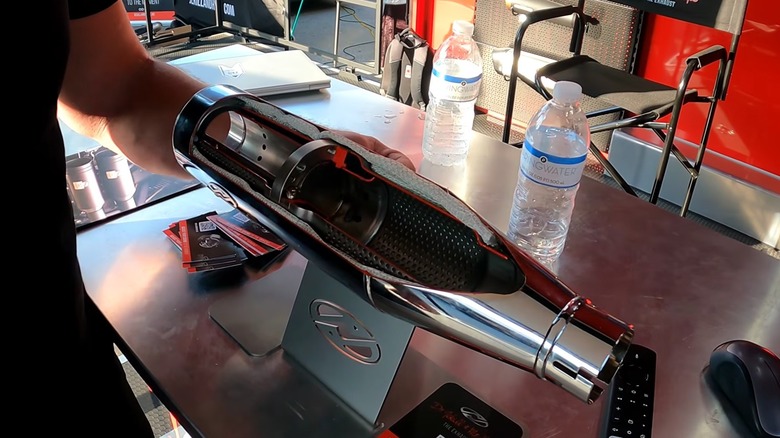
The electronic switch on the Dr. Jekill and Mr. Hyde exhaust system controls a valve inside the muffler. In the closed position, this valve limits how much sound comes out of the tailpipe as the gas is redirected through several perforations surrounded by Nomex packing. While there aren't any official decibel-level measurements for the exhaust in its quietest mode, the system is street legal in Europe. Countries in Europe have even more stringent noise restrictions than the U.S. in some cases, with class 3 bikes (including most motorcycles) needing to be under 77 decibels. For context, a typical vacuum cleaner is around 75 decibels.
Our Methodology
This article is based upon information obtained from Harley-Davidson press releases, outlets covering motorcycles like Motorcycle.com, Adventure Rider, Hagerty, and BackYard Rider. Much of the data concerning the Jekill and Hyde exhaust system came directly from the company, but also from the YouTube channel RevZilla and Motorcycholas. Information on decibel levels and regulations came from Connexion France, Cycle Trader, Today I Found Out, and the rider forum 1130 CC.