

Mid-Controls Vs. Forward Motorcycle Controls: Which Type Is Better For Handling?
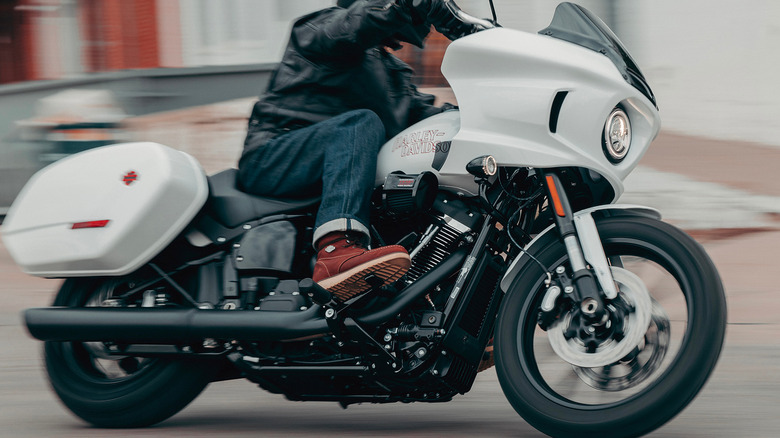
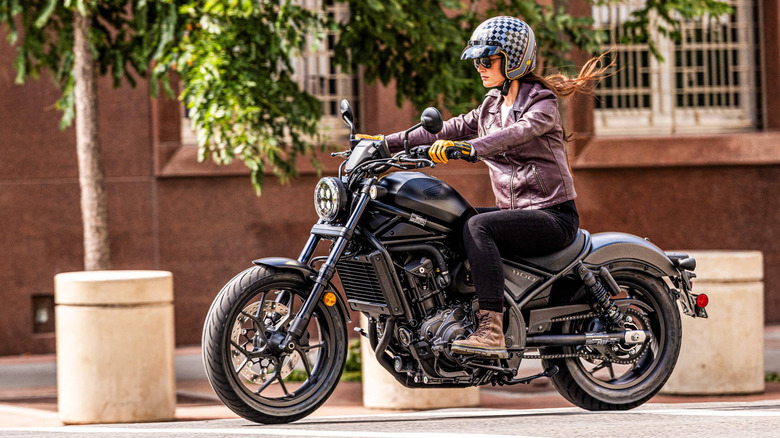
You can't just leave your feet dangling awkwardly off the sides on motorcycles — they have to go somewhere. On cruisers, there are two ways you can rest your feet. Both have upsides and downsides, but one wins when it comes to handling. The first is mid-controls, which position the footpegs, shift lever, and rear brake pedal directly under the seat. As a result, your knees are bent at a roughly 90-degree angle. The other option is called forward controls. It moves all that hardware up toward the front of the bike, allowing you to stretch your legs out in front of you for a more relaxed riding position with that classic cruiser look.
Between the two, mid-controls generally make the better pick for handling. They're the standard on many motorcycles for a reason. The thing is, having feet underneath lets you turn and lean the bike more effectively since you can use your legs to shift weight. At the same time, your body weight is spread more evenly, too, across the seat, the handlebars, and the pegs. This is quite different from forward controls where most of your weight is piled straight onto the seat. As a result, you have far less opportunity to shift your weight around, making tight corners much harder to take.
How mid-controls hold up in the real world
Real-world testing agrees with this. Cycle World's Morgan Gales tested this on the 2022 Harley-Davidson Low Rider S, a cruiser that comes with mid-controls from the factory. He notes that the mid-mounted pegs let him shift his weight better through hard corners. Now, some taller riders do wish the bike featured forward controls. However, Gales, 6-foot-4, disagrees because the current layout improves handling.
Some of the favorability around mid-controls for handling also has to do with ground clearance. The thing is, cruisers already sit fairly low to the road. Feet-forward pegs do nothing to help this – leaning far enough, and they'd end up scraping the pavement. That's why some of the more sport-oriented Harleys — like the Low Rider ST, which is basically a Low Rider S with a fairing and saddlebags – tend to feature mid-controls. According to Rider magazine, the Low Rider models can lean 31.3 degrees before their footpegs scuff, which among the six Harley cruisers Rider tested, is the best. And since footpegs are among the first components to scrape the ground when leaning in a bike, that number can be improved further when they are mounted even higher. Honda's Rebel 1100, a midsize cruiser, does just this. The result is a good 35 degrees of lean on either side. So not only are you able to handle the motorcycle better, but you can also lean further, helping you take tighter corners far more easily.
Mids are great but riders still favor forward controls for comfort
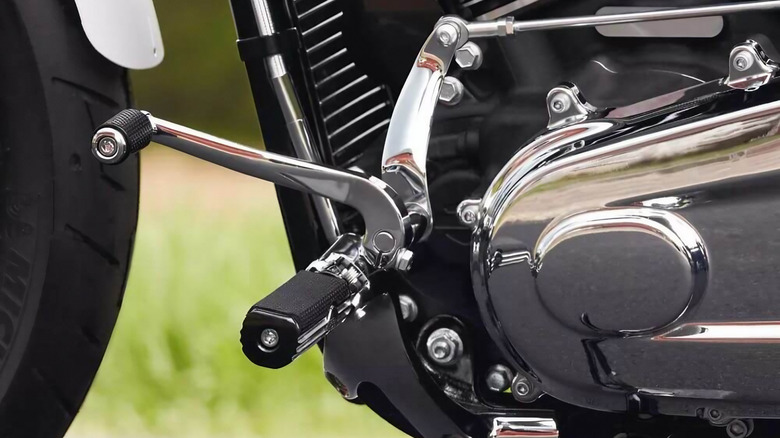
Beyond the above, mid-controls also let you make low-speed maneuvers with ease. With your feet under your hips, you can shift your weight better on the pegs, helping steady the bike at walking pace. This grows more apparent in tight spots like a parking lot U-turn. Mid-controls also place your feet a lot closer to where they'd touch the ground, potentially making them better at stopping, too.
That said, foot position isn't the only thing deciding how a cruiser corners, and therefore, handles. Harley's Street Bob, a stripped-down cruiser with chopped fenders, has mid-mount pegs, too. Even so, it offers just 28.5 degrees of lean. The bike simply has a considerably low ride height, which mid-mounted pegs alone simply can't offset.
Mids have other downsides, too. While many riders may be comfortable with them, plenty of others say they feel cramped. Sawicki Speed, a North Carolina exhaust maker, says mid-controls can feel tight once riders top 5-foot-8. This problem gets worse with a low seat, which pushes you into a squatting position with your knees pushed up even higher. For such taller riders, forward controls can make more sense, even with the worse handling. They let you stretch your legs, which means less bend in your knees. This allows for a more relaxed position, which is especially comfortable for longer rides.