

Why The PlayStation 5 Used To Have 8K On The Box – But Doesn't Anymore
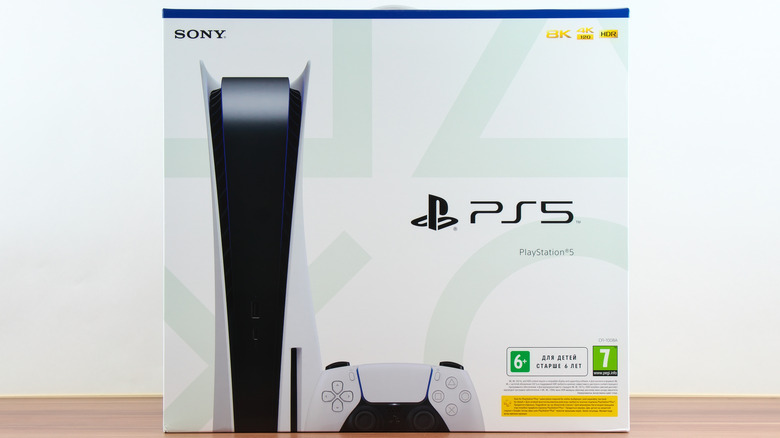
One feature used to be prominently displayed on the box of Sony's PS5 consoles: a gold colored "8K" next to the "4K" and "HDR" badges in the upper right-hand corner. The "8K" quietly disappeared from the PS5 box in 2024, with few seeming to notice the omission. Perhaps it's getting more attention now as Sony is under increased scrutiny following the highly unpopular decision for PlayStation to stop producing physical discs in 2028. But why remove the "8K" logo years after launch?
Sony likely did this for a few reasons. First, 8K resolution (7680 horizontal pixels by 4320 vertical pixels) hasn't really caught on. This has prompted many to ask whether an 8K TV is worth buying in 2026. Secondly, while the standard PS5 is no slouch in the performance department, it doesn't have anywhere close to the required muscle to pull off 8K gaming at a playable framerate. And lastly, Sony never released the promised software update to enable 8K output on the standard iteration of the console.
However, when Sony released the PS5 Pro in 2024, it did make good on the 8K promise — well, sort of. The PS5 Pro can output 8K resolution, but it doesn't do it natively. Instead, it uses upscaling, with PSSR (PlayStation Spectral Super Resolution) doing some of the heavy lifting. The handful of PS5 titles that support 8K are largely rendered at around 4K and then upscaled, with some titles like "The Callisto Protocol" utilizing dynamic resolution, which can jump to 6K in some cases.
What kind of hardware can actually run games at native 8K?
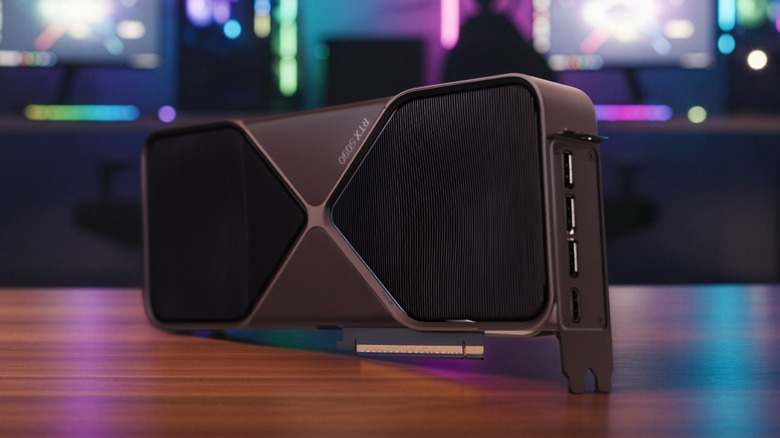
Because 8K is essentially the equivalent of running four 4K resolution screens simultaneously, it requires some beastly components. So, if the standard PS5 was never truly up to the task, and the PS5 Pro leans heavily on PSSR upscaling, what does it actually take to render games in native 8K?
You'll likely need top-tier hardware priced in the thousands of dollars for a single graphics card. An RTX 4090 runs north of $4,000, with RTX 5090 cards more than double that in some cases. How do these GPUs fare against native 8K? YouTube channel Linus Tech Tips tested an Nvidia RTX 4090 in Doom Eternal and achieved around 60 fps (frames per second) at native 8K resolution. Of course, you may be able to run some older titles at this high resolution with less GPU power, but results can vary dramatically.
Other outlets testing the newer Nvidia RTX 5090 against titles that support 8K found different results. Tech Radar, using the notoriously difficult-to-run Cyberpunk 2077, set resolution to 8K with Ray Tracing Overdrive enabled to test the brawny GPU. However, even with DLSS 4 enabled — which some consider cheating, as it's upscaling similar to PlayStation's PSSR — the most powerful gaming GPU available couldn't reach 55 fps. This means native 8K settings would drop FPS potentially by a considerable amount.