

Why (And When) Did NASA's Ingenuity Helicopter Stop Flying On Mars?
In the mid-1960s, the National Aeronautics and Space Administration, or NASA, embarked on its pioneering first attempts to investigate Mars. After one failed attempt in 1964, well before Apollo 11's historic moon landing, Mariner 4 completed a flyby of Mars, capturing the first close-up images of any planet other than our own. In 1976, the Viking 1 mission successfully landed on the surface of Mars, kicking off decades of unmanned Martian exploration.
Many of us fondly remember Spirit and Opportunity, the plucky rovers that roamed for years longer than NASA's intended 90-day exploration window. In 2020, NASA's successful launch of a new rover, Perseverance, along with a sidekick, the Ingenuity Helicopter, served as a welcome distraction from the worldwide COVID-19 pandemic. Designed to complete only five test flights on Mars, Ingenuity was slowly deployed from underneath Perseverance over several days. On April 19, 2021, it completed the first ever powered, controlled flight on another planet, a feat that was dubbed its Wright Brothers moment.
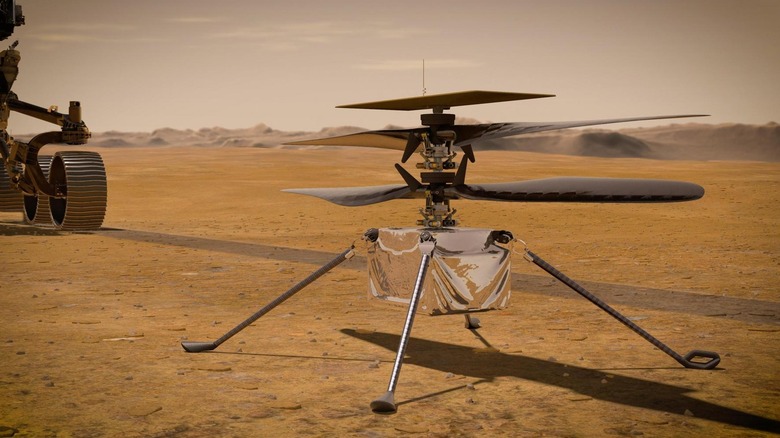
Though it resembles a large drone, NASA categorizes Ingenuity as a helicopter. It weighed four pounds on Earth but only 1.5 pounds on Mars due to the difference in gravity. The blades span almost four feet, and it uses solar power to charge its lithium-ion batteries. Much like the enduring rovers before it, Ingenuity overdelivered and flew for almost three years. It continued to communicate with Earth but was ultimately grounded by damaged rotor blades in early 2024. While we can no longer "talk" to Ingenuity, it remains on Mars, collecting data and taking photographs for future retrieval.
Ingenuity's mission and legacy
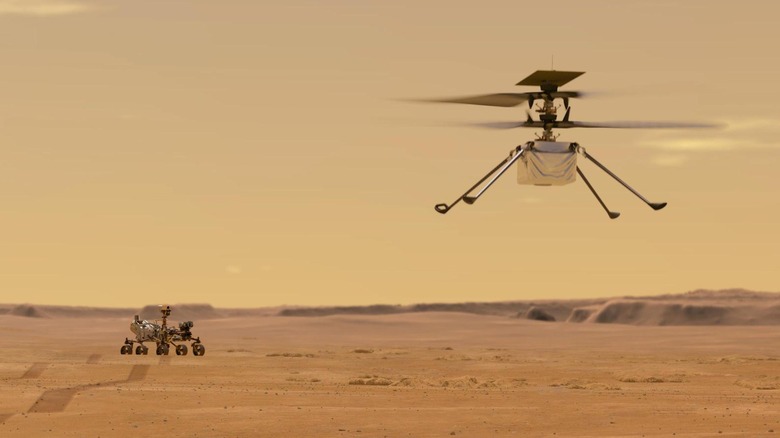
Humans tend to anthropomorphize things — it's one of the reasons why we love Wall-E so much, even though he barely says a word. The same is true for several of NASA's Mars rovers, including Perseverance, nicknamed Percy, and Ingenuity, nicknamed Ginny. We love to follow their journeys, and we're often upset when their missions end. Ingenuity ultimately made 72 historic flights, spending a total of about 128 minutes in the air. Two hours may not sound like much, but the helicopter covered almost 11 miles, flying 14 times farther than NASA engineers originally planned.
During its almost 1,000 Martian days, Ingenuity did more than prove that humans are capable of controlled flight on another planet. It scouted routes for its partner, Perseverance, and underwent experimental test flights to help NASA learn more about the limits of aerodynamics on Mars. Its mission now continues from the ground, even though we can no longer communicate with it from here on Earth.
Communications to Ingenuity were routed through Percy, which has driven out of range. NASA sent one last software update that commanded it to continue to "wake up" and activate the flight computers; test its solar panel, batteries, and electronics; collect surface temperature data; and take a photo. Ingenuity was successfully updated and then sent one final message to Earth that highlighted the mission's contributors. Ingenuity may be grounded, but Perseverance continues to explore the surface of Mars, searching for signs of ancient life and sending home incredible photos of a planet that is 140 million miles from Earth.