

GM Is Giving Drivers Another Chance To Use Apple CarPlay And Android Auto
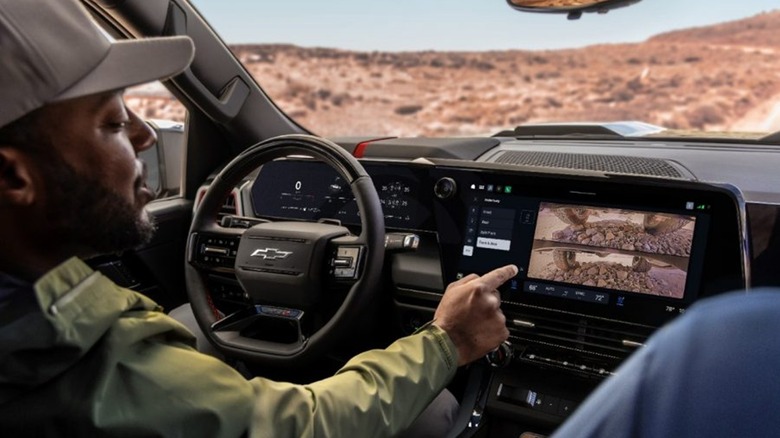
General Motors has introduced a newly designed interface for the 2027 GMC Sierra and 2027 Chevrolet Silverado, two light-duty pickup trucks that are currently the highest-volume vehicles in GM's lineup. Focused on making infotainment personalized, convenient, and simple, the new UI includes both Android Auto and Apple CarPlay, allowing drivers to seamlessly switch between the two so they can use the features and apps in a more intuitive and cohesive way.
In fact, drivers can even have CarPlay and Android Auto open in a split-screen view on the fully interactive 60-inch infotainment screen. "As we evolve our UI systems, we want customers to feel like they're interacting with a single experience rather than moving from room to room inside a house," said Mike Wahlstrom, GM's Executive Director of Software Product Management, in a news release.
General Motors was one of the first automakers to implement Android Auto and Apple CarPlay into their gas-powered vehicles. However, the automaker removed both from its electric vehicles in 2023, replacing them with a Gemini-powered infotainment system instead. GM wanted to do the same with its gas-powered vehicles, citing concerns with the way Android Auto and CarPlay take over the infotainment screen. After gathering feedback from drivers, it seems that this split-screen concept has eliminated some distractions from the road, since they no longer have to dig through menus to find different vehicle gauges previously blocked by Android Auto and CarPlay.
General Motors hopes new interface offers fewer distractions
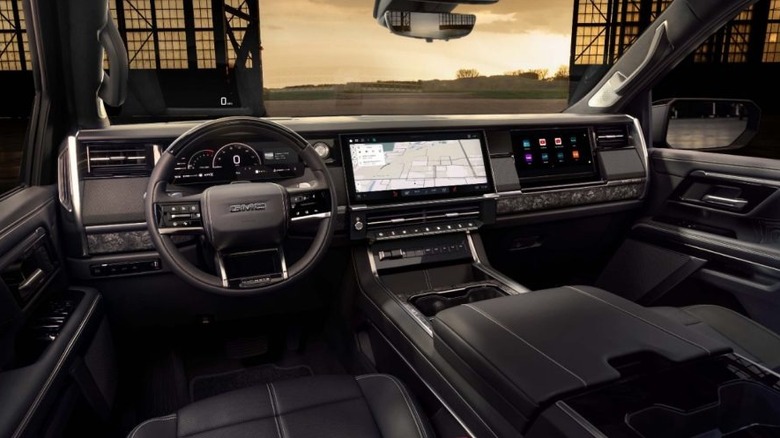
With this new interface, General Motors hopes to eliminate "complex menus" from infotainment screens, not just in the 2027 Silverado and Sierra, but eventually across all of its electric, gas, and diesel vehicles. The design is meant to make navigation simple and hands-free, reducing distractions while driving. On top of having split-screen views for Android Auto and Apple CarPlay, there is a default split-view layout for the home screen that lets drivers see important vehicle information and a large map side-by-side. This way, drivers can check the vehicle's status and change music without interrupting navigation.
Drivers can also personalize their quick-access controls to ensure their most frequently used features and apps are easier to access, which can further reduce scrolling and clicking through menus. There's also physical controls available for those more comfortable with tactile feedback. "There are certain functions where safety, muscle memory and quick access matter," said Executive Director of Human Interface Design Sebastian Bauer. "Some of those functions can be well implemented through touchscreen controls, while others are more intuitive with physical controls, which provide tactile feedback that customers can access instinctively without looking."
General Motors' interface update couldn't have come at a more appropriate time. A new JD Power study found that drivers have become dissatisfied with infotainment screens due to their intrusive, all-encompassing design. And according to AAA, the average time it takes someone to program navigation is over 40 seconds, a lengthy amount of time for drivers to take their eyes off the road. Unfortunately, these more complex infotainment designs can turn simple tasks into quite dangerous ones.