

What Is A Laser Flashlight Used For?
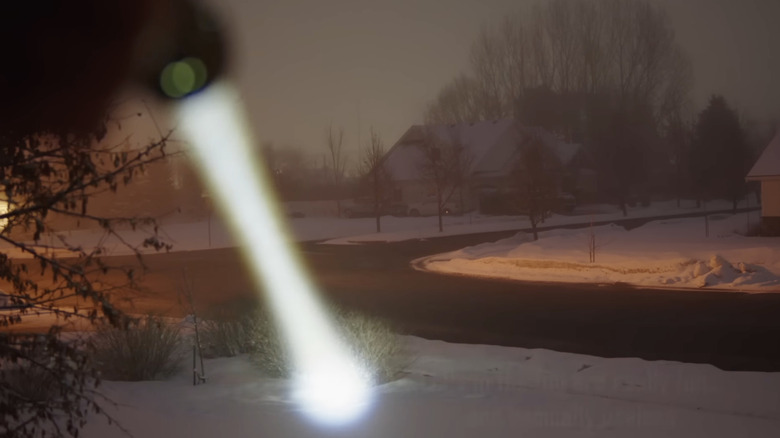
A laser flashlight, also known as a LEP flashlight, occupies the middle ground between a regular flashlight and a laser light. While not nearly as illuminating as a regular flashlight, it offers a much longer range, though its beam is noticeably narrower. LEP stands for laser-excited phosphor, and while they do use a laser (more on that later), the beam is not a raw laser. Instead, you get a narrow ray of light that's also visible in the air.
The whole point is to light something up in the distance, with LEP flashlight beams capable of traveling more than a mile, significantly further than even the most powerful EDC flashlights. Another advantage is that LEP beams leave the housing at one or two degrees of divergence, whereas a compact LED flashlight struggles to get under ten degrees. This means that the beam from a laser flashlight holds up over long distances, where LED beams tend to fall apart.
Therefore, it's no surprise that mountain and maritime rescue teams use LEP flashlights, usually to spot people in the wild. Military and police units also use them, typically for throwing light on a target for someone else. Or they can use them to send visual signals across a distance. Utility crews that work on structures like high-voltage towers also use these lights to inspect the towers from the ground, saving them the trouble of climbing up for a visual inspection.
What LEPs can do for you and how they do it
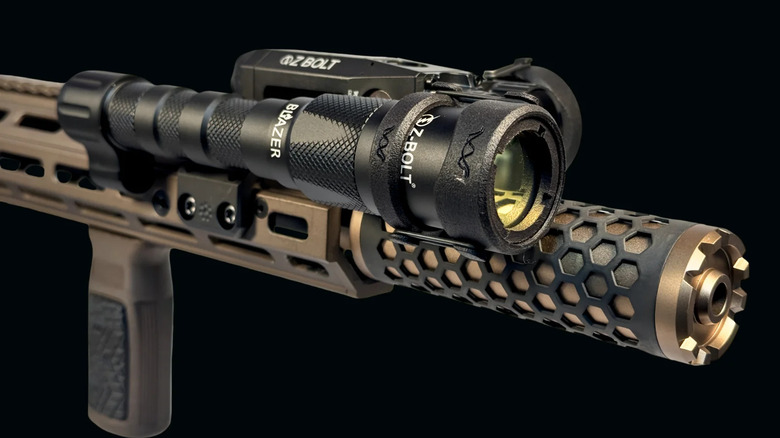
Beyond professional use, LEP flashlights can also mark your position or send an SOS, especially when you're out in the wilderness at night. This sets LEP flashlights apart from laser pointers and regular flashlights. The latter's beam spreads too thin by the time it reaches the subject in these areas, and normal LEDs start falling behind at about the 16-foot mark. Laser pointers have the reach, but they can't illuminate like LEP flashlights.
LEP flashlights work similarly to laser headlights. They have a laser inside the head, which points at a small plate. This small plate is a cerium-doped yttrium aluminum garnet, a synthetic crystal that glows when energy hits it. The plate soaks up the blue light from the laser and converts it to yellow light. The blue and yellow then combine to create white light.
While that plate scatters the light in every direction, LEP flashlights use a lens to focus the light, creating a cone of illumination that stays narrow as it travels. That only works because the glowing patch is so small, which makes the light easy to collect and straighten out in a way an LED never allows.