

How Long Does It Really Take For J-B Weld To Completely Dry?
We've all been there. The hammer slips when you're working on your boat and you crack the hull, or find a break in the handle of your favorite tool. Fortunately, you have some J-B Epoxy in your tool kit. But once you've slathered it on, how long until it's really dry enough to get back to work?
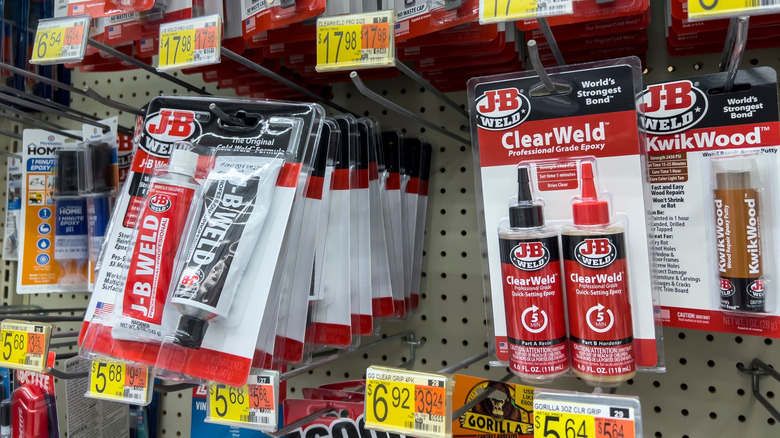
For the flagship original J‑B Weld Epoxy Twin Tube (steel‑reinforced epoxy, which J-B Weld proudly makes in America), the manufacturer says it sets within four to six hours and fully cures within 15 to 24. That means the bond becomes solid enough to handle after about half a day, but it won't reach its rated strength until about a full day has passed (assuming a room-temp environment). It's great for automotive cracks, hole patching, and even some light carpentry, but there are definitely things J-B Weld should and shouldn't be used for, which is why they make other products.
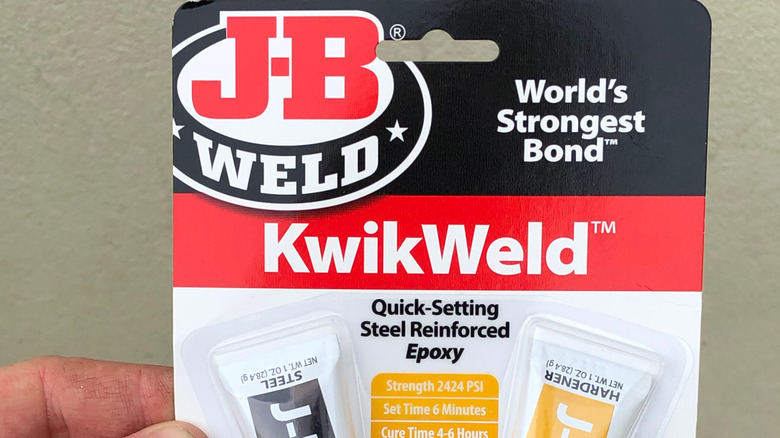
But times vary across the product line. J‑B Weld KwikWeld, for instance, is marketed as a fast‑setting steel‑reinforced epoxy that sets in just a few minutes and only takes four to six hours to fully cure. But it's designed for quick fixes, not high-stress applications. PlasticWeld and some of the other plastic‑focused epoxies claim set times around 20 to 30 minutes, with full cure in about an hour. Then there are high‑temperature products like J‑B Weld ExtremeHeat which require longer cure cycles (many up to 24 hours) to develop extremely strong bonds with heat‑resistant properties.
Why is my J-B Weld still tacky?
The main advantage of J-B Weld and other epoxies is the incredible bond strength, so tackiness after a full cure cycle is annoying. If your J‑B Weld is still tacky after a day, there are three likely culprits: mix ratio, mixing quality, or ambient temperature. The setting and curing timelines the company lays out assume an equal blend of resin and hardener, thorough mixing, and clean surfaces. They also assume a dry, room-temperature environment, around 70 degrees Fahrenheit.
If you've passed the 24-hour mark and the epoxy is still tacky, you may have undermixed or used an incorrect ratio of resin to hardener. Too much of either will disrupt the chemical reaction that creates the bond, and the epoxy won't fully cure; the same result occurs if you don't fully mix. Also, if you don't mix long enough, you may get pockets of uncured resin.
To troubleshoot, remove all uncured epoxy. Then remix really thoroughly, try your best to get as close to a perfect one-to-one ratio as possible, and thoroughly clean or roughen the surfaces before reapplication so it has something to stick to. Make sure you recap any unused epoxy, as well, to stretch out how long opened J-B Weld will last.