

Car Brands From South Korea That Aren't Owned By Hyundai
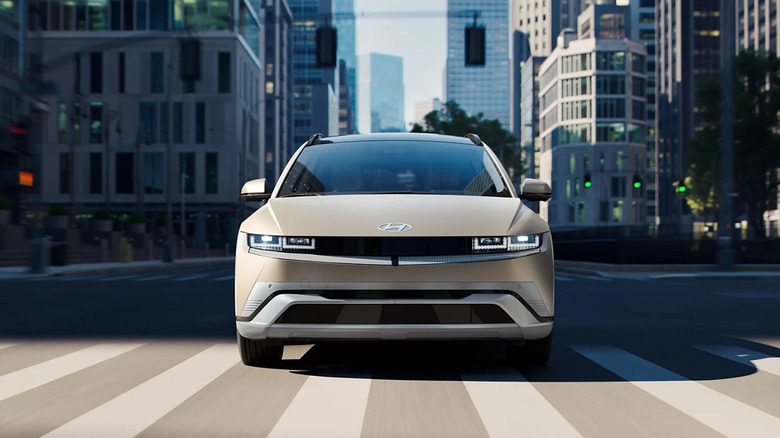
Every country seems to have its big car brand. America has Ford, Japan has Toyota, Germany has BMW, and South Korea has Hyundai. Hyundai Motor Company was founded in 1967, with the Ulsan assembly plant following the year after. In cooperation with Ford, the Hyundai Cortina was the first vehicle assembled in Ulsan — it now outputs 1.6 million vehicles a year, and is the largest integrated automobile manufacturing facility.
However, this is only part of Hyundai's automotive story: the Hyundai Motor Group also owns Genesis and Kia, two prominent South Korean brands. Kia was acquired following its bankruptcy during the 1997 Asian financial crisis. Genesis was launched by Hyundai in 2015 as the country's first luxury brand. The only active South Korean brand left that's not owned by Hyundai? KG Mobility, formerly SsangYong, which makes SUVs and pickups.
The South Korean car brands that aren't owned by Hyundai
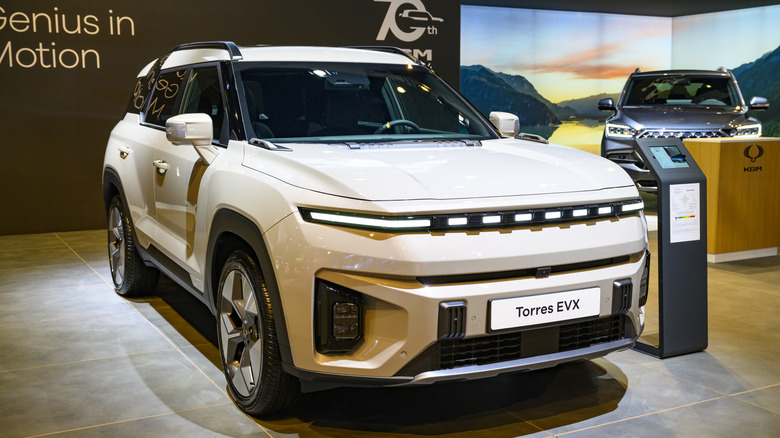
KG Mobility isn't owned by Hyundai. Instead, it is Hyundai's direct competitor — it revealed the first ever South Korean electric pickup truck in 2025, the Musso EV. KG was established in 1954, producing trucks and buses largely for other countries. It was acquired by SsangYong Group in 1986 and then partnered with Mercedes-Benz in 1991. The off-roading SUV Rexton was launched in 2001 using Mercedes-Benz technology. They've continued to launch a wide range of SUVs and pickup trucks. In early 2026, KGM held an 86% share of Korea's domestic pickup truck market, with the Musso selling 6,642 units in South Korea since its January launch.
While KG Mobility is the only active South Korean car brand not owned by Hyundai, that doesn't mean there were never any others. Oullim Motors, previously known as Proto Motors, was founded in the 1990s by a husband-and-wife team. One of the brand's most popular vehicles was the Spirra supercar, the first-ever hand-built supercar from South Korea. An EV version was also in talks at one point. The automaker hasn't been active since 2016. There are also global brands with a South Korean segment, including Renault Korea, which has been active in the country for over 20 years, and GM Korea, which is looking to increase production.
What has made Hyundai so dominant in the South Korean car market?

Hyundai has become a massive success since it was founded in 1967. By 2025, Hyundai and Kia made up 90% of South Korea's automotive market share. This is largely due to the brands' focus on affordable and reliable vehicles, ranging from the sharp and stylish Elantra sedan to the three-row Palisade SUV. Hyundai and Kia have plenty of models available in South Korea that aren't in the United States, like the Hyundai Grandeur luxury sedan and the rugged Kia Tasman pickup truck.
Hyundai has been able to grow alongside South Korea, however, due to much more than its vehicle lineup. Its founding chairman, Ju-yung Chung, had a huge role in the development of Route 1 in the 1960s, a highway that connected Busan to Seoul. In the 1970s, the Hyundai Pony became the first independently developed car in South Korea as the country pushed to grow its own automotive industry. In the 2020s, Hyundai has been expanding its electric vehicle fleet as the country focuses on clean energy mobility options — this includes Hyundai's hydrogen-powered buses and commercial trucks.
In 2025, Hyundai revealed $128.4 billion in revenue, making it one of the world's most successful automakers, let alone South Korea's. Hyundai has continued to diversify, innovate, and invest in technology. This includes ownership of Boston Dynamics and its start-up venture, ZER01NE, focused on AI, mobility, and energy.