

What Is The 4-To-1 Rule For Ladders?
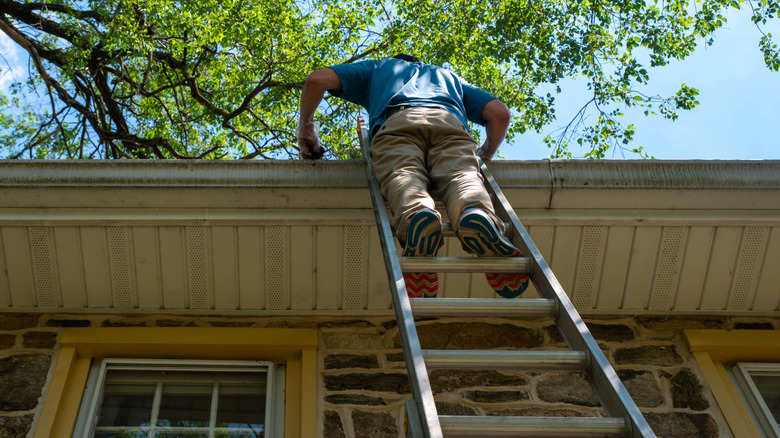
It's the weekend, and you finally get the time to attend to your gutter and clear out any leaves and gunk that have accumulated. You're all set to go with your ladder and your Ryobi tools built to clear rain gutters and downspouts. Without thinking much, you prop the ladder against the siding, nudge the feet around with your boot until the placement looks about right, and begin your climb. This is the same process that just about everyone follows. However, safety regulators recommend that you do a bit of math beforehand. The math takes the form of a rule, which actually goes by several names. Americans call it the four-to-one rule, the 4:1 rule, or the 4-foot rule. The British call it the 1-in-4 rule. They all refer to the same thing, though.
The rule involves first measuring how high up from the ground the ladder makes contact. Divide that by four, and you get how far you need to rest the feet out from the bottom of the wall. So, suppose you have a ladder touching the wall 20 feet up. Divide that number by four, and you get five, which is how far back the feet should be set. The rule is pretty much universal, too, so it doesn't matter what units you measure in. Feed the formula meters instead of feet, and the answer comes back in meters.
How to actually apply the rule
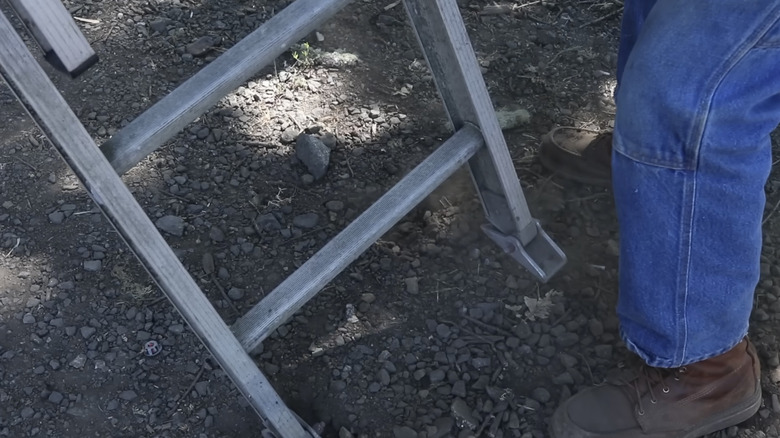
The best part about this rule is how simple it is to use. You can even approximate the rule without a measuring tape. All you have to do is stand with your toes touching the feet of the ladder and stick your arms out, straight in front of you. If you've gotten the angle right, your palms should meet a rung at shoulder height. Your body should stay straight too; if you have to lean forward to touch, then your feet are too far from the wall.
The whole point of the 4-to-1 rule is to get the safest possible angle for you to climb on — approximately 76 degrees. Push the feet any further out and the ladder sits flatter, raising the chances of the feet skidding away from the wall once you climb. Pull the feet closer and the ladder stands too far upright. This increases the chances of the ladder peeling backward off the wall.
What OSHA makes of the 4-to-1 rule

That palm test is a quick stand-in for a requirement written into OSHA's construction rules (29 CFR 1926.1053). Getting the angle right is crucial since the National Institute for Occupational Safety and Health blames a base sliding out for about 40% of ladder injuries.
That said, OSHA measures the ratio a bit differently. Rather than measuring straight up the wall, it instead uses the working length, meaning the distance along the ladder itself, from its feet to the spot where it rests against the wall. The two methods produce similar angles and on a short ladder it doesn't matter which method you use.
Where it starts to matter is on an extension ladder, which is essential for those DIY roof repairs. The two sections of the extension ladder must stay overlapped by at least three feet so that the ladder can't pull apart. That overlap doesn't count as working length. Therefore, if you extend a 24-foot extension ladder to its maximum length, it'll only be 21 feet long.