

Do Tesla's Cybercabs Really Need Starlink? Here's Why Elon Musk Says Yes
Tesla vehicles, including the new Cybercab fleet, currently use AT&T's cellular modems for connectivity in the United States, allowing drivers to do things like stream music and visualize live traffic. Tesla currently uses 4G networks, but has started offering 5G in newer models for added bandwidth. However, this may eventually not be enough for the Cybercab, according to Tesla CEO Elon Musk.
In July 2026, Musk stated in Tesla's Q2 2026 earnings call that the Cybercab — and the entire Tesla fleet — will have Starlink integration. "For a robotaxi situation, you need to have coverage everywhere," Musk explained, claiming that there are many areas in Silicon Valley that have bad cellular service, which would render 5G useless in those spots. If you ended up in one of these spots without coverage, Musk warned that the Cybercab would be "stuck" in a Bermuda Triangle-like situation, and passengers wouldn't be able to make important phone calls, "do high productivity stuff," or use any form of entertainment.
First Cybercab with @Starlink integration pic.twitter.com/8TI6LYSFjl
— Tesla Robotaxi (@robotaxi) August 10, 2026
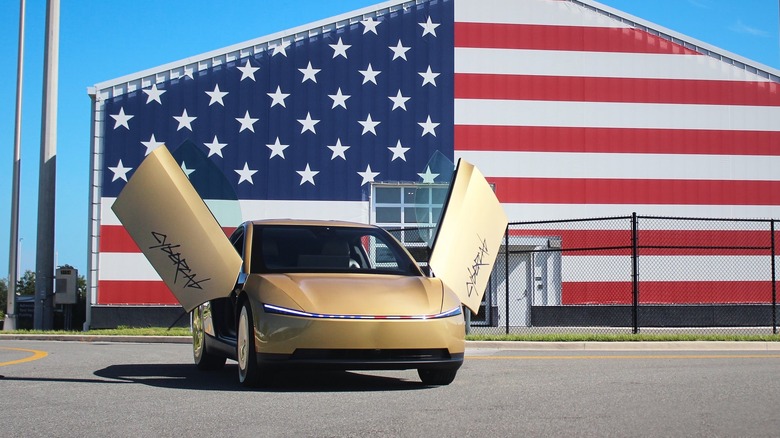
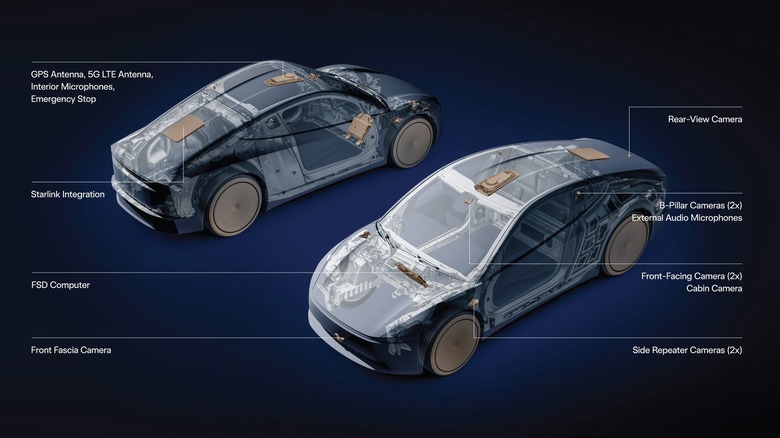
A few weeks later, the official Tesla Robotaxi account tweeted an image of the notorious gold and pedal-less Cybercab with the caption: "First Cybercab with Starlink integration." This further confirmed Musk's position that the Cybercab will have Starlink — and likely the V5 terminal. Back in July 2026, the Tesla account also showed a diagram of the Cybercab using Starlink V5, a smaller and more energy-efficient terminal that would make it more convenient for vehicles.
Is Starlink actually better for the Cybercab than 5G?
It should be noted that Starlink is operated by SpaceX, a company that is 46% owned by Musk. While Musk and his followers were excited by the idea of Tesla and SpaceX merging together, it doesn't prove that Starlink is necessarily more capable than 5G. In fact, one of Musk's examples for needing Starlink in vehicles was watching 4K videos, which 5G is currently able to do.
Starlink uses a low-orbit satellite system while 5G uses terrestrial cellular towers. The latter currently offers faster speeds and more bandwidth, with average internet speeds reaching 100 to 200 Mbps, though some plans advertise up to 1,000 Mbps. Starlink offers up to 400 Mbps. 5G also has lower latency than Starlink, meaning less lag.
Although 5G can offer faster internet speeds, the benefit of Starlink is that it provides coverage in more remote areas that don't have the cellular service that 5G needs. However, the Cybercab will likely be driving in heavily populated cities that have plenty of towers, making Starlink's advantage less relevant in this scenario. 5G is considered stronger than Starlink in cities like San Francisco, which has 4,460 cellular towers in the area.