

Cassettes Vs CDs: Which Audio Format Actually Sounds Better?
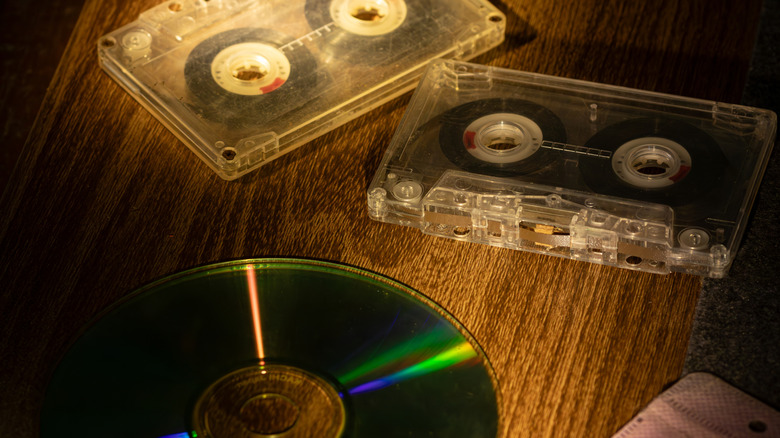
A couple of decades ago, cassettes were everywhere. Most cars came with cassette players, though this is a car feature you don't see anymore because cassettes were soon replaced by CDs. As a more convenient option, CDs felt futuristic and hassle-free at the time. Today, both CDs and cassettes have their separate fan base. When it comes to audio quality, however, CDs have an edge.
There are several reasons for this, but the most important aspect relates to the underlying technology the two rely on. Cassettes record audio on a magnetic tape using magnetic patterns, and data is stored in an analog format. CDs, on the other hand, use a digital format where the data is stored in the binary form. This eliminates hisses and audio distortion, improving the overall sound quality. Additionally, when mastered properly, CDs more accurately reproduce sounds from the master copy compared to cassettes. That, among other things, led to their mass adoption.
That doesn't mean that cassettes have entirely lost their appeal, however. As surprising as it may sound, cassettes have made a comeback in the past few years largely due to mass nostalgia. For the average listener, the difference in audio quality between cassettes and CDs isn't always obvious. For an audiophile, though, it may be more noticeable.
CDs deliver better audio quality
To understand why CDs generally offer superior sound quality compared to cassettes, we will need to discuss two important aspects: dynamic range and signal-to-noise ratio. Dynamic range, measured in decibels (dB), is the difference between the lowest and the highest sound. The wider the dynamic range, the better the sound quality. If we compare the two, CDs generally have a dynamic range of 96 dB, while for cassettes, it's limited to 50-75 dB.
Similarly, the signal-to-noise ratio basically compares the desired sounds in a recording against the undesired sounds or noise. Again, the higher the ratio, the better the audio quality. CDs have a better signal-to-noise ratio than cassettes as well. As a result, audio from CDs tends to feels more clear.
Beyond audio quality, cassettes can sometimes be a pain to handle as well. Over time, the magnetic tape stretches, impacting the audio quality. While CDs can become scratched, they don't experience the same degree of wear and tear from excessive use. That's why you can easily find decades-old CDs that are still in playable condition, while finding a perfectly-fine cassette from that era will prove a little challenging.
The difference isn't always noticeable
From a purely technical standpoint, CDs do have an edge over cassettes. Yet whether that is even noticeable depends on a lot of factors. This includes an individual's ability to recognize the difference, in addition to the quality of the cassette. Cassettes have undergone changes, and while the earlier ones were no match for CDs, many released later featured improvements like noise reduction circuits, which made the audio clearer.
People still love cassettes as well. Their sales have increased in the past few years, and many people enjoy listening to music from a cassette because it brings back memories of a different era. For a few, the imperfections, including any hissing or distortions, forms a part of the experience. Others may not even notice the difference because with high-quality cassettes and a good cassette player, it's not that obvious. CDs are probably the preferred choice if you prioritize audio clarity, accuracy, and convenience. If you enjoy the uniqueness of analog, cassettes may be more your cup of tea.