

What Are Crush Washers And Can You Reuse Them For An Oil Change?
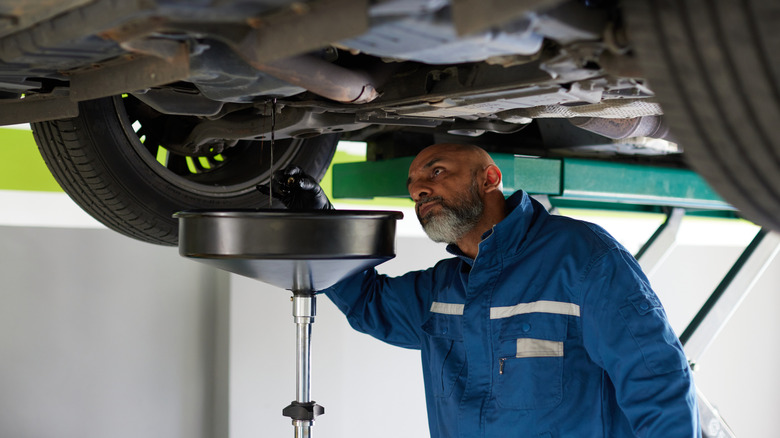
If you don't mind getting your hands dirty, and are comfortable working on your own car, one of the simplest maintenance tasks to handle on your own is the oil change. It doesn't require any wildly expensive tools or deep automotive knowledge, just a little bit of vehicle know-how to avoid making any of the many common oil change mistakes.
For instance, a key part of an oil change is the crush washer, which is a small washer that sits between the oil plug and oil pan. It's intended to create a tight seal between the two. This way once you refill your vehicle's oil supply, oil won't drip out from that space.
A good rule of thumb is that once a crush washer has been used for some amount of time, it should not be reused. This is due to the copper or aluminum material these washers are typically made from, which is soft enough to be crushed — hence the name — between the plug and pan. This is where the tight seal comes from. After being crushed and driven on for some time, the material becomes brittle and deformed, requiring replacement. Otherwise, the seal will be compromised as the washer breaks down and cracks, leading to inevitable oil leakage.
Fortunately, crush washers are relatively inexpensive and come in multipacks, so it's easy to stock up for future oil changes without breaking the bank. Still, some attest that crush washers can be reused, albeit with proper treatment to make them road-ready again.
Workarounds to reuse crush washers in a pinch
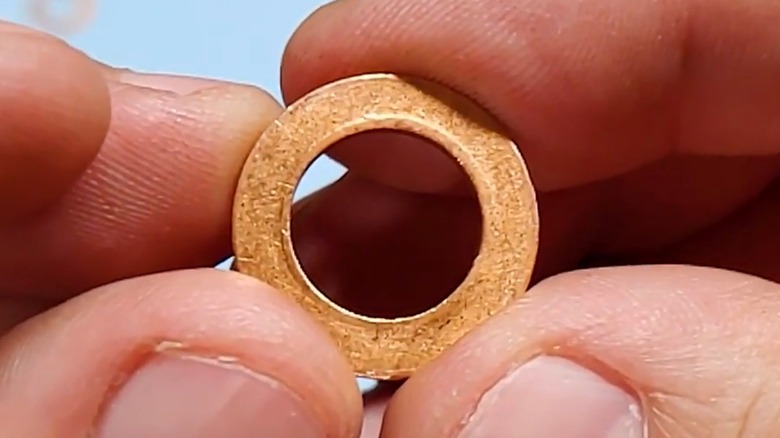
Generally, reusing crush washers isn't a good idea. With that said, in a pinch, they can be reconditioned so that they're once again effective at sealing the oil pan up. One option is to give the washer a good sanding, assuming it's still in one piece. All it requires is taking fine sandpaper and smoothing the washer out. If it's returned to its original color, smoothness, and shininess on both sides, and not distorted in any way, it should once again crush as initially intended and see a slightly prolonged lifespan.
Meanwhile, there's the much more involved and potentially dangerous heat-up method. In this case, you have to take a heat source like a propane torch — one of many handy garage tools needed for simplifying car repairs — and heat up the washer until it takes on a glowing yellow-orange color. At this point, dunk it in some cold water to cool it down. This process is known as annealing, which greatly reduces brittleness and brings the metal of the washer back to its original softened form. It goes without saying that proper eye and hand protection are essential for this route. It must be reiterated though that repair is only a temporary fix, and full-on washer replacement is always the best choice if possible.
It may not look like much at first glance, but the importance of the crush washer can't be overstated. Without it, or at least without one in good condition, you're likely to lose oil and potentially face much larger consequences for subpar internal vehicle lubrication.