

What Is Thrust Vectoring And Which Fighter Jets Use It?
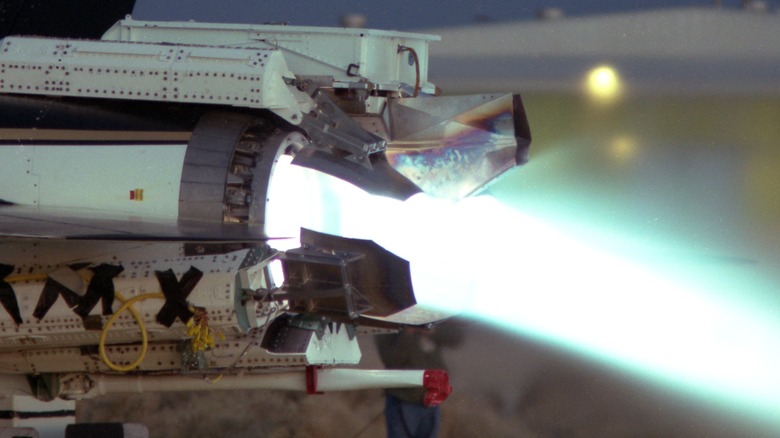
Fighter jets have been around since the Messerschmitt Me 262 took to the skies in 1944. Since then, there have been five distinct generations of fighter jets, with each new generation introducing innovative technology that expands aircraft capabilities. Modern fighter jets seemingly defy gravity, as they use technology that wasn't even considered during World War II. One of the ways that fighter jets expand their maneuverability to the extreme is via thrust vectoring, which first appeared during the third generation with the Hawker Siddeley Harrier.
That aircraft used thrust vectoring to enable vertical takeoff and landing (VTOL). Thrust vectoring is the ability to alter the direction of an engine's thrust, which allows the pilot to control both the jet's altitude and/or its angular velocity. The technology dates back to the 1930s, when rocket thrust was altered via various methods, but it didn't find its way into common use in fighter jets for some time. Since its introduction, thrust vectoring has advanced significantly into the 4th and 5th generations, making it more common as new fighter jets are introduced.
Today, there are a handful of operational fighter jets that feature thrust vectoring of various types. The Sukhoi Su-57, F-22 Raptor, Shenyang J-50, and the F-35B Lightning II are all examples of fighter jets from various nations that utilize thrust vectoring. There are others, including the V-22 Osprey tiltrotor aircraft, which alters its rotor thrust between vertical for hovering and forward for flight, though that's not a fighter jet. Regardless, there are many that use the technology for greater maneuverability, so future 6th-generation fighters will likely feature thrust vectoring as well.
How thrust vectoring is used by 5th-generation fighter jets
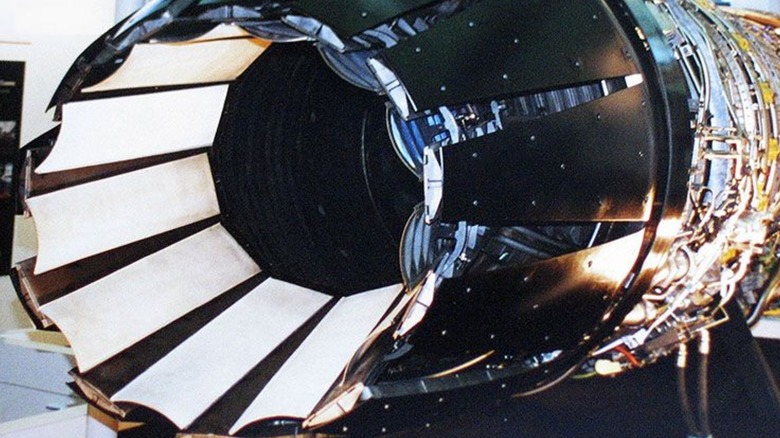
There are numerous types of thrust vectoring used by various 5th-generation fighter jets. The F-35B Lightning II is the only variant that utilizes thrust vectoring. The F-35A and F-35C do not, and it's entirely due to the fact that the F-35B belongs to the United States Marine Corps, which employs the Joint Strike Fighter where runways aren't always present. The aircraft's fuselage is heavily altered from the other variants to incorporate thrust vectoring and achieve short take-off and vertical landing (STOVL).
The F-22 Raptor, which is the first operational 5th-generation fighter jet, uses thrust vectoring for two-dimensional pitch. This alters the aircraft's up and down movement, where yaw covers the side-to-side movement. While 2D thrust vectoring is typically associated with pitch, 3D employs pitch, yaw, and roll, which is the diagonal movement of an aircraft. The Sukhoi Su-57 is highly maneuverable as a result, as it enables the fighter jet to pull off the cobra maneuver, seemingly defying physics at airshows.
Thrust vectoring, whether 2D or 3D, significantly increases an aircraft's agility, which is one of the reasons it's common in modern fighter jets. To avoid missiles and fly safely through the skies, any edge helps — and the ability to rapidly adjust an aircraft's movement certainly gives a fighter jet an edge. While its design remains unconfirmed, it's likely that the future 6th-generation F-47 will feature 3D thrust vectoring. It is probable that the technology will continue to expand as time passes.