

Why Do Most Sports Cars Only Have 2 Doors?
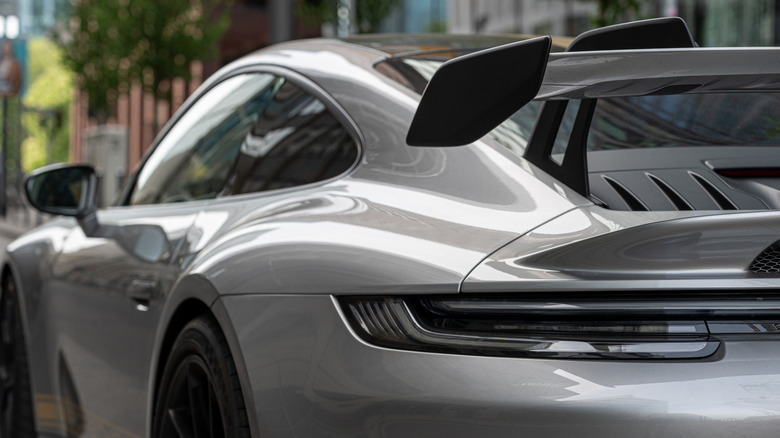
At a glance, the question of why sports cars are generally two-door has a somewhat circular logic. Sports cars have two doors because two-door cars are often sportier, problem solved. Then again, that's not strictly true; there are a lot of sports sedans, for one, ranging from perennials like BMW M5s to more recent additions like the Cadillac Blackwing or Porsche Panamera. In short, it's deceptively complicated from a cultural standpoint, but not so much from a scientific one.
Yes, it's true that we associate sports cars with having two doors, and often only two seats. But why is that, exactly? As in, why is that the norm? It's not like there's any guidebook dictating that sports cars must be designed this way, but a little intuition goes a long way here — what makes a car "sporty?" Acceleration, balance, handling, sharp looks, and so on; not so much practicality, cargo space, or legroom.
So then, why bother extending the cabin, potentially ruining the lines of the car in the process, for rear doors and additional passengers? That's not the car's purpose. Instead, why not design a car with two doors, a more compact and svelte design, and save a bunch of weight while doing it? Put simply, it's a matter of priorities at the engineering level. And, of course, you don't always need four doors to have something that's at least semi-practical; 2+2 and four-seater sports cars do exist, after all. At which point it more or less becomes a matter of expectations; people who buy sports cars, funnily enough, like a sportier-looking car — and two-door cars look sportier. Is there more to it, though? Let's discuss.
The physics behind two-door versus four-door vehicles
Two-door vehicles are shorter than four-door models; therefore, they weigh less and have a shorter wheelbase, so they tend to handle more sharply. Simple.
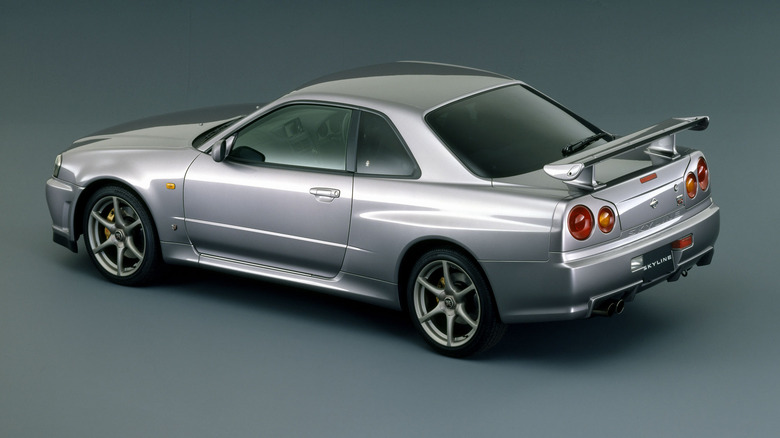
Actually no. Well, okay, that's true, but there's more to it, and it has to do with how these cars are constructed. This all relates to chassis stiffness and lightness; let's look at an example of a sports car with both two- and four-door configurations. Plenty of these exist, such as the Honda Integra, Nissan Skyline, or Audi RS5.
In all these examples, there's no mechanism to lower the rear window, if indeed a rear window exists at all. There are no hinges for the nonexistent door, nor is there additional strengthening of the B-pillar to compensate for the loss of rigidity by cutting away the bodywork to make the door. In fact, even the front doors can be made differently, as seen across the Nissan Skyline family. A four-door Skyline has framed doors, meaning there's a top bit above the window that's part of the door. Meanwhile, the coupes are frameless, so there's nothing above the window line integral to the door.
While it's not specifically documented, common sense nevertheless dictates that the fewer elements, the simpler and lighter something can be. Having no rear doors allows the manufacturer to shorten the car lengthwise while retaining or improving chassis stiffness. Moreover, the lack of structural reinforcements necessitated by the vehicle's length only accentuates the weight savings. And a lighter car accelerates faster, since force equals mass times acceleration.
It's a design thing, too
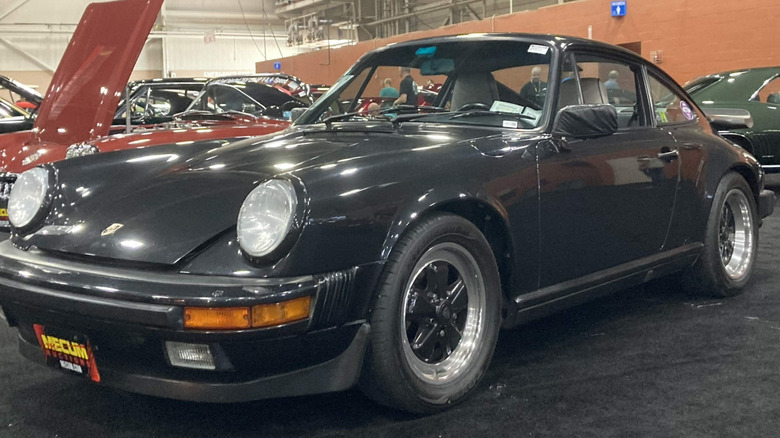
The other benefit of a two-door design, apart from the physics behind it, is a more striking appearance. If you're a car designer aiming for sharp lines that make the car look fast even when standing still, you're likely to avoid an excessively long passenger compartment. Moreover, there's a defined archetype one can expect with sports cars. You have two basic design templates: The three-box and fastback.
First up is the three-box. The most quintessential example of this is the classic notchback Ford Mustang, the first-gen model. It's marked by three distinct sections: The hood and engine bay, the passenger compartment, and the trunk, with each barely overlapping, if at all. Hence why it's called the three-box, because each segment can fit into a box. This contrasts with one- and two-box designs, like minivans and SUVs, respectively. Sedans also fit into the three-box category; however, they're not really as "sporty" as the follow-up, the fastback.
As the name implies, a fastback design is intended from the outset to be fast. This is the quintessential sports car design, and that's not by accident; unlike the three-box, these designs harken back to the old streamliner days. Basically, a fastback can be viewed as a streamlined coupe, with an extended rear hatch designed to minimize aerodynamic drag, thereby making it faster. A faster back — fastback. And thanks to cars like the Porsche 911, Mustang Fastback, Corvette Stingray, and many more, we now associate this design — used almost exclusively in two-door configuration — with sports cars in general.