

Volkswagen Pioneered A Feature In The '60s Every Car Relies On Today
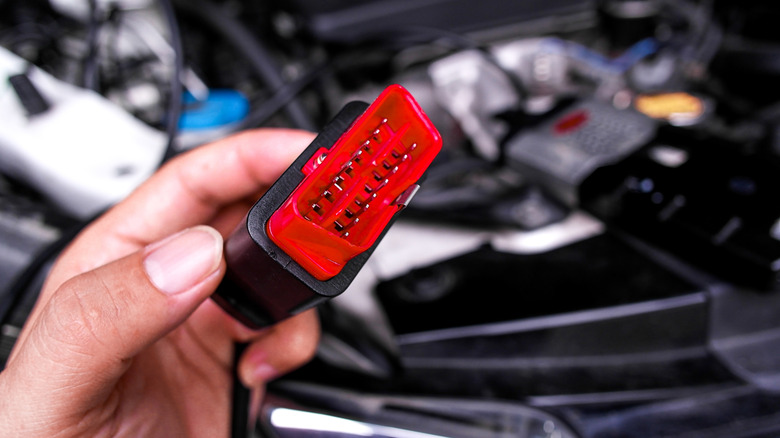
With hundreds of gigabytes of memory storing millions of lines of programming code, today's high-tech automobiles have more memory than NASA's Apollo spaceships. Part of the complex information network in your vehicle involves its OBD — which stands for on-board diagnostics. This built-in, self-diagnosing computer system routinely monitors the engine components and emission systems of your car. It fires off a warning when something goes wrong, usually in the form of a check engine light.
In 1994, federal emission standards required every new light-duty vehicle built that year to have at least a basic OBD system. It also stated that the OBD must retain information in the vehicle's computer so a mechanic can properly diagnose and repair the problem. While the OBD might seem like a fairly new invention, its origins date back to a 1968 Volkswagen. No, it's not the Beetle, although that was the same year that Herbie "The Love Bug" roared onto the world stage.
In '68, Volkswagen rolled out its "diagnostic and service center system" in Germany. By the following year, it was also being offered in export markets. This early version of the OBD was crude by today's standards. The whole diagnostic test took about an hour and ran between 50 and 70 individual tests (depending on the vehicle). Results were determined by observations recorded by the technician as well as gauge readings, some of which yielded only positive or negative results. Still, it was a first step into the high-tech world we live in now.
Volkswagen's early diagnostic system evolved over time
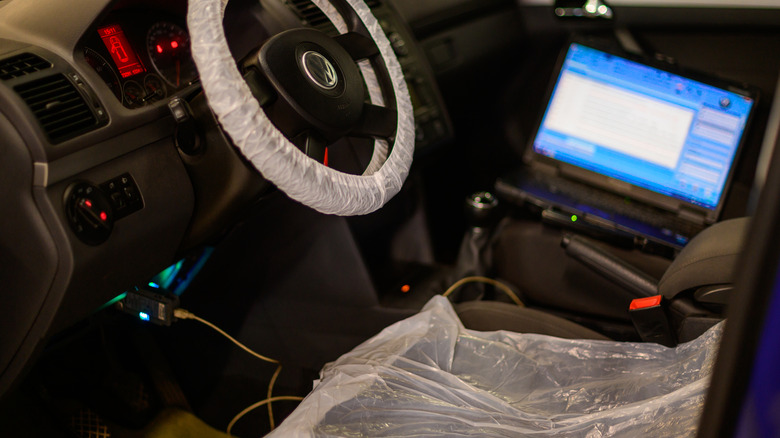
At the time, the diagnostic equipment used by Volkswagen was designed and built by Bosch, the makers of the D-Jetronic fuel injection system they used in their Type 3. Volkswagen's 1969 annual report claimed that most of its 300+ British dealers could perform a "health check" on any VW vehicle. In 1970, all of VW's cars were sold with five diagnostic check vouchers, each good for the car's first 24,000 miles. Since the vouchers were attached to the car rather than to the owner, they remained valid for a full five years.
By June 1971, every VW that rolled off the production line came with what we now know as the ubiquitous OBD port. It gave a trained technician the ability to simply plug in and perform what amounted to a thorough safety and functionality checkup. The comprehensive service report that accompanied the inspection even included a cost estimate for any necessary repairs.
The aforementioned VW Type 3 was the first vehicle to have a mass-produced automotive ECU — aka the Engine Control Module (ECM) — or more colloquially, the car's brain box. While the Type 3 had a single ECU, modern cars can have as many as 150. Volkswagen was one of the first manufacturers to understand that computers were the wave of the future in automobile manufacturing. From research and development to body shell design and beyond, VW foresaw a day when computers would be used in all facets of engineering and service. Today, your OBD port can do a lot more than you think.